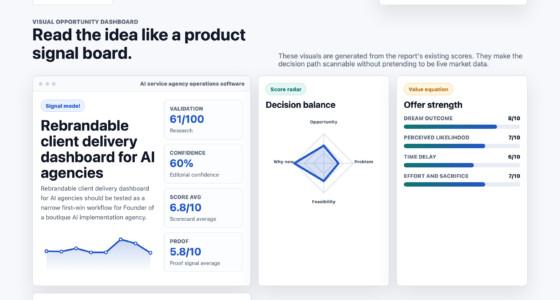

📊 Full opportunity report: Every Benchmark Launched 2023-2024 Has Fallen — The METR / SWE-Bench / CORE-Bench / MLE-Bench / PostTrainBench Sequence on ThorstenMeyerAI.com — validation score, market gap, and execution plan.
TL;DR
Six key AI benchmarks introduced in 2023-2024 have all either saturated or are close to saturation, signaling a swift acceleration in AI research capabilities. This pattern suggests AI progress is faster than many anticipated.
All six major AI research benchmarks launched between 2023 and 2024 have either saturated or are rapidly approaching saturation within months, according to recent analysis by Thorsten Meyer. This pattern indicates that AI capability growth is occurring at a faster pace than many experts previously projected, with implications for AI development, investment, and policy.
Thorsten Meyer, citing data from Jack Clark’s recent analysis, reports that every benchmark designed to measure AI research capabilities has reached or is close to saturation. The benchmarks include SWE-Bench, METR time horizons, CORE-Bench, MLE-Bench, PostTrainBench, and CPU speedup, each tracking different facets of AI progress.
For example, SWE-Bench, which evaluates real-world software engineering tasks, improved from 2% in late 2023 to 93.9% in May 2026, achieving saturation after 30 months and a 47-fold improvement. Similarly, METR time horizons, measuring task duration, shrank from 30 seconds in 2022 to 12 hours in 2026, representing a 1,440-fold increase in speed over four years.
Other benchmarks, like CORE-Bench, which assesses research reproduction, have been declared solved by their authors after reaching 95.5% in December 2025, just 15 months after starting from 21.5%. MLE-Bench, tracking autonomous machine learning engineering, is also nearing saturation, with progress from 16.9% to 64.4% over 16 months.
These patterns suggest a structural trend: the benchmarks, which were explicitly designed to be challenging, are all saturating on similar timelines, indicating a rapid, converging advancement across different AI research domains.
Implications of Rapid Benchmark Saturation for AI Progress
The saturation of all six benchmarks within a short timeframe signifies that AI research capabilities are advancing faster than many industry and academic forecasts predicted. This rapid progression could accelerate deployment timelines, influence AI policy and regulation, and reshape workforce planning. It also raises questions about the limits of current evaluation methods and whether these benchmarks fully capture AI’s evolving capabilities.
Furthermore, the pattern suggests that AI systems are approaching or surpassing human-level performance in key research tasks, which could lead to an era of more autonomous AI development and deployment, with broad societal and economic impacts.

AI Systems Performance Engineering: Optimizing Model Training and Inference Workloads with GPUs, CUDA, and PyTorch
As an affiliate, we earn on qualifying purchases.
As an affiliate, we earn on qualifying purchases.
Background on Benchmark Development and AI Capability Trajectories
Since 2022, researchers and industry leaders have introduced a series of challenging benchmarks to measure AI research and engineering progress. These benchmarks were designed to be difficult, with the intention of tracking meaningful improvements in AI’s ability to perform complex tasks autonomously. As of 2023-2024, six such benchmarks have been launched, each targeting different aspects of AI research, including software engineering, model training speed, research reproduction, and fine-tuning.
Until recently, improvements appeared gradual, but recent data shows a sharp acceleration. Jack Clark’s analysis highlights that all six benchmarks are now saturated or nearing it, with some declared solved by their creators. This trend suggests that AI systems are rapidly approaching the limits of current evaluation metrics, raising questions about the future trajectory of AI capabilities and the adequacy of existing benchmarks.
“The pattern across these six benchmarks is a clear indicator of a structural acceleration in AI research capabilities, occurring over a few months rather than years.”
— Thorsten Meyer

GIGABYTE AORUS RTX 5090 AI Box Graphics Card – External GPU (32GB GDDR7, 512-bit, PCIe 5.0, HDMI/DP 2.1b, 240mm Radiator, Silent Fans, Direct-Coverage Copper Plate, Thunderbolt 5™)
Game Changing Performance – Powered by the GeForce RTX 5090 with NVIDIA Blackwell architecture. Enjoy high frame rates…
As an affiliate, we earn on qualifying purchases.
As an affiliate, we earn on qualifying purchases.
Uncertainties About Benchmark Completeness and Future Limits
It remains unclear whether the current benchmarks fully capture the true extent of AI capabilities or if they are approaching their intrinsic limits. Some experts question whether saturation indicates genuine performance ceilings or if new evaluation methods are needed to measure ongoing progress. Additionally, the long-term implications of these rapid saturations for AI safety, regulation, and societal impact are still uncertain.

BKFK New Type-C 4K@60Hz-1080P120HZ Virtual Display Adapter USB c,DDC EDID Dummy Plug Headless Ghost Display Emulator 3840 x2160@60Hz 1920x1080p@120Hz
1. Instantly Unlock Full GPU Power–New second-generation model 3840×2160@60hz 1080P120HZ 4k Activate your graphics card and enable video…
As an affiliate, we earn on qualifying purchases.
As an affiliate, we earn on qualifying purchases.
Next Steps in Monitoring AI Progress and Benchmark Evolution
Researchers and industry leaders will likely focus on developing next-generation benchmarks to challenge AI systems beyond current saturation points. Monitoring how AI capabilities evolve relative to these benchmarks will be critical, along with assessing whether new metrics are needed. Policy discussions and safety assessments may also accelerate in response to the rapid pace of AI advancement.
Further analysis will be needed to determine if the saturation signals genuine performance ceilings or if AI systems will continue to improve in ways not yet captured by existing tests.

Corsair AI Workstation 300 Desktop PC – AMD Ryzen AI Max 385 CPU – AMD Radeon 8050S iGPU (Up to 48GBs vRAM) – 64GB LPDDR5X 8000MHz Memory – 1TB M.2 SSD – Black
AI-Optimized Compact Workstation: Experience AI performance out of the box with the compact 4.4L form factor, built for…
As an affiliate, we earn on qualifying purchases.
As an affiliate, we earn on qualifying purchases.
Key Questions
What do benchmark saturation levels indicate about AI progress?
Saturation suggests that AI systems have reached or are close to reaching the maximum performance levels defined by those benchmarks, indicating rapid progress and possibly approaching the limits of current evaluation methods.
Are these benchmarks reliable indicators of overall AI capability?
While they are designed to be challenging and informative, benchmarks may not fully capture all aspects of AI intelligence or real-world performance, especially as AI systems evolve quickly.
What are the implications for AI regulation and safety?
The rapid saturation and advancement in capabilities could prompt faster policy responses and safety considerations, as AI systems become more autonomous and capable in research and deployment tasks.
Will new benchmarks be developed to measure ongoing AI progress?
Yes, researchers are likely to create more advanced benchmarks to continue challenging AI systems beyond current saturation points, ensuring ongoing measurement of progress.
How soon might AI systems surpass human-level performance in research tasks?
Given the rapid improvements, some benchmarks suggest AI could reach or surpass human performance in key research tasks within the next few years, but exact timelines remain uncertain.
Source: ThorstenMeyerAI.com