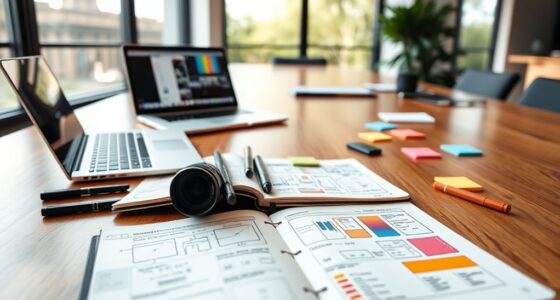

By blending design thinking with agile, you create a workflow that balances discovery and delivery seamlessly. You focus on understanding user needs early, rapidly prototyping ideas, and gathering feedback throughout the process. This approach helps you innovate efficiently while ensuring solutions align with real user demands. Continuous validation allows you to adapt quickly and prioritize impactful features. Keep exploring, and you’ll discover how this combined workflow can transform your project outcomes.
Key Takeaways
- Combines user-centric discovery through design thinking with rapid, iterative delivery in Agile for innovative solutions.
- Uses prototyping early in the process to validate ideas and gather user feedback continuously.
- Promotes cross-functional collaboration, enabling quick adaptation based on real-world insights.
- Incorporates ongoing validation to prioritize impactful features and eliminate unnecessary ones.
- Balances exploration with execution, increasing responsiveness and aligning solutions with user needs.

Integrating design thinking with agile methodologies can considerably enhance your product development process by fostering user-centric innovation and rapid iteration. When you combine these approaches, you create a powerful workflow that emphasizes understanding user needs while delivering functional solutions quickly. Central to this integration is a focus on user experience, ensuring that every step is aligned with what users truly want and need. By adopting a user-centered mindset, you’re better equipped to identify pain points early, reduce unnecessary features, and craft solutions that resonate deeply with your target audience.
Prototyping methods play a pivotal role in this combined approach. With design thinking, you start by empathizing with users and defining core problems. From there, rapid prototyping allows you to bring ideas to life swiftly, testing concepts without investing excessive time or resources. These prototypes serve as tangible representations of your ideas, giving you a clear way to gather feedback. In an agile setting, you iteratively refine these prototypes based on real user input, which helps you avoid costly mistakes and ensures that the final product genuinely meets user expectations. The cycle of building, testing, and learning becomes seamless when you use prototyping methods aligned with agile sprints, enabling you to pivot or double down as needed.
Your workflow benefits from this synergy because it encourages continuous discovery alongside delivery. Instead of waiting until the end of a project to evaluate user experience, you incorporate user feedback at every stage. This ongoing validation helps you prioritize the most impactful features and discard those that don’t add value. Agile’s incremental approach complements design thinking’s emphasis on understanding users, making it easier to adapt your roadmap based on real-world insights. As a result, you’re not just building a product; you’re crafting an experience that’s both innovative and aligned with user needs.
Furthermore, integrating these methodologies fosters a collaborative environment. Cross-functional teams work together more effectively when everyone shares a common focus on user experience and rapid prototyping. Developers, designers, and product managers can quickly iterate on ideas, reducing bottlenecks and increasing transparency. This blend accelerates decision-making, allowing you to respond swiftly to market changes or emerging user insights. Additionally, considering state-specific tax laws and how they impact financial planning can help teams better tailor solutions to diverse user needs. Ultimately, this combined workflow creates a dynamic process that balances exploration with execution, making your product development more responsive, user-focused, and efficient.
Frequently Asked Questions
How Do Teams Measure Success When Combining Design Thinking and Agile?
You measure success by gathering customer feedback throughout the process to guarantee the product truly meets user needs. Innovation metrics, like the number of new ideas implemented or improvements in user engagement, help track progress. Tracking how quickly you adapt based on feedback and how well your solutions solve problems also indicates success. Combining these measures keeps your team focused on delivering value while fostering continuous innovation.
What Are Common Challenges Faced During Integration of These Methodologies?
You’ll often face cultural barriers and stakeholder misalignment when integrating design thinking with agile. These challenges stem from differing priorities, communication styles, and expectations. To overcome them, you need to foster open dialogue, align goals early, and promote a shared understanding of both methodologies. Addressing these issues guarantees smoother collaboration, faster decision-making, and a more cohesive workflow that effectively combines discovery and delivery.
How Can Remote Teams Effectively Implement Blended Workflows?
You can master remote collaboration by leveraging virtual workshops and clear communication channels. Use collaborative tools like Miro or MURAL to foster real-time ideation, ensuring everyone’s voice is heard. Schedule regular check-ins and foster a culture of transparency to keep discovery and delivery aligned. Emphasize flexibility to adapt workflows as needed, making your team’s blended approach as seamless as a perfectly synchronized dance, even across time zones.
What Tools Best Support a Hybrid Design Thinking and Agile Approach?
You should use collaborative tools like Miro or MURAL to facilitate real-time brainstorming and team collaboration. Visual management tools such as Jira or Trello help you track progress, prioritize tasks, and maintain transparency. These tools support a hybrid design thinking and agile approach by enabling seamless communication, fostering innovation, and ensuring everyone stays aligned throughout discovery and delivery phases. They make it easier to adapt and iterate quickly.
How Do Roles and Responsibilities Change in Integrated Workflows?
In integrated workflows, your role evolves as you take on broader responsibilities, blending design thinking and agile practices. Responsibility shifts mean you actively participate in both discovery and delivery phases, fostering collaboration across teams. You become more adaptable, shifting from specialized tasks to a more holistic approach, ensuring user insights guide development. Your role emphasizes facilitation, communication, and continuous learning, making the process more dynamic and user-centered.
Conclusion
By blending design thinking with agile, you create a powerful workflow that balances discovery and delivery seamlessly. This integration fosters innovation and responsiveness, helping you meet user needs more effectively. Did you know that companies adopting this combined approach see a 30% faster time-to-market? Embrace this synergy, and you’ll not only stay ahead of the competition but also deliver meaningful, user-centered solutions that truly make a difference.