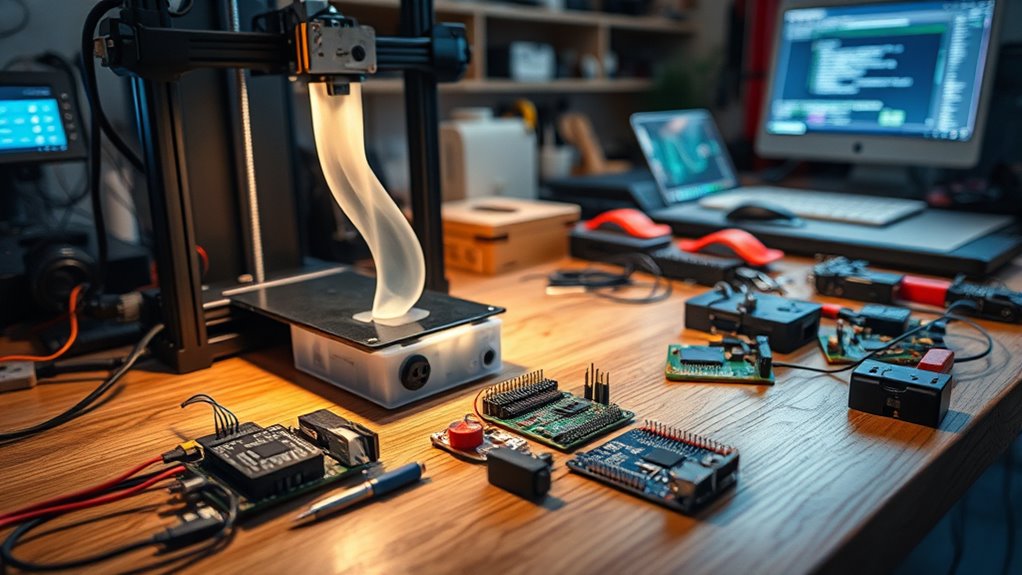

You can speed up your development process by combining 3D printing and electronics for rapid hardware prototyping. It lets you create custom enclosures with integrated sensors and wiring, making testing quick and easy. Using this approach, you can try out different sensor types, placements, and power solutions without long delays. This strategy helps you identify issues early and refine your design efficiently. Keep exploring to discover how these tools can elevate your prototyping game.
Get ready for Prime Big Deal Days — try Prime free
Exclusive member deals on October 6–7, plus fast free delivery. Cancel anytime.
As an affiliate, we earn on qualifying purchases.
Key Takeaways
- Integrate sensors into 3D-printed enclosures for quick testing of sensor responsiveness and accuracy.
- Use 3D printing to create custom hardware prototypes with embedded electronics for rapid iteration.
- Combine 3D-printed parts with electronic circuits to streamline design validation and reduce development time.
- Implement power management strategies within prototypes to evaluate energy efficiency and optimize power solutions early.
- Rapidly modify prototypes by redesigning 3D models and adjusting electronic components to refine ideas efficiently.

Rapid hardware prototyping has become essential for accelerating product development and reducing time-to-market. When you’re working on bringing a new device or system to life, quickly testing ideas is crucial. With advancements in 3D printing and electronics, you can now create functional prototypes that incorporate sensor integration and effective power management, enabling you to evaluate and refine your concepts faster than ever before. This approach allows you to identify potential issues early, saving both time and costs as you iterate your designs.
Rapid prototyping accelerates product development by enabling quick testing of ideas with integrated sensors and optimized power management.
Sensor integration is a key aspect of modern prototypes, especially when you’re developing IoT devices or smart systems. Using rapid prototyping techniques, you can embed sensors directly into your 3D-printed enclosures or circuit boards, giving you immediate feedback on how your sensors perform in real-world conditions. For example, integrating temperature, humidity, or motion sensors allows you to test their responsiveness and accuracy within your prototype, ensuring that your final product will meet expectations. This flexibility means you can easily swap out sensors or modify their placement without waiting for lengthy manufacturing processes, streamlining your testing cycle. Additionally, leveraging high contrast ratios in display elements can enhance the clarity of visual indicators or interfaces in your prototypes, helping you better assess user experience and functionality.
Power management is equally important in creating effective prototypes. When you’re designing portable or battery-powered devices, managing power consumption becomes a priority. Rapid prototyping lets you incorporate power-efficient components and test different power management strategies on the fly. You can include rechargeable batteries, low-power microcontrollers, and energy-harvesting modules into your prototypes, then evaluate their performance under various conditions. This hands-on approach helps you identify the most critical power solution early, minimizing the risk of costly redesigns later in the development process. Additionally, integrating power monitoring circuitry into your prototype allows you to track energy usage in real-time, providing valuable data to improve overall efficiency.
Combining 3D printing with electronics for rapid prototyping means you’re not limited by traditional manufacturing timelines. You can quickly produce custom enclosures that fit your circuit boards perfectly, with integrated channels for sensors and wiring. This customization accelerates testing and allows you to validate design choices before committing to mass production. Furthermore, the ability to iterate rapidly makes it easier to experiment with different sensor types, placements, and power solutions, ultimately leading to a more refined and reliable product.
In essence, rapid hardware prototyping empowers you to turn ideas into tangible, testable prototypes swiftly. By focusing on sensor integration and power management from the outset, you guarantee your device is not only functional but also efficient and ready for deployment. This iterative process helps you make smarter decisions early, reducing development time and increasing your chances of success in the competitive tech landscape.
3D printer for rapid prototyping
As an affiliate, we earn on qualifying purchases.
As an affiliate, we earn on qualifying purchases.
Frequently Asked Questions
What Materials Are Best for 3D Printing Functional Prototypes?
You should choose materials like ABS, PETG, or Nylon for functional prototypes because they offer the right balance of strength, flexibility, and ease of print. Material selection is vital for durability testing, ensuring your prototype withstands real-world stresses. These materials are known for their durability and toughness, making them ideal for testing how your design performs under actual conditions. Pick the right material to improve your prototype’s reliability.
How Do I Select the Right Electronics Components for My Project?
Choosing the right electronics components can make or break your project. Start by evaluating component compatibility to guarantee everything works seamlessly together. Don’t overlook power management—select components that match your power supply to avoid failures. Keep your goals in focus, and test different options when needed. By carefully balancing compatibility and power needs, you’ll open the potential for a successful prototype that truly pushes your ideas forward.
What Software Tools Are Recommended for Designing Quick Prototypes?
You should use CAD software like Fusion 360 or Tinkercad for designing quick prototypes. These tools allow virtual prototyping, so you can test your ideas before printing or building. They’re user-friendly and ideal for rapid development, giving you the ability to modify designs quickly. By leveraging CAD software, you streamline your workflow and reduce errors, making your prototyping process more efficient and effective.
How Can I Ensure Electrical Safety During Rapid Prototyping?
To guarantee electrical safety during rapid prototyping, you should prioritize proper grounding practices and insulation techniques. Always connect your circuits to a reliable ground to prevent static buildup and accidental shocks. Use insulated wires and coatings on exposed connections to avoid short circuits and electrical hazards. Regularly inspect your wiring, and keep your workspace dry and organized. These steps help protect you and ensure your prototype operates safely.
What Are Common Challenges Faced in Integrating 3D Printed Parts With Electronics?
Ironically, integrating 3D printed parts with electronics seems simple, but you’ll face alignment issues and durability concerns. Precise fit can be tricky, leading to loose connections or mechanical failures. The materials might not withstand wear and tear, risking damage to your electronics. You need careful design adjustments, choosing suitable filaments, and testing thoroughly to guarantee your prototypes stay reliable and aligned during real-world use.
embedded sensor modules for electronics projects
As an affiliate, we earn on qualifying purchases.
As an affiliate, we earn on qualifying purchases.
Conclusion
As you hold your 3D-printed part and connect the electronics, it’s almost like your ideas have magically come to life. The coincidence of quick fabrication and immediate testing means your innovation isn’t just a dream anymore — it’s tangible. With rapid hardware prototyping, you’re not waiting months; you’re turning concepts into reality in days. That perfect blend of technology and creativity makes every breakthrough feel just within your reach, ready to shape the future you envision.
power management components for microcontrollers
As an affiliate, we earn on qualifying purchases.
As an affiliate, we earn on qualifying purchases.
custom enclosures for electronics
As an affiliate, we earn on qualifying purchases.
As an affiliate, we earn on qualifying purchases.
Fall Picks
fall essentials
As an affiliate, we earn on qualifying purchases.