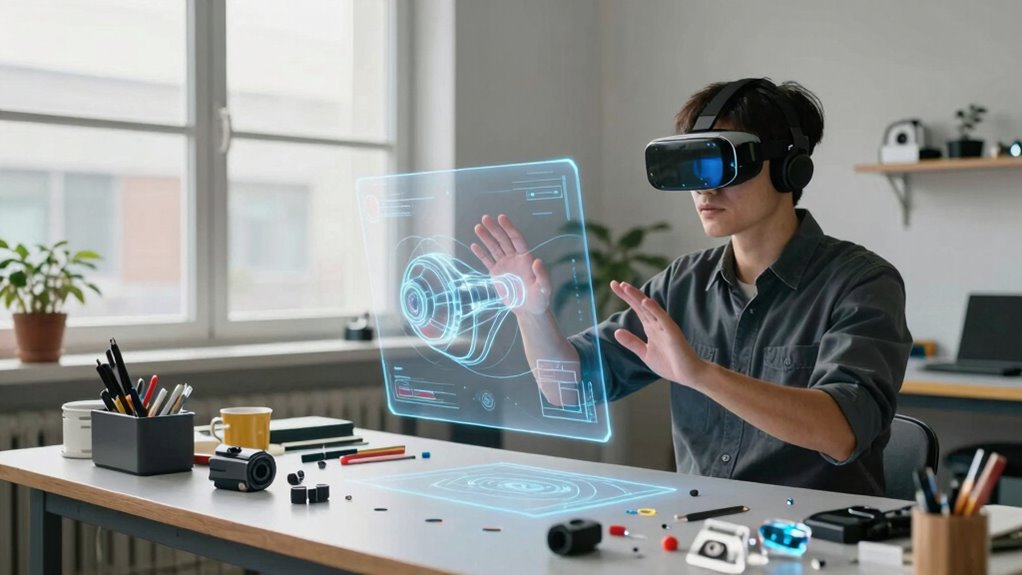

Spatial computing can revolutionize your workshop by seamlessly blending digital and physical environments for better training, collaboration, and maintenance. You’ll interact with 3D models and receive real-time guidance, making complex tasks easier and safer. It enables remote teamwork and faster problem-solving, reducing downtime. By visualizing parts and processes directly in your workspace, you’ll work smarter and improve accuracy. To discover how these changes can impact your workshop, keep exploring the possibilities.
Key Takeaways
- Enable real-time 3D visualization of complex parts, improving understanding and reducing errors during training and repairs.
- Replace traditional manuals with immersive AR guides, enhancing accuracy and speeding up maintenance procedures.
- Foster remote collaboration by allowing multiple users to interact with shared digital models simultaneously.
- Enhance safety by overlaying digital instructions directly onto physical equipment, minimizing risk during complex tasks.
- Accelerate skill development through immersive, hands-on AR experiences that simulate real-world scenarios.
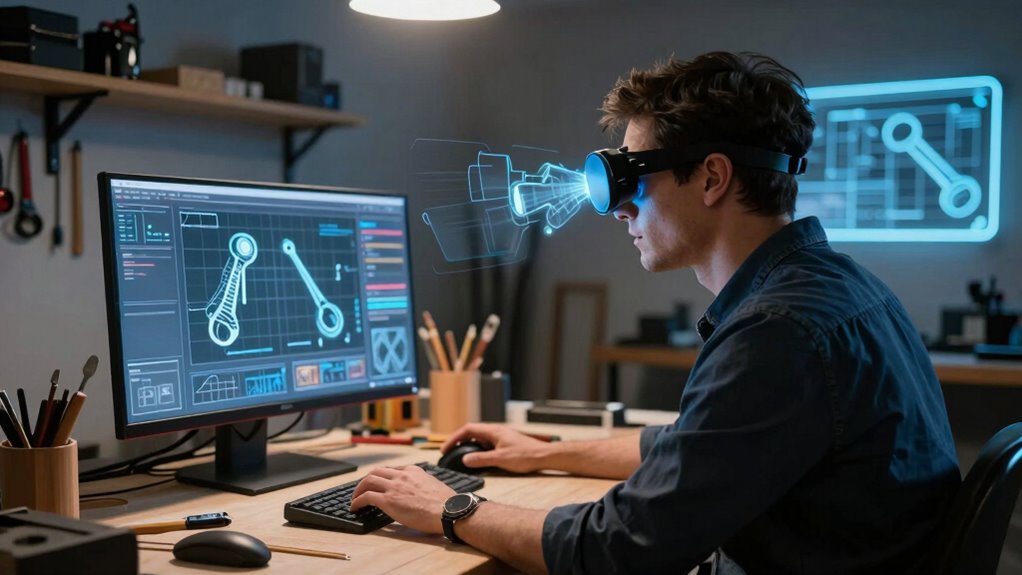
Spatial computing is transforming workshops by seamlessly blending digital and physical environments, allowing you to interact with 3D models and tools in real time. This technology makes it possible to visualize complex parts, systems, or processes directly within your workspace, giving you a clearer understanding without the need for traditional blueprints or static diagrams. With augmented reality (AR), you can overlay digital information onto physical objects, enhancing your ability to diagnose problems, plan repairs, or assemble components more accurately. This integration leads to faster learning curves and reduces costly mistakes, especially when it comes to hands-on training.
Spatial computing blends digital and physical environments, enhancing understanding, diagnostics, and training with real-time 3D visualization.
In a workshop setting, augmented reality becomes a powerful tool for hands-on training. Instead of relying solely on manuals or instructor-led demonstrations, AR allows you to practice skills in an immersive environment. For example, you might see step-by-step instructions projected onto the actual machinery you’re working on, guiding you through each task with visual cues. This approach not only boosts your confidence but also ensures that you follow procedures precisely, minimizing errors. It creates an interactive learning experience where you can experiment and learn from mistakes without risking damage to expensive equipment.
Spatial computing also changes how you approach collaboration. Multiple users can interact with the same digital models simultaneously, regardless of their physical location. This capability is particularly useful for remote teams or multi-site workshops, enabling real-time collaboration and problem-solving. You can manipulate 3D models together, identify issues more quickly, and brainstorm solutions without the delays of physical handoffs or miscommunications. The ability to visualize complex assemblies or workflows in three dimensions helps you grasp concepts faster and makes training sessions more engaging. Additionally, the interactive nature of spatial computing encourages innovative problem-solving and creative thinking among team members. Incorporating real-time collaboration tools further enhances the ability to coordinate efforts efficiently, regardless of geographic distance. As the technology advances, spatial computing is becoming more accessible and affordable for a wider range of workshops and industries.
Furthermore, spatial computing streamlines maintenance and troubleshooting. Instead of consulting paper manuals or static diagrams, you can access dynamic, interactive guides directly overlaid on the equipment. When a technician encounters a problem, they can see exactly where to look and what parts to check, reducing downtime and increasing efficiency. This real-time, augmented view accelerates repairs and helps less experienced workers develop expertise more rapidly through immersive, hands-on practice. Integrating digital overlays enhances precision and reduces the likelihood of errors during complex repairs.
All these advancements point toward a future where workshops become more efficient, safer, and more accessible. Spatial computing, with its augmented reality capabilities and focus on hands-on training, empowers you to learn faster, work smarter, and collaborate more effectively. It’s not just about digital innovation; it’s about transforming how you approach every task, making complex processes straightforward and intuitive. One key element behind these improvements is spatial computing technology, which is revolutionizing the way we work and learn in hands-on environments.

cybersight HUD Display Sports Glasses, for Cycling and Hiking, Smart AI/AR Sports Sunglasses, Real-Time Display, Smart Navigation, Proactive AI Alerts, Monitor Heart Rate, Speed
Real-Time HUD Display for Unmatched Focus: ZENITH smart glasses project your critical metrics—speed, heart rate, power, navigation—directly into…
As an affiliate, we earn on qualifying purchases.
As an affiliate, we earn on qualifying purchases.
Frequently Asked Questions
How Affordable Is Implementing Spatial Computing in Small Workshops?
Implementing spatial computing in small workshops can be quite affordable, depending on your specific needs. You should consider cost considerations like hardware, software, and training, but affordability factors are improving as technology advances. Entry-level devices and cloud-based solutions help reduce costs, making it accessible for small businesses. By carefully evaluating your requirements and budget, you can find a spatial computing setup that offers significant benefits without breaking the bank.
What Are the Main Technical Challenges of Integrating Spatial Computing?
You face the challenge of ensuring virtual interfaces work seamlessly and hardware compatibility remains consistent. You need to troubleshoot technical issues, optimize system performance, and adapt to diverse devices. Balancing innovation with stability, you must tackle software integration, manage hardware limitations, and keep up with rapid technological advances. These hurdles demand patience, precision, and ongoing learning to fully unleash spatial computing’s transformative potential.
How Does Spatial Computing Improve Safety in Workshop Environments?
Spatial computing enhances safety in workshops by enabling real-time hazard detection, helping you identify risks before they cause harm. It allows you to visualize safety protocols directly in your environment, making compliance easier. With augmented reality overlays, you can see potential dangers like equipment malfunctions or unsafe zones instantly. This proactive approach minimizes accidents, guarantees adherence to safety standards, and creates a safer, more efficient workspace for everyone involved.
Can Spatial Computing Be Used for Remote Workshop Collaboration?
Imagine you’re the captain of a ship steering through fog; spatial computing acts as your lighthouse. You can collaborate remotely by sharing virtual prototypes, guiding your team through complex tasks via real-time visualization. This technology bridges distances, allowing everyone to see and interact with 3D models as if they were physically present. It transforms workshop collaboration, making remote teamwork as clear and precise as if you were all in the same room.
What Training Is Required for Staff to Use Spatial Computing Tools Effectively?
You’ll need targeted training programs to use spatial computing tools effectively. Start with basic skill development to familiarize staff with navigation and interaction within 3D environments. Hands-on workshops, tutorials, and ongoing support help build confidence and proficiency. Encourage continuous learning by integrating new features into your training. With proper preparation, your team can seamlessly adopt spatial computing, enhancing collaboration and productivity in your workshops.
3D visualization AR headset
As an affiliate, we earn on qualifying purchases.
As an affiliate, we earn on qualifying purchases.
Conclusion
Imagine a workshop where every tool, instruction, and collaboration is seamlessly woven into your environment, transforming chaos into clarity. Spatial computing isn’t just a buzzword; it’s the key to unleashing efficiency, creativity, and safety in your workspace. As you embrace this technology, remember: the future isn’t something you wait for—it’s something you create. So, why not step into this new world and make your workshop a canvas for innovation? Your next breakthrough awaits.

Space Stations in Action (An Augmented Reality Experience) (Space in Action: Augmented Reality (Alternator Books ® ))
As an affiliate, we earn on qualifying purchases.
As an affiliate, we earn on qualifying purchases.

Yahboom Aurora S 3D Visual Perception System AI-Visual SLAM 3D Mapping Semantic Understanding Dedicated to Robotics Embodied Intelligence Supports ROS1/ROS2/C++ SDK
Aurora S deeply integrates vision, inertial navigation, and proprietary AI-Visual SLAM technology, providing plug-and-play 3D environmental perception, mapping,…
As an affiliate, we earn on qualifying purchases.
As an affiliate, we earn on qualifying purchases.