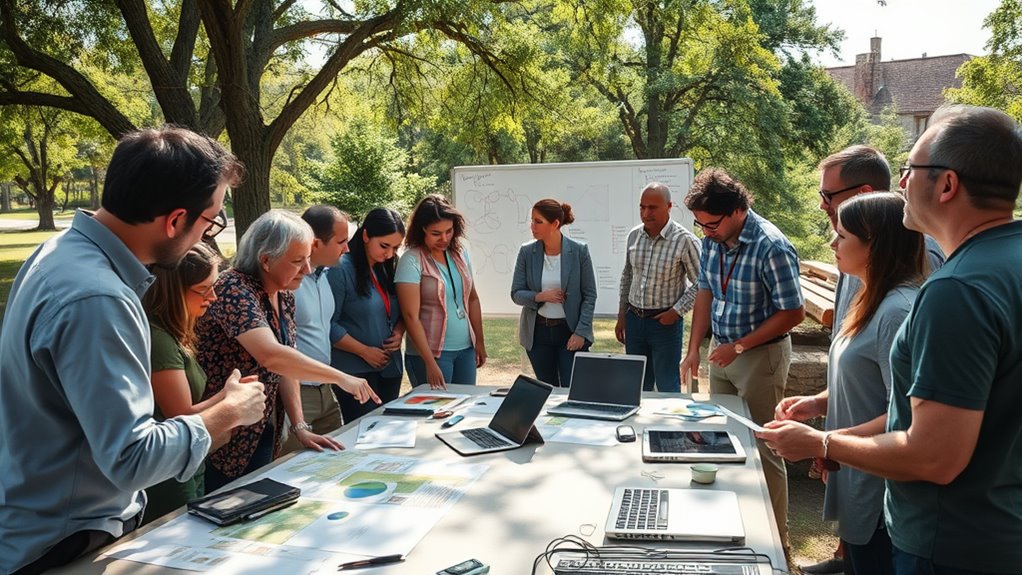
Involving stakeholders as observers in collaborative research allows you to harness diverse expertise and real-world insights, making your work more relevant and credible. You can facilitate two-way dialogue through participatory methods like workshops and mapping, fostering trust and ownership. This approach guarantees transparency, helps identify issues early, and improves data accuracy. By engaging stakeholders, you strengthen the impact and acceptance of your research efforts—so, if you keep exploring, you’ll discover ways to maximize their valuable contributions.
Key Takeaways
- Engaging stakeholders as observers fosters two-way dialogue, ensuring their insights inform research processes and outcomes.
- Transparent communication builds trust, encouraging ongoing stakeholder participation and demonstrating the value of their contributions.
- Involving stakeholders enhances research relevance, capturing real-world knowledge and improving practical applicability.
- Stakeholder observation helps identify issues early, increasing research credibility and facilitating smoother implementation.
- Collaborative observation democratizes science, promoting inclusivity, mutual respect, and stronger community and expert support.

Collaborative research has become essential in addressing complex scientific and societal challenges, as it combines diverse expertise and perspectives to achieve more extensive results. When you involve stakeholders as observers, you tap into a wealth of knowledge and real-world experiences that enrich your research process. Engaging stakeholders isn’t just about gathering opinions; it’s about fostering meaningful participation through participatory methods that give them an active role. This approach helps bridge gaps between scientists and community members, ensuring the research remains relevant and grounded in practical needs.
Involving stakeholders as observers enriches research through diverse insights and fosters inclusive, practical solutions.
By integrating stakeholder engagement into your project, you create a two-way dialogue where stakeholders can observe and contribute without dominating the process. Participatory methods, such as workshops, focus groups, or collaborative mapping, allow stakeholders to share insights and concerns directly related to the research topic. When they observe the ongoing work, they become more invested and feel a sense of ownership. This active involvement can lead to more accurate data collection, because stakeholders often provide nuanced information that external researchers might overlook. Furthermore, their observations can help identify potential issues early on, saving time and resources later.
As you involve stakeholders as observers, it’s vital to establish clear communication channels and transparent processes. Let them see how decisions are made, how data is collected, and how their insights fit into the bigger picture. This transparency builds trust and encourages ongoing participation. Participatory methods also foster mutual respect; stakeholders see their input valued, which motivates continued engagement. When everyone’s voice is heard, the research becomes more inclusive and better reflects the diverse perspectives of the community or domain you’re studying. Incorporating well-being considerations can also enhance the overall impact and acceptance of the research outcomes.
Another advantage of involving stakeholders as observers is that it enhances the credibility and legitimacy of your research. When local communities or industry experts observe and participate in the process, they’re more likely to accept the findings and support implementation. This collaborative approach can facilitate smoother adoption of solutions or policies derived from the research. It also helps democratize science, making it accessible to those directly affected by the outcomes.
Frequently Asked Questions
How Are Stakeholder Observers Selected for Collaborative Research Projects?
You select stakeholder observers based on their relevance and expertise in the project. You guarantee effective stakeholder engagement by choosing individuals who can offer valuable perspectives and contribute meaningfully. The observer selection process involves identifying representatives from key groups, evaluating their interest and potential impact, and inviting those who can enhance collaboration. This approach fosters inclusive research, ensuring diverse insights and stronger project outcomes.
What Training Do Stakeholder Observers Need Before Participating?
Research shows that effective observer engagement depends on tailored training. You need training that covers project goals, ethical guidelines, data collection methods, and confidentiality protocols to guarantee the training effectiveness. This preparation helps observers understand their role, navigate complex situations, and contribute valuable insights. Prioritizing extensive, interactive training boosts observer confidence and engagement, ultimately enriching the research process.
How Is Observer Input Integrated Into Research Analysis?
You integrate observer input into research analysis through data integration methods, guaranteeing their observations are systematically recorded and analyzed alongside other data. You also actively address bias mitigation by validating stakeholder insights and cross-referencing with existing evidence. This approach helps maintain objectivity, enriches the analysis, and ensures that stakeholder perspectives are meaningfully incorporated, ultimately strengthening the research findings.
Are There Confidentiality Concerns With Stakeholder Observers?
Like a vault safeguarding treasures, confidentiality concerns with stakeholder observers are real. You must guarantee observer privacy by establishing clear guidelines and confidentiality agreements, which protect sensitive information. While involving stakeholders enriches research, it’s vital to balance transparency with privacy. Address potential confidentiality concerns upfront, and implement secure data handling practices to prevent breaches. This approach maintains trust and safeguards the integrity of your collaborative research process.
How Do Observers Influence Research Outcomes and Decision-Making?
As an observer, your presence can influence research outcomes and decision-making through observer bias, where your perceptions and expectations shape what you see and interpret. This bias can sway decisions, consciously or unconsciously, affecting the study’s validity. To minimize this, you should stay neutral, document observations carefully, and communicate transparently, ensuring your influence remains objective and doesn’t unduly sway the research process.
Conclusion
So, next time you invite stakeholders as mere observers, remember—you’re not just including them, you’re giving them a front-row seat to the grand spectacle of collaborative research. Watch as they nod wisely, scribble notes, and perhaps even claim the findings as their own. After all, what’s better than involving everyone, then pretending they’re just there for the coffee? Truly, it’s the perfect recipe for progress—if only everyone played along.