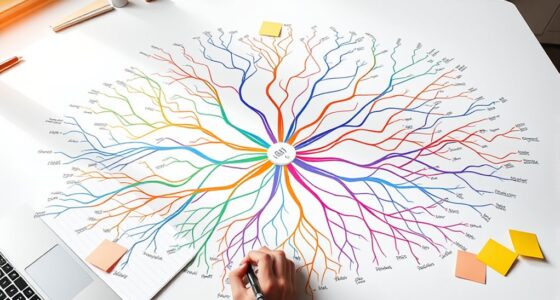

Traditional personas often oversimplify user behaviors and miss the influence of real-world contexts and environmental factors. To go beyond them, focus on developing dynamic, context-aware archetypes that consider situational variables like location, social settings, and device use. These archetypes adapt over time and reflect genuine user interactions. By understanding how environments shape behavior, you can create more responsive and personalized designs. Keep exploring to discover how integrating these insights can transform your user experience approach.
Key Takeaways
- Contextual archetypes focus on situational factors like environment, device, and social context rather than static user traits.
- They enable dynamic, adaptable designs that respond to real-time environmental changes and user behaviors.
- Incorporating environmental cues and cultural norms leads to more relevant, personalized user experiences.
- Methods include field research, behavioral analysis, and scenario testing to develop flexible archetypes.
- Technologies such as sensors and AI facilitate real-time context awareness, moving beyond traditional fixed personas.

MONIGEAR Network Temperature Humidity Monitor, THERMOMETER, Environmental Sensor, Supports MQTT, BACnet, SNMP, Modbus TCP, PoE Power Supply
Supports Multiple Industry-Standard Communication Protocols: Modbus TCP, SNMP, BACnet, and MQTT. Our system is compatible with all these…
As an affiliate, we earn on qualifying purchases.
As an affiliate, we earn on qualifying purchases.
Understanding the Limitations of Traditional Personas

Traditional personas often simplify user behavior by assigning fixed traits and demographics, but this approach can overlook the complexity and variability of real users. Relying on demographic stereotypes risks reinforcing outdated ideas and ignoring individual differences. Cultural biases can influence how personas are created, leading to assumptions that don’t reflect actual user needs or behaviors. These stereotypes may cause you to design solutions that don’t resonate across diverse audiences, limiting usability and engagement. By focusing solely on superficial traits, you miss the nuanced motivations and contexts that drive user actions. Recognizing these limitations helps you move beyond static profiles, encouraging more dynamic, inclusive, and accurate representations of your users. This awareness is vital for creating adaptable designs that truly serve real-world diversity. Additionally, understanding the importance of sustainable weight loss and healthy lifestyle choices can inform more empathetic and adaptable user-centered designs.
AI-powered context-aware user interface tools
As an affiliate, we earn on qualifying purchases.
As an affiliate, we earn on qualifying purchases.
The Evolution Toward Context-Aware Design

You recognize that static personas no longer capture the full user experience. By incorporating environmental factors, your designs can adapt to real-time contexts, making interactions more relevant. Moving toward these dynamic, context-aware approaches transforms how users engage with your products. Recognizing the importance of active listening and empathy in understanding user needs further enhances the effectiveness of your adaptive designs.
Shifting From Static to Dynamic
As technology advances, static personas no longer suffice for creating truly effective user experiences. You need to acknowledge behavioral variability, recognizing that users adapt their actions based on different contexts. Instead of fixed profiles, focus on dynamic models that reflect real-time changes in user behavior. Environmental influence plays a vital role, as factors like location, device, or time of day can shift how users interact with your product. By shifting from static to dynamic design, you can better anticipate these fluctuations and create adaptable interfaces. Color accuracy impacts how users perceive visual information, emphasizing the importance of designing for varying conditions. This approach guarantees your design remains relevant and personalized, providing seamless experiences regardless of changing circumstances. Embracing this evolution makes your work more responsive, ultimately delivering greater value to users in diverse situations.
Incorporating Environmental Factors
Recognizing that user behavior varies with environmental conditions allows you to create more responsive and personalized experiences. By considering environmental impact, you can design interfaces that adapt to different settings, whether it’s lighting, noise levels, or connectivity. Social influences also shape how users interact with technology, depending on their surroundings and cultural norms. Incorporating these factors helps you develop cultural intelligence-driven context-aware solutions that respond dynamically to users’ environments. For example, a mobile app might adjust its notifications based on location or time of day, or a website could change content delivery depending on social context. Understanding these environmental influences ensures your design is more relevant and engaging, ultimately fostering a deeper connection between users and your product.
dynamic user archetype software
As an affiliate, we earn on qualifying purchases.
As an affiliate, we earn on qualifying purchases.
Defining What Exactly Are Contextual Archetypes

You’ll want to understand how contextual archetypes originated and what sets them apart from traditional personas. Unlike personas, which focus on static user profiles, archetypes emphasize dynamic behaviors shaped by context. Recognizing these differences helps you design more adaptable and relevant user experiences. Additionally, considering factors like nutrient-rich ingredients can inform how users interact with health-related content in various situations.
Origins and Concepts
What exactly are contextual archetypes, and where do they come from? They are models that capture how people behave in specific situations, influenced by cultural nuances and technological shifts. Unlike personas, which focus on static profiles, these archetypes emphasize dynamic, real-world interactions. They originate from observing patterns across diverse contexts, recognizing that behaviors vary based on environment, social norms, and evolving technology. As cultures adapt and new tools emerge, people’s responses change, creating different archetypes. These models help you understand the underlying motivations and behaviors that drive actions in particular settings. By focusing on context rather than just demographics, you gain a clearer picture of how individuals actually engage with products, services, or experiences in their daily lives. Recognizing the role of behavioral patterns is essential in developing more adaptable and relevant design strategies.
Differentiating From Personas
While personas provide detailed, static profiles of target users based on demographics and psychographics, contextual archetypes focus on capturing how people behave in specific situations. They emphasize emotional insights and the influence of cultural nuances that shape user behavior in particular contexts. Unlike personas, which often generalize traits, archetypes reveal dynamic, situational patterns that help you understand users’ motivations and reactions as they navigate real-world scenarios. This approach enables you to design more empathetic and relevant solutions, responsive to the complexities of human behavior driven by cultural backgrounds and emotional states. Additionally, understanding space utilization can uncover how individuals adapt their environments to meet their needs, making your designs more responsive to real-world behaviors. By focusing on these contextual factors, you gain a deeper, more actionable understanding that enhances user experience beyond static profiles.
GPS Tracker for Vehicles – Hidden Tracking Devices for Cars, GPS Tracker for Vehicle No Monthly Fee, Car Tracker Device with Real-Time Location, No Subscription, Compact Tracker Device
Apple"Find My" Network Integration – Leverage 100M+ Apple Devices for Global Tracking | Zero Subscription Fees Seamlessly connect…
As an affiliate, we earn on qualifying purchases.
As an affiliate, we earn on qualifying purchases.
Identifying Real-World Situations and Environments

How can you accurately identify the real-world situations and environments where your personas will operate? Start by observing environmental cues that signal specific contexts—noise levels, lighting, social interactions, and technology use. These cues help you understand how users behave and what challenges they face in different settings. Developing strong situational awareness allows you to see beyond assumptions, capturing the nuances of real environments. Conduct field research, such as shadowing or contextual inquiries, to gather direct insights. Pay attention to patterns in user behavior across various circumstances. For example, awareness of operating hours can inform you about peak activity times and user availability. This approach ensures your design aligns with authentic experiences, making your solutions relevant and effective. By grounding your understanding in actual situations, you create more meaningful, adaptable, and user-centered designs.
Incorporating Environmental and Social Factors Into Design

Have you considered how environmental and social factors influence user behavior and decision-making? These factors shape how users interact with your design and what they value. Environmental impact can affect user choices, especially if sustainability is a priority. For example, eco-friendly products often appeal to environmentally conscious consumers. Social dynamics also play a crucial role; social norms, cultural values, and peer influence guide behavior. When designing, integrate these insights to create solutions that resonate with users’ environmental concerns and social contexts. Additionally, understanding preppy dog names can inspire branding strategies that appeal to a sophisticated audience. By understanding these factors, you can craft more relevant, responsible designs that foster positive engagement and trust. Incorporating environmental and social considerations ensures your design aligns with users’ values and broader societal expectations, ultimately enhancing its impact and acceptance.
Case Studies Highlighting Contextual Archetypes in Action

Case studies provide concrete examples of how contextual archetypes shape design decisions in real-world scenarios. For instance, in one project, designers tailored adaptive interfaces to suit users’ cultural nuances, recognizing that visual cues and interaction patterns vary across regions. By understanding these archetypes, they created interfaces that dynamically adjust content and layout, enhancing user engagement and satisfaction. Another example involves designing for diverse environments, where contextual archetypes helped identify specific needs, such as language preferences or social behaviors. These insights led to more inclusive, responsive designs that respect cultural differences. Such case studies highlight the value of moving beyond generic personas, emphasizing how contextual archetypes enable you to craft more meaningful, adaptable user experiences rooted in real-world diversity.
Methods for Developing and Validating Archetypes

To develop and validate archetypes effectively, you should start by conducting empathy interviews to gain deep insights into user motivations. Analyzing behavioral data helps confirm patterns and refine your archetypes over time. Additionally, understanding performance enhancement techniques can inform how users interact with tuning modifications. Finally, prototype and test scenarios to make certain your archetypes accurately reflect real user needs and behaviors.
Conduct Empathy Interviews
Conducting empathy interviews is a crucial step in developing and validating archetypes because it allows you to gain deep, firsthand insights into users’ experiences, motivations, and challenges. During these interviews, focus on empathy mapping to visualize users’ feelings, thoughts, and pain points, helping you understand their true needs. User interviews provide rich qualitative data, revealing nuances that quantitative data might miss. Ask open-ended questions to encourage honest responses and listen actively to identify patterns and key themes. These conversations help you confirm whether your initial assumptions about archetypes hold true or need refinement. By engaging directly with users, you ensure your archetypes are rooted in real-world contexts, making them more accurate and useful for designing meaningful solutions.
Analyze Behavioral Data
Analyzing behavioral data is essential for developing and validating archetypes because it provides objective insights into user actions, preferences, and patterns over time. By leveraging behavioral analytics, you can identify consistent trends and recurring behaviors that reveal true user motivations. This data-driven approach helps you move beyond assumptions, grounding archetypes in real-world evidence. You might track metrics like clickstreams, time spent on tasks, or feature usage to uncover how users interact with your product. Validating archetypes with behavioral data guarantees they accurately represent your audience’s actual behavior, not just their stated needs or demographics. Ultimately, this process allows you to create more precise, actionable archetypes that inform better design decisions and enhance user experiences.
Prototype and Test Scenarios
Developing and validating archetypes effectively involves creating and testing prototypes that embody the identified user segments. To do this, you simulate real-world scenarios by considering physical environments and social dynamics. For example, you might set up prototypes in diverse settings—offices, homes, public spaces—to observe how users interact within different physical contexts. You also test how social interactions influence behaviors, ensuring archetypes reflect genuine social dynamics. By observing users steering through these scenarios, you identify pain points and opportunities for refinement. Testing should be iterative: gather feedback, adjust prototypes, and retest. This process helps you validate whether your archetypes accurately represent the target segments’ behaviors across various physical and social contexts, ultimately leading to more user-centered, adaptable designs.
Comparing Static Personas and Dynamic Archetypes

While static personas provide a fixed snapshot of target users, dynamic archetypes evolve over time, offering a more nuanced understanding of behaviors and motivations. Static personas are useful for initial behavioral modeling, but they often overlook how users change in different contexts. Dynamic archetypes allow you to track archetype evolution, reflecting shifting needs, preferences, and behaviors. This ongoing adaptation helps you design more flexible, relevant experiences. Unlike static profiles, which risk becoming outdated, archetypes grow with your understanding of users, capturing complex motivations and contextual influences. By comparing these approaches, you’ll see that dynamic archetypes foster a deeper connection with users, enabling more responsive and adaptive design solutions that truly resonate over time.
Practical Steps for Integrating Contextual Archetypes Into Projects

To effectively incorporate contextual archetypes into your projects, start by identifying the key variables that influence user behavior in different situations. Focus on understanding how context shapes actions, preferences, and needs. Use contextual storytelling to gather insights, capturing real scenarios users face. This approach helps you create adaptive interfaces that respond dynamically to changing conditions, enhancing user experience. Develop archetypes based on situational factors like location, device, or social environment, rather than static characteristics alone. Test these archetypes through user research and iterative prototypes, ensuring they reflect real-world behaviors. Integrate insights into your design process by tailoring features and content to specific contexts. This approach guarantees your solutions are more relevant, flexible, and user-centered across diverse scenarios.
The Future of User-Centered Design With Context Awareness

As technology advances, user-centered design is increasingly embracing context awareness to create more intuitive and responsive experiences. By leveraging digital empathy, designers can better understand users’ environments, emotions, and needs in real-time. This shift enables the development of adaptive interfaces that adjust dynamically based on context, making interactions smoother and more personalized. Future designs will prioritize seamless integration of sensors, AI, and data analytics to anticipate user intentions and adapt accordingly. You’ll find interfaces that respond to subtle cues like location, activity, or mood, fostering a deeper connection between users and technology. This evolution moves beyond static personas, empowering products to serve users in a way that feels natural, empathetic, and highly tailored to their current situation.
Frequently Asked Questions
How Do Contextual Archetypes Differ From Traditional Personas?
You might wonder how contextual archetypes differ from traditional personas. Unlike personas, which focus on static traits, contextual archetypes emphasize behavioral shifts driven by environment influences. You consider how users act differently depending on their surroundings, adapting your design to these changing behaviors. This approach helps you create more dynamic solutions that respond to real-world context, making your designs more relevant and effective by acknowledging the impact of environment influences on user behavior.
Can Contextual Archetypes Adapt Over Time and Changing Environments?
You’ll find that contextual archetypes are designed with evolutionary adaptability and environmental responsiveness in mind. As your environment changes, these archetypes can adapt more fluidly than traditional personas, allowing your design to stay relevant. By focusing on the context and user behaviors, you guarantee your approach remains flexible, making it easier to respond to new trends, challenges, and user needs over time.
What Tools or Software Facilitate Designing With Contextual Archetypes?
You can use tools like Miro or Lucidchart to design with contextual archetypes. These platforms let you perform behavior mapping and scenario simulation, helping you understand how your archetypes act in different environments. By visualizing behaviors and testing scenarios, you adapt your designs to real-world contexts. These tools make it easier to refine your approach, ensuring your design resonates with users across diverse situations and evolving needs.
Are There Industry-Specific Examples of Successful Contextual Archetype Implementation?
Think of industry application like a tailor fitting a suit; it molds to fit specific needs. Case studies across healthcare, retail, and finance showcase how successful contextual archetype implementation drives user engagement and product relevance. These examples reveal how understanding user environments enhances design, much like a seasoned chef perfects a signature dish. Such industry-specific insights help you tailor experiences that resonate deeply with your audience’s unique contexts.
How Do Cultural Differences Influence the Creation of Contextual Archetypes?
You should consider that cultural differences greatly influence the creation of contextual archetypes. Cultural nuances shape user behaviors, values, and expectations, so your global perspectives help you develop more accurate archetypes. By understanding local customs, communication styles, and preferences, you can tailor your designs effectively. This approach guarantees your archetypes resonate across diverse markets, fostering better user engagement and more successful product outcomes worldwide.
Conclusion
By embracing contextual archetypes, you’re not just designing—you’re creating experiences that practically read your users’ minds! Say goodbye to outdated personas and hello to a future where your designs adapt faster than a chameleon on a rainbow. With this approach, you’ll craft solutions so intuitive, they’ll seem almost psychic. Get ready to revolutionize your user-centered design game—because in this world, understanding context isn’t just a benefit; it’s the superpower that’ll make you unstoppable!