
📊 Full opportunity report: The Social Media Management Workspace Built Around Tasks on IdeaNavigator AI — validation score, market gap, and execution plan.

Get business pricing on monitors, keyboards and dev gear
- Business-only prices and quantity discounts
- Tax-exempt purchasing
- Multiple users, one account, clear invoices
TL;DR
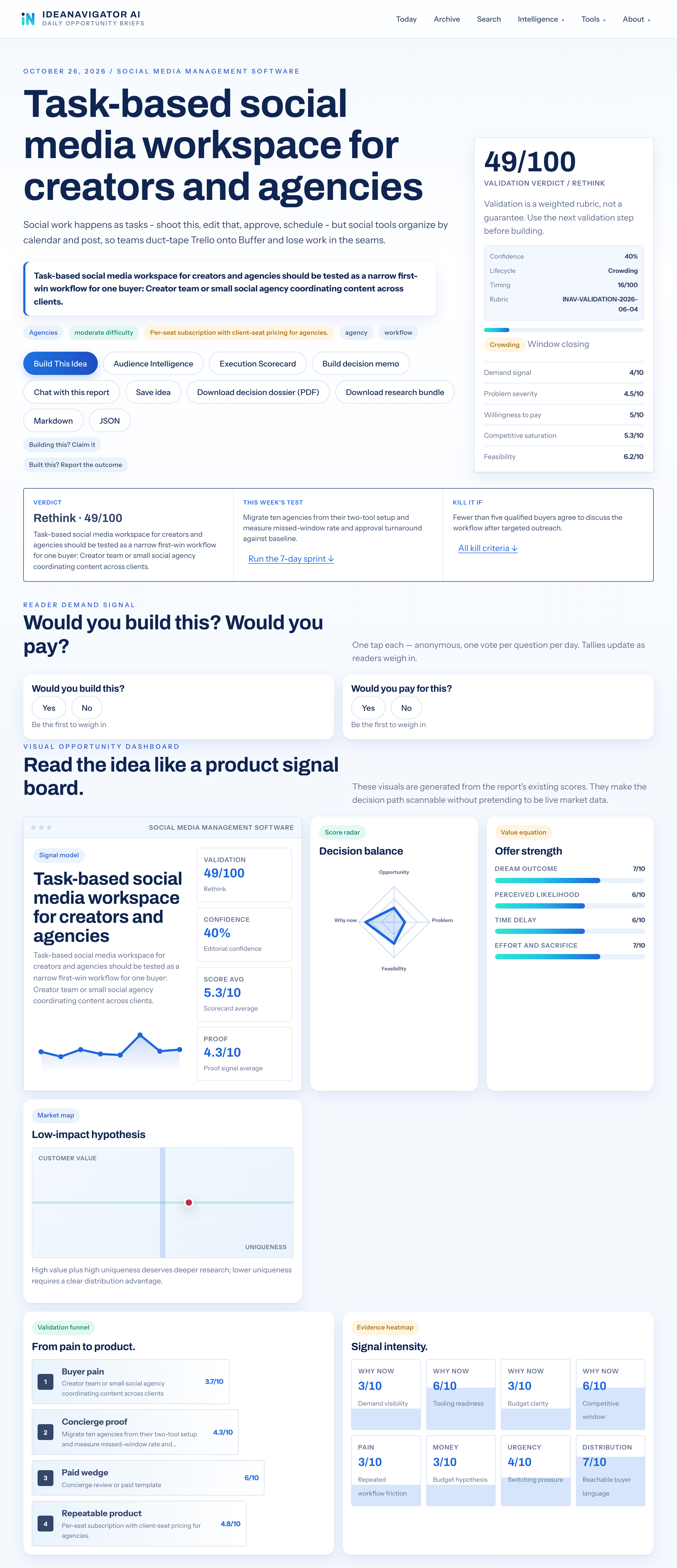
IdeaNavigator AI’s proposal describes a social media workspace that treats each post as a task moving through briefing, asset creation, editing, approval and scheduling. It is a product opportunity, not a reported launch: the proposal calls for testing it with 10 agencies and comparing missed publishing windows and approval times with their current setup.
IdeaNavigator AI has outlined a proposed task-based social media workspace for creator teams and small agencies managing content across clients, centering the product on each post’s progress from brief to publication. In its proposal, the company describes an MVP combining work stages, client approval links, asset versioning and scheduling, but does not report that a product has launched or that the concept has been tested.
IdeaNavigator AI’s proposal starts from a workflow problem: social teams coordinate work such as shooting, editing, reviewing and scheduling, while many social tools are organized around calendars and individual posts. The proposal says teams may bridge that gap by pairing a social scheduling service with a generic project-management tool, creating points where work or information can be missed.
The suggested MVP would make each post a task with stages for briefing, assets, editing, approval and scheduling. IdeaNavigator AI also proposes client-facing approval links and asset versioning, with content scheduled after approval. The intended result is one pipeline from an initial idea to publication, rather than separate systems for production and distribution.
IdeaNavigator AI proposes a per-seat subscription, including pricing for client seats aimed at agencies. Its proposed validation plan is to move 10 agencies from their existing two-tool arrangements and compare missed-window rates and approval turnaround times against a baseline. The proposal provides no baseline figures, test results, pricing amounts or evidence of customer commitments.
Connecting Content Work to Publishing
The proposal focuses on the work that happens between deciding to publish and placing a post on a calendar. For small agencies and creator teams, approvals, asset changes and handoffs can involve multiple people and clients. Bringing those steps into a single workflow could make it easier to see who owns each task and what is holding up a post, if the product works as described.
The commercial question is whether a purpose-built workflow offers enough value beyond existing scheduling and project-management tools to justify another subscription. The proposed measures—missed publishing windows and approval turnaround—could help test that question, but no findings are available. Until a pilot is completed, the suggested benefits remain a hypothesis rather than a demonstrated improvement.
Popular right now

Bose QuietComfort Ultra Earbuds (2nd Gen), Deep Plum

Ninja Foodi DZ201 8-Quart DualZone 6-in-1 Air Fryer

eufy E25 Robot Vacuum and Mop Combo with HydroJet Roller Mop
As an affiliate, we earn on qualifying purchases.
The Proposed Agency Workflow
The product idea targets a specific buyer: a creator team or small social agency coordinating content across clients. It is not presented as a general replacement for every social-media management platform. Its premise is that scheduling tools handle publishing while generic work tools handle tasks, leaving teams to connect the two themselves.
IdeaNavigator AI frames the timing around rising expectations for content production and the limitations of tools that do not organize work around the full production process. That rationale is part of the proposal; it is not accompanied by market data or measured evidence in the material provided. The defined next step is a focused test with 10 agencies, rather than a reported market rollout.
Pilot Results and Product Status
No product launch, finished software or pilot outcome is reported. It is unclear whether development has begun, whether agencies have agreed to participate, or when a test might take place. The proposal also does not specify how missed windows or approval turnaround would be defined, what baseline period would be used, or what results would count as a successful test.
Other details remain open, including the subscription price, how client seats would be charged, which social networks could be scheduled to, and how permissions or approval changes would work. These are unanswered product questions, not confirmed shortcomings of an existing service.
Testing With Ten Agencies
IdeaNavigator AI’s proposal sets out a next step of migrating 10 agencies from their two-tool setup and comparing performance with a baseline. The proposed test would track whether the workspace changes missed-window rates and the time needed to secure approvals. No timetable or recruitment details are given.
Until that test produces results, the concept should be understood as an early product opportunity. Evidence on workflow outcomes, agency willingness to pay and the effort required to move client work into the system would help establish whether the proposed task-centered approach addresses a practical need.
Source: IdeaNavigator AI’s product proposal
Key Questions
Has the task-based social media workspace launched?
No launch is reported. IdeaNavigator AI’s material describes a product concept and an MVP proposal, not an available product.
Who is the proposed workspace for?
IdeaNavigator AI says it is aimed at creator teams and small social agencies coordinating content across clients.
What would the MVP include?
In the proposal, the MVP would track each post through briefing, asset creation, editing, approval and scheduling, with client approval links and asset versioning.
How would the idea be tested?
IdeaNavigator AI’s proposal calls for moving 10 agencies from two-tool workflows and comparing missed publishing windows and approval turnaround with a baseline. No results or test schedule are provided.
Source: IdeaNavigator AI