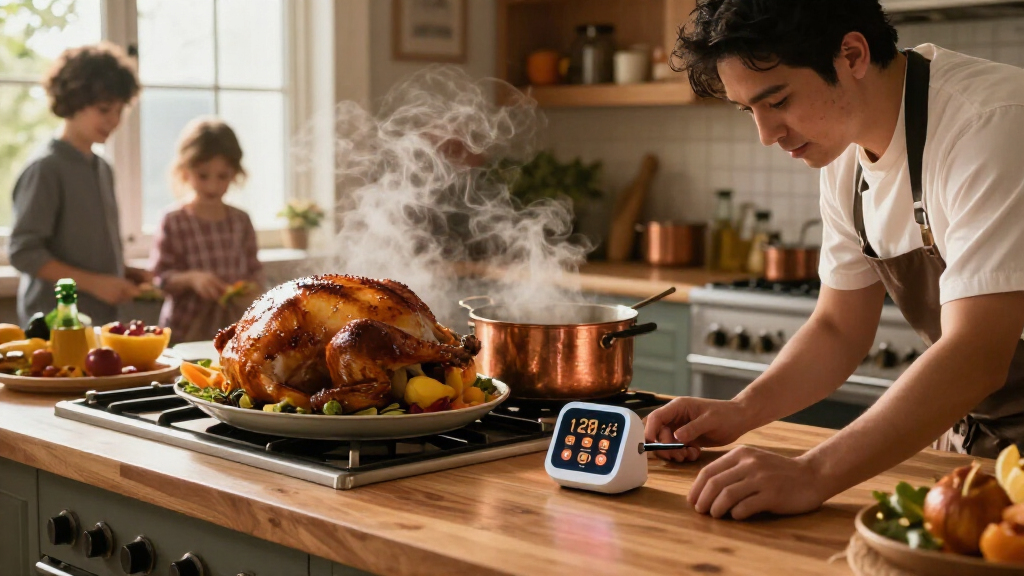
🔍 Read the full analysis: AI-Powered Kitchen Timers: Planning Your Thanksgiving Cooking on ThorstenMeyerAI.com

Get business pricing on monitors, keyboards and dev gear
- Business-only prices and quantity discounts
- Tax-exempt purchasing
- Multiple users, one account, clear invoices
TL;DR
AI-powered kitchen timers can interpret spoken requests, manage labeled countdowns and, in some products, suggest timers from recipe steps. The source material is a consumer guide, not a report of a newly announced product or study; it cautions that speech and recipe errors, outages and food-safety limits remain relevant.
AI-powered kitchen timers can interpret spoken cooking requests, keep multiple labeled countdowns and, in some products, suggest alerts from recipe steps, according to the original consumer guide from ThorstenMeyerAI.com. The guide says these functions may ease the multitasking involved in Thanksgiving cooking, while warning that speech recognition, recipe interpretation and internet access can fail—and that a timer cannot confirm food is safely cooked.
The term “AI-powered” covers a range of features, rather than one standard capability. A device might recognize a spoken timer request, let users label and adjust several countdowns, connect to an app, or turn recipe instructions into suggested alerts. The guide cautions that a connected product is not necessarily using AI: some functions may rely on fixed voice commands or preset automations, a reminder of the importance of planning for AI system failures. Shoppers should check the manufacturer’s current feature list rather than infer capabilities from the label.
For a busy meal, a cook might ask for a nine-minute pasta timer and a separate reminder to check the sauce in five minutes. Clear labels help distinguish alerts when several countdowns run at once. The guide recommends checking the screen or spoken confirmation, naming timers by food or task, and making sure one countdown can be changed without resetting the others. Background noise, accents and ambiguous wording can lead to a mistaken duration or task.
Some systems can convert recipe instructions into proposed reminders, but those schedules need review. A recipe’s wording may be misread, and cooking conditions can differ from the assumptions behind a suggested time. The guide also advises keeping a basic timer available in case of a connection problem or missed alert, alongside other useful precision cooking tools. A countdown tracks elapsed time; it does not assess the food itself or establish that it has reached a safe temperature.
Check what a product actually does: voice control and Wi-Fi alone do not prove it uses AI.
Use clear timer names, review spoken commands, and confirm recipe-generated alerts before cooking.
Compare alert options, timer adjustments, offline use, privacy controls, and total cost.
Treat recipe timers as reminders to check; use a food thermometer when safe temperature matters.
Keeping Thanksgiving Tasks on Track
Thanksgiving meals often involve several dishes with different cooking and resting times. A system that handles multiple named reminders hands-free could reduce the need to touch a phone or stop food preparation to enter each countdown. Labels may also help a cook decide which task needs attention when alerts overlap.
The value depends on reliable controls, not simply on conversational features. A misunderstood number, an unlabeled beep or a failed connection can add confusion at the moment the cook is trying to coordinate several jobs. Reviewing each timer and retaining an offline backup are practical safeguards. Recipe suggestions can support planning, but they are not a substitute for checking the food and following appropriate cooking guidance.
Popular right now

Ninja AF101 4-Quart Air Fryer, 4-in-1, Grey

Vitamix Touch & Go Advance 32-Ounce Bar Blender, White

Vitamix VX1 Professional-Grade Blender, 64 oz, Black
As an affiliate, we earn on qualifying purchases.
What the AI Label Covers
The source describes a developing mix of features across voice assistants, recipe services and smart displays. As of information available through mid-2024, it said companies were adding conversational and generative AI capabilities to existing products. It does not identify a single new launch, a specific product comparison or independent test results establishing how accurately these timers perform.
Capabilities can vary by device, software version, region and subscription, and cloud-dependent functions may change without a hardware change. Buyers should check current product documentation for supported commands, recipe functions, internet requirements, alerts, privacy settings and cost. A simpler timer with easy-to-check controls may better suit a cook who values predictability over flexible voice requests.
Reliability and Safety Limits
The source material does not provide named product tests, measured error rates, prices or a current comparison of devices. It is therefore unclear which products most reliably distinguish multiple spoken requests in a noisy kitchen, how well recipe-based suggestions work across different recipes, or which functions remain available during an internet outage. Those details need to be checked with current manufacturer information and, where available, independent reviews.
More broadly, the guide does not claim that AI timers can assess doneness. Their alerts are reminders based on a requested duration or suggested schedule, not confirmation of a dish’s condition. Cooks should not treat a timer alert as proof that food is ready or safe to serve.
Check Features Before Cooking
Before Thanksgiving, users can test the timer with a few low-stakes requests: create separate labeled countdowns, confirm their durations, adjust one without changing another, and check how alerts work. They can also find out whether the core countdown remains usable without internet access and whether recipe features require an account or paid subscription.
For any meal, review recipe-generated alerts before starting and keep a manual or phone timer available as a backup. Product capabilities may change with software updates, so the next step for prospective buyers is to consult current documentation rather than rely on a general “AI” label. The source provides no announcement or future product milestone; its guidance is to verify features and treat timers as aids, not food-safety checks.
Key Questions
What does an AI-powered kitchen timer do?
Depending on the product, it may interpret spoken requests, create or label several countdowns, or suggest reminders based on recipe steps. The AI label does not guarantee that every product offers all of these functions.
Can a kitchen timer tell me whether Thanksgiving food is safe to eat?
No. A timer tracks a requested duration or a suggested schedule; it does not confirm that food is safely cooked. An alert is not a food-safety assessment.
What should I check before buying one?
Check which spoken commands and recipe features are supported, whether alerts are clearly labeled, whether one timer can be changed independently, what works offline, and whether privacy settings or subscriptions affect use.
What if the voice assistant misunderstands a timer request?
Check the display or listen to the confirmation before relying on the countdown. Name each timer clearly, correct it if needed, and keep a manual or phone timer available as a backup.
Are recipe-based timer suggestions reliable?
The source advises treating them as a draft and reviewing them before starting. Recipe wording and cooking conditions can vary, so a suggested alert should not replace monitoring the food.
Source: ThorstenMeyerAI.com