📊 Full opportunity report: Tracking Intel One Mono Across Arts And Culture Organizations In 2023 on IdeaNavigator AI — validation score, market gap, and execution plan.

Get business pricing on monitors, keyboards and dev gear
- Business-only prices and quantity discounts
- Tax-exempt purchasing
- Multiple users, one account, clear invoices
TL;DR

IdeaNavigator AI has proposed monitoring Intel One Mono, a typeface released in 2023, as a possible signal for programming leads at venues, galleries and festivals. The proposal is a product idea, not evidence that arts organizations are adopting the font or that it is changing audience demand.
IdeaNavigator AI has proposed tracking Intel One Mono, a typeface released in 2023, as a possible cultural signal for programming leads at venues, galleries and festivals. The proposal describes a potential monitoring service, not confirmed adoption by arts organizations or evidence that the font is influencing programming decisions.
According to the IdeaNavigator AI proposal, the idea is to monitor Hacker News and similar feeds for developments that might affect cultural organizations, then filter those items for one intended reader: a programming lead at a venue, gallery or festival. Each selected item would become a short brief explaining what changed, why it may matter and what action to consider.
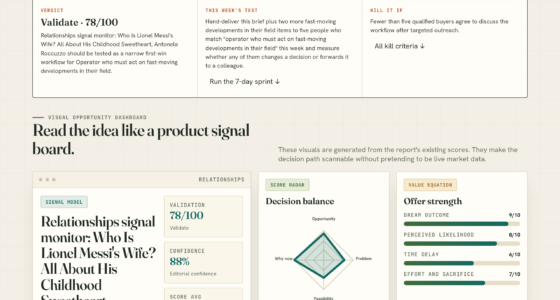
IdeaNavigator AI assigns the Intel One Mono signal an 88/100 rating on Hacker News. The proposal does not explain the scoring method, the scale’s meaning, the period measured or how the rating compares with other topics. The number should therefore be read as a platform-specific signal in the proposal, not a measure of public interest or proven relevance to arts programming.
The proposal describes a subscription business model for programming leads seeking an early, role-filtered read on cultural trends and audience demand. It recommends testing the idea by delivering the Intel One Mono brief and two other trend items to five people in the target role, then checking whether anyone changes a decision or forwards a brief to a colleague. The source reports no test results or customer commitments.
Tracking Intel One Mono A signal to test
IdeaNavigator AI proposes monitoring the 2023 typeface for arts programming leads. This is a product hypothesis, not evidence of adoption or audience demand.
What is being proposed
A role-filtered briefing service would monitor feeds and summarize developments for cultural programmers.
Programming leads
The intended readers work at venues, galleries and festivals.
Short, actionable briefs
Each brief would explain what changed, why it may matter and what action to consider.
What the signal tells us
The proposal gives Intel One Mono an 88/100 Hacker News rating, but leaves its meaning unclear.
- The score appears in the proposal.
- The topic is suggested for monitoring.
- Scoring method and measurement period.
- Arts-sector adoption or audience impact.
Proposed pilot
The test is designed to check whether the brief format earns attention from its intended readers.
Include Intel One Mono and two other trend items.
Share the briefs with people in the intended programming roles.
Check whether anyone changes a decision or forwards a brief.
Testing Signals for Arts Programmers
The proposal addresses a practical information problem: developments relevant to a cultural organization may appear across news, online forums and filings, leaving staff to decide which are worth attention. A targeted brief could save time if it helps a programmer distinguish a passing online mention from a development that merits a discussion about events, exhibitions or audience outreach.
But the value depends on more than spotting a topic. For Intel One Mono to matter to a venue or gallery, a monitor would need to connect the font to a concrete change in audience behavior, creative practice, accessibility, or the organization’s own programming. The IdeaNavigator AI proposal does not provide that connection; it presents the typeface as an example to test. Its immediate significance is therefore as a product hypothesis, not as a documented shift in arts-sector practice.
The suggested pilot would give the idea a basic test of usefulness: whether five people in the target role act on or share the briefs. That could indicate whether the format earns attention, though it would not by itself establish broad demand, subscription willingness or the accuracy of the service over time.
Popular right now

Hisense 85U6SF Pro 85-Inch U6 Pro Mini-LED 4K UHD Smart Fire TV

Apple AirPods Pro (2nd Generation) Wireless Earbuds with USB-C MagSafe Charging Case

Ninja Foodi 8-Qt DualZone 6-in-1 Air Fryer, Grey (DZ201)
As an affiliate, we earn on qualifying purchases.
From Typeface to Monitoring Proposal
Intel One Mono is the subject named in the 2023-dated IdeaNavigator AI proposal. The source does not give details about the typeface’s design, release history, licensing or use by cultural organizations, so those points cannot be treated as established in this account. The stated development is the suggestion to monitor the topic, rather than a new announcement about the font itself.
The idea sits within a wider proposed service: watch information feeds, apply a filter based on a specific job, and summarize only items judged relevant to that role. Its target is deliberately narrow—programming leads at venues, galleries and festivals—rather than arts organizations generally. The proposal argues that cultural trends and audience demand can move quickly, making a same-day briefing potentially more useful than a generic weekly roundup. It supplies no evidence comparing response times or outcomes.
IdeaNavigator AI frames the concept as a market opportunity and recommends a small validation exercise before building a fuller product. That distinction matters: the monitoring workflow, subscription model and expected usefulness are proposals to evaluate, not an existing service or confirmed commercial result described in the available source.
Evidence Behind the Signal
Several points remain unverified or unspecified in the IdeaNavigator AI proposal. It does not say who is using Intel One Mono in arts settings, whether the topic has affected a programming choice, or whether audiences have shown measurable interest connected to it. The 88/100 Hacker News score lacks a stated methodology and time window, so its significance cannot be independently interpreted from the source.
It is also unclear which “similar feeds” the proposed monitor would cover, how it would decide that a trend is relevant, or how it would distinguish a notable development from ordinary online discussion. The proposal reports no pilot findings, customer interviews, pricing, operating costs or evidence of willingness to pay. Its five-person exercise is a validation plan, not proof of demand.
The Proposed Five-Person Pilot
The next step proposed by IdeaNavigator AI is to send a short Intel One Mono brief, alongside two additional cultural-trend items, to five people who match the target role. The test would track whether recipients change a decision or forward a brief to a colleague. The proposal describes the intended activity as happening “this week,” but gives no calendar date, identifies no participants and reports that outreach has not taken place.
Results would help determine whether the briefing format is useful enough to warrant further development. To support a stronger conclusion, a subsequent test would need to clarify what counts as a decision change, ask recipients how they judge relevance, and examine whether interest persists beyond a small initial group. Until such evidence is available, the monitor remains a concept under consideration, and Intel One Mono’s relevance to arts programming remains unestablished.
Source: IdeaNavigator AI proposal. Claims about the proposed monitor, intended users, 88/100 rating and suggested pilot are attributed to this source; it does not report adoption, pilot results or audience-demand data.
Key Questions
What is the development being reported?
IdeaNavigator AI proposed monitoring Intel One Mono as a possible cultural signal for programming leads. The development is a product concept, not a report that organizations have adopted the font.
What does the 88/100 score mean?
The proposal gives the topic an 88/100 Hacker News signal, but does not state the scoring method, time window or comparison baseline. It cannot be interpreted as a measured increase in interest or audience demand.
Who would use the proposed monitor?
The intended users are programming leads at venues, galleries and festivals seeking short, role-filtered briefs about developments that might affect their work.
Has the service been tested with arts organizations?
No results are provided. The proposed next step is a test with five people in the target role, using three briefs and tracking whether recipients change a decision or share one.
Is Intel One Mono confirmed to be changing arts programming?
No. The available information identifies it as a topic to investigate; it does not document adoption by arts organizations or an effect on programming or audiences.
Source: IdeaNavigator AI