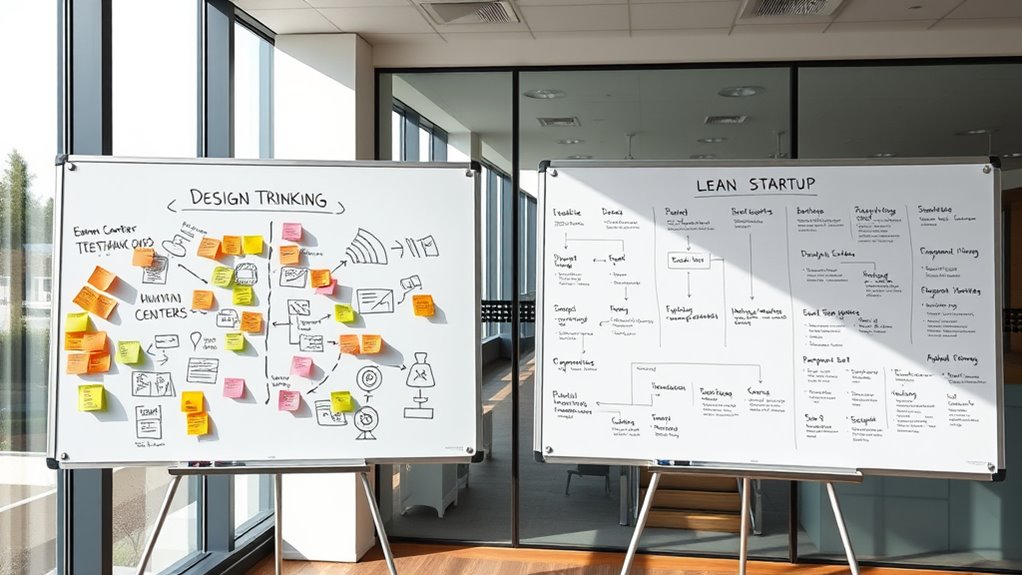

Design Thinking and Lean Startup differ in approach: Design Thinking focuses on understanding customer needs deeply through empathy and idea generation, while Lean Startup emphasizes rapid experimentation with minimal products to validate business models. They complement each other by combining human-centered insights with data-driven validation. Using both methods helps you create innovative, customer-focused solutions that are also practical and market-ready. If you want to explore how these approaches work together, there’s more to discover.
Open a free Amazon Business account
Business pricing, bulk buying and tax-exempt orders.
As an affiliate, we earn on qualifying purchases.
Key Takeaways
- Design Thinking focuses on empathizing with users to generate innovative ideas, while Lean Startup emphasizes rapid experimentation and validated learning.
- Design Thinking gathers qualitative customer insights through empathy exercises; Lean Startup relies on quantitative data from MVP testing.
- The goal of Design Thinking is to uncover meaningful problems; Lean Startup aims to validate and refine business models efficiently.
- Design Thinking begins with understanding customer needs; Lean Startup develops MVPs to test assumptions quickly.
- Combining both methods leads to innovative, customer-centered solutions that are validated and market-ready.

When it comes to developing innovative products and services, both Design Thinking and Lean Startup offer valuable approaches, but they differ markedly in focus and methodology. As you explore these methods, you’ll find that Design Thinking emphasizes understanding your users deeply, while Lean Startup centers on rapid experimentation and validated learning. Both approaches value customer feedback, but they do so at different stages and with different aims. With Design Thinking, you start by empathizing with your customers, immersing yourself in their experiences to uncover real needs. This user-centric approach helps you generate ideas that genuinely resonate with your target audience. Customer feedback here is more qualitative, gathered through interviews, observations, and empathy exercises, shaping your understanding of what users truly want.
Design Thinking focuses on deep user empathy to generate meaningful, customer-centered ideas.
In contrast, Lean Startup shifts the focus toward testing hypotheses through quick, low-cost experiments. You develop minimal viable products (MVPs) to gather real-world data, enabling you to validate or invalidate assumptions about your business models. Customer feedback in this context becomes a critical metric for decision-making, guiding whether you pivot or persevere. The goal isn’t just to understand customer needs but to rapidly adapt your offerings based on actual user responses. This iterative process helps you avoid building features or products that nobody wants, saving time and resources.
While Design Thinking often leads to innovative ideas rooted in deep empathy, Lean Startup helps you validate those ideas quickly and efficiently. You might use Design Thinking to discover a problem worth solving and then apply Lean Startup principles to test potential solutions. Together, these methods complement each other by ensuring your business models are both customer-centered and grounded in validated learning. The business models you develop through this combined approach become more resilient and aligned with market demands because they’re shaped by continuous customer feedback and real data. Additionally, leveraging vetted resources can help ensure your approach remains credible and effective throughout the process.
Ultimately, understanding the distinctions and synergies between these approaches empowers you to create products and services that are both innovative and viable. Design Thinking provides the empathetic insight needed to identify meaningful problems, while Lean Startup ensures that your solutions are tested, refined, and validated in the real world. By leveraging both, you can build a more customer-focused, adaptable business model that responds swiftly to feedback and minimizes risk. This combined mindset helps you stay agile, innovative, and aligned with your customers’ evolving needs.
As an affiliate, we earn on qualifying purchases.
Frequently Asked Questions
How Do Design Thinking and Lean Startup Impact Team Collaboration?
You foster creative collaboration and encourage iterative feedback when applying design thinking and lean startup. These methods promote open communication, allowing team members to share ideas freely and refine solutions quickly. As you iterate, everyone stays engaged and aligned, breaking down silos. This dynamic approach accelerates problem-solving, builds trust, and guarantees your team works cohesively toward innovative outcomes, making collaboration more effective and responsive.
Can These Methodologies Be Combined in a Single Project?
Imagine blending colorful paint strokes and precise lines—this visualizes how you can merge these methodologies. Yes, you can combine design thinking and lean startup in a single project, creating a creative synergy that enhances innovation. Methodological integration allows you to harness user empathy and rapid testing simultaneously, ensuring your ideas are both human-centered and market-ready. This approach maximizes flexibility, fostering a dynamic environment for continuous improvement.
What Industries Benefit Most From Each Approach?
You’ll find that Design Thinking benefits industries like healthcare and education, where customer-centric solutions drive innovation. Lean Startup works well in tech, e-commerce, and startups, helping with rapid market adaptation strategies. By applying industry-specific applications, you can tailor each methodology to meet unique challenges, ensuring faster development cycles and better user experiences. Combining these approaches can give you a competitive edge across diverse sectors, fostering innovation and agility.
How Do Costs Differ When Implementing Them?
Thinking of launching your brilliant idea? Well, brace for a cost rollercoaster! Lean Startup minimizes expenses with rapid iterations and lean resource allocation, making it perfect for tight budgets. Meanwhile, Design Thinking might drain your coffers with extensive research and prototyping, but its rich cost structure pays off in user-centered solutions. Choose wisely—your resource allocation and budget will thank you, or regret it forever.
What Are Common Pitfalls When Applying These Methods?
When applying these methods, you risk bias and overlooking user needs, which can skew results and hinder innovation. Resource constraints might cause you to skip essential steps like testing or iteration, leading to incomplete solutions. Be aware of bias risks and manage your resources carefully. Avoid rushing through stages, and guarantee you involve diverse perspectives to minimize bias and maximize value from your efforts.
As an affiliate, we earn on qualifying purchases.
Conclusion
Understanding how design thinking and lean startup differ and complement each other helps you innovate more effectively. Did you know that companies adopting design thinking see a 20% increase in customer satisfaction? By combining these approaches, you can better identify user needs and rapidly test ideas, reducing risk. Embrace both methods to create solutions that are not only innovative but also grounded in real user insights, giving you a competitive edge in today’s fast-paced market.
Customer empathy interview guide
As an affiliate, we earn on qualifying purchases.
As an affiliate, we earn on qualifying purchases.
Rapid experimentation tools for startups
As an affiliate, we earn on qualifying purchases.
As an affiliate, we earn on qualifying purchases.
Fall Picks
fall essentials
As an affiliate, we earn on qualifying purchases.