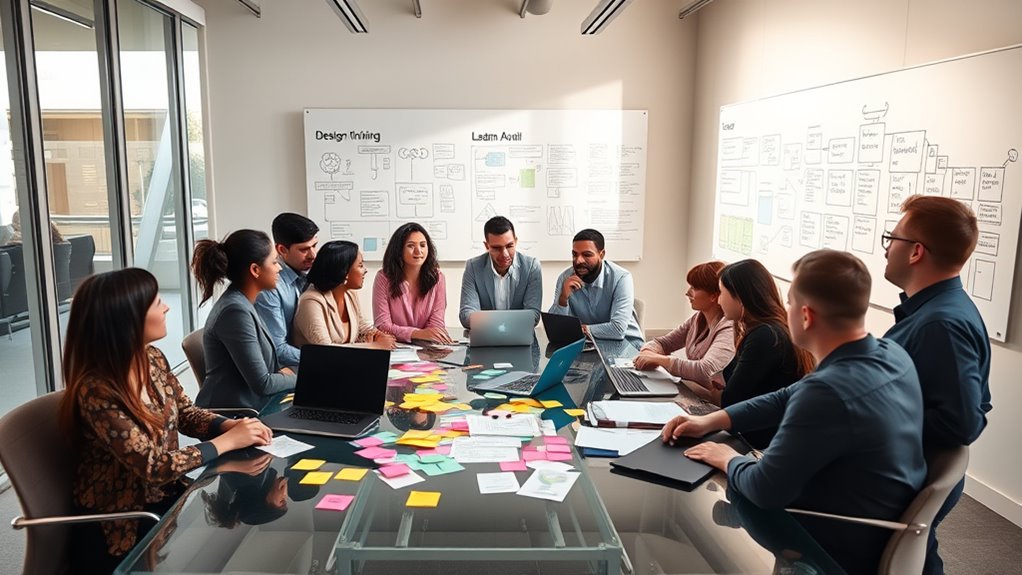

To find the right mix of Design Thinking, Lean, and Agile, focus on integrating their strengths: start with user empathy and creative exploration from Design Thinking, prioritize efficiency and rapid validation from Lean, and maintain flexibility through Agile’s iterative cycles. This approach fosters collaboration, quick adaptation, and customer-centric solutions. By blending these methods, you’ll create a dynamic environment that encourages innovation and continuous improvement — and there’s much more to learn about shaping it effectively.

Get monitors, keyboards and dev gear delivered free — and shop member deals
- Fast, free delivery on millions of items
- Access to Prime Big Deal Days deals on October 6–7
- Prime Video, Amazon Music and more included
Key Takeaways
- Tailor the integration based on project complexity, team skills, and customer needs for optimal results.
- Use Design Thinking to foster empathy and ideation, Lean to validate ideas efficiently, and Agile for iterative development.
- Promote cross-disciplinary collaboration to balance creativity, efficiency, and adaptability throughout the process.
- Continuously assess and adjust the blend to align with evolving goals, resources, and market feedback.
- Focus on delivering value quickly while maintaining flexibility to innovate and respond to change effectively.

In today’s fast-paced business environment, combining Design Thinking, Lean, and Agile offers a powerful approach to innovation and product development. This integrated methodology helps you tackle complex problems, foster creative ideas, and deliver value quickly. When you harness these methods together, you create a dynamic environment where innovative solutions emerge through seamless team collaboration. The key is understanding how each approach complements the others, enabling you to adapt swiftly and develop products that truly meet customer needs.
Design Thinking serves as your starting point, emphasizing empathy and deep user understanding. It pushes you to explore problems from the user’s perspective, encouraging creative ideation. By focusing on human-centered design, you’re able to generate innovative solutions that resonate with your target audience. This approach sparks team collaboration because it invites diverse perspectives and promotes open dialogue, guaranteeing everyone’s ideas contribute to the problem-solving process. When you involve team members early and often, you foster a culture of shared ownership, which accelerates innovation.
Start with empathy and user insights to fuel innovation and foster collaborative problem-solving.
Lean methodology complements this by emphasizing efficiency and eliminating waste. Once you identify potential solutions through Design Thinking, Lean helps you validate ideas quickly and avoid unnecessary resource expenditure. It encourages rapid experimentation and learning, so you can pivot or persevere based on real feedback. This iterative cycle keeps your team aligned, focused on what truly adds value, and promotes a mindset of continuous improvement. With Lean, your team becomes more agile, able to adapt to changing market conditions and customer demands without losing momentum. Incorporating comparative advantage insights further enhances your strategic position by focusing on resource allocation and specialization.
Agile ties everything together by providing a flexible framework for project management and delivery. Its iterative sprints allow your team to break down complex projects into manageable chunks, delivering incremental value at each stage. Agile’s emphasis on collaboration and transparency ensures that team members stay aligned, communicate effectively, and respond swiftly to obstacles or new insights. When you integrate Agile practices with Design Thinking and Lean, you create a cohesive process that’s responsive and customer-focused. The combination enables your team to generate innovative solutions rapidly, test them efficiently, and refine products based on real user feedback.
Ultimately, blending these three methodologies means you’re not just working faster but working smarter. You foster a culture where innovative solutions are born from collaboration, validated through rapid experimentation, and delivered with agility. This integrated approach helps you stay competitive, meet customer expectations, and continuously evolve your products and services. When you find the right mix, you *unlock* your team’s full potential, turning ideas into impactful solutions that resonate in today’s dynamic business landscape.
Design Thinking toolkit for teams
As an affiliate, we earn on qualifying purchases.
As an affiliate, we earn on qualifying purchases.
Frequently Asked Questions
How Do These Methodologies Complement Each Other in Practice?
You combine these methodologies to enhance user experience and foster stakeholder collaboration. Design Thinking helps you deeply understand user needs, while Lean eliminates waste and streamlines processes. Agile ensures you adapt quickly through iterative cycles. Together, they create a flexible approach that encourages continuous feedback, innovation, and teamwork, enabling you to deliver solutions that truly meet user expectations and involve stakeholders at every stage.
What Are Common Challenges When Integrating These Approaches?
You might face challenges like cultural barriers that resist change and misunderstanding of each methodology’s value. Leadership alignment is vital; if leaders aren’t committed, efforts can falter. You also risk siloed teams working at cross-purposes. To overcome these, foster open communication, educate teams on shared goals, and guarantee leaders champion the integrated approach. This helps create a unified culture that embraces the blended methodologies effectively.
How to Measure Success in a Blended Methodology?
You’ll find success isn’t measured by a single number. Instead, you should focus on metrics alignment—are your KPIs truly reflecting your goals? Expect cultural shifts to play a big role, as changing mindsets can be the real indicator of progress. Ironically, when everyone embraces the blend, success becomes clearer. Keep monitoring these signs, and your blended approach will show its true impact over time.
Which Industries Benefit Most From This Integrated Approach?
You’ll find that industries like tech, healthcare, and manufacturing benefit most from this integrated approach. Sector adoption accelerates innovation, improves customer focus, and streamlines processes. By combining Design Thinking’s user-centricity, Lean’s efficiency, and Agile’s adaptability, you can tackle complex challenges more effectively. This blend drives faster product development, better solutions, and competitive advantages, making it especially valuable in sectors that prioritize rapid innovation and continuous improvement.
How Can Teams Adapt These Methods to Remote Work Environments?
Think of remote collaboration as a dance where virtual tools are your guiding steps. You can adapt these methods by leveraging video conferencing, shared digital workspaces, and instant messaging to stay connected and agile. Embrace flexible routines, encourage open feedback, and foster a culture of transparency. This way, your team can seamlessly blend Design Thinking, Lean, and Agile, no matter where everyone’s working from, creating a rhythm that drives innovation.
As an affiliate, we earn on qualifying purchases.
Conclusion
By blending design thinking, lean, and agile, you create a flexible, innovative approach that adapts to your needs. Some might think mixing methods complicates processes, but it actually streamlines your workflow and sparks creativity. Embrace the mix, and you’ll find that combining these strategies helps you deliver better solutions faster. Don’t let the idea of complexity hold you back—it’s the key to staying ahead and continuously improving your projects.
Agile project management software
As an affiliate, we earn on qualifying purchases.
As an affiliate, we earn on qualifying purchases.
As an affiliate, we earn on qualifying purchases.
Halloween Picks
halloween
As an affiliate, we earn on qualifying purchases.