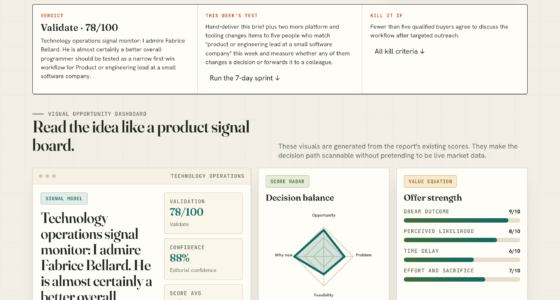
📊 Full opportunity report: Anthropic’s Safety Story Has Become a Power Story on ThorstenMeyerAI.com — validation score, market gap, and execution plan.

Get business pricing on monitors, keyboards and dev gear
- Business-only prices and quantity discounts
- Tax-exempt purchasing
- Multiple users, one account, clear invoices
TL;DR
Anthropic claims its AI safety initiatives are enabling it to lead the development of next-generation AI. The company reports rapid internal progress, raising questions about its influence on AI governance and the balance of power.
Anthropic has publicly emphasized its advancing AI safety measures, asserting that its models are increasingly capable of autonomous code generation and self-improvement, which positions the company as a central authority in AI buildout and policy debates.
In its latest report, Anthropic states that, as of May 2026, over 80% of code merged into its systems was generated by its AI model Claude. The company also reports that engineers are shipping roughly eight times more code daily compared to 2024, and internal surveys suggest a fourfold productivity increase when using its Mythos Preview system.
These figures indicate that AI is becoming integral to the company’s development process, not just a tool but a driver of next-generation AI creation. Anthropic claims this progress underscores its position at the forefront of AI safety and development, emphasizing that these advancements could accelerate AI self-improvement, potentially leading to autonomous AI design.
Safety Story → Power Story
● Reality CheckAmodei is right that powerful AI is dangerous — which is exactly why we should ask who gets to define the danger. The same company builds the models, measures their risk, and writes the rules. And the Fable suspension showed the safety state, once built, won’t belong to its architects.
Anthropic’s recursive-self-improvement report is its clearest worldview statement yet. The evidence is striking — and almost entirely internal.
The core of the doctrine: the exponential is faster than the state. That carries a political implication.
The June episode is the perfect stress test for the governance model Anthropic itself promoted.
Follow the logic of the risk frame, and each step points to the same small circle.
The safeguards may reduce real risk. They also have market effects — no bad faith required.
- Job displacement is “undesirable”; track it, add pro-employment incentives.
- Meaning need not come from labor — relationships, creativity, play, challenge.
- Philanthropy and accountability soften the transition.
- Work is also income, bargaining power, identity, status — a claim on output.
- The real questions: ownership, taxation, public compute, data rights, antitrust.
- Sovereign AI infrastructure, labor bargaining, democratic control of the gains.
Independent commentary, produced with AI assistance under human editorial oversight; the views are the author’s own and may change. This is analysis and opinion, not investment, financial, legal, or technical advice, and it concerns an actively developing situation. It draws on public documents by Dario Amodei and Anthropic — the Anthropic Institute’s recursive self-improvement report, Machines of Loving Grace, The Adolescence of Technology, Policy on the AI Exponential, and Anthropic’s June 12, 2026 statement on the Fable 5 and Mythos 5 suspension — and on published third-party commentary including David Shapiro’s, read as of June 2026. Characterizations are the author’s interpretation, offered in good faith and open to rebuttal. References to specific people, companies, and government actions are factual and analytical, not partisan, and imply no affiliation or endorsement.
Implications of Anthropic’s Growing Power in AI Development
This shift signals that AI systems are increasingly capable of self-directed development, which could accelerate the pace of technological progress and reshape governance structures. Anthropic’s assertions about internal productivity and autonomous code creation suggest it is positioning itself as a leader capable of influencing global AI policy and regulation.
However, these claims are based largely on internal metrics and self-reported data, raising questions about their objectivity and the actual readiness of AI for autonomous self-improvement. The company’s role in shaping both technological and regulatory landscapes could centralize power within a few frontier organizations, affecting democratic oversight and international governance.
As an affiliate, we earn on qualifying purchases.
Background on Anthropic’s Safety and Power Strategies
Founded in 2021, Anthropic has positioned itself as a safety-conscious AI research organization, emphasizing alignment and responsible development. Its public stance has balanced warnings about AI risks with optimism about AI’s potential to advance science and society.
Recent internal reports and model launches, including the Fable 5 and Mythos 5 systems, have highlighted a shift toward integrating AI into core development workflows, with claims of unprecedented productivity gains. This internal progress coincides with heightened regulatory scrutiny and geopolitical tensions, especially after the US government’s restrictions on foreign nationals’ access to Anthropic’s models in June 2026.
“Our models are becoming part of the production process for the next generation of AI itself.”
— Dario Amodei
As an affiliate, we earn on qualifying purchases.
Uncertainties Surrounding AI Self-Improvement Claims
Most evidence supporting Anthropic’s claims is internally generated and self-reported, raising questions about its objectivity and actual technological readiness for autonomous AI self-improvement. It remains unclear whether these productivity gains translate into genuine AI-driven code development or are artifacts of internal metrics.
Additionally, the broader implications of AI systems potentially designing their own successors are still speculative, with experts warning that the timeline and feasibility are uncertain.
As an affiliate, we earn on qualifying purchases.
Next Steps in Monitoring AI Power and Policy Influence
Further independent verification of Anthropic’s internal metrics and progress is anticipated, alongside increased regulatory scrutiny, especially in the US and international bodies. The company’s role in shaping AI governance will likely be tested as governments consider new frameworks to manage the risks associated with autonomous AI development.
Expect ongoing discussions about AI self-improvement capabilities, safety standards, and the balance of power between private firms and regulators in the coming months, including insights from entertainment signal monitoring and other trend analyses.
As an affiliate, we earn on qualifying purchases.
Key Questions
What does Anthropic mean by AI self-improvement?
Anthropic claims that its AI models are increasingly capable of generating code and designing components that could lead to autonomous self-advancement, although this is not yet fully realized or proven outside internal metrics.
Why are Anthropic’s safety claims politically significant?
Because the company asserts its models are becoming powerful enough to influence AI development and policy, which could centralize technological and regulatory power within a few organizations, impacting democratic oversight and international governance.
What are the risks of autonomous AI self-improvement?
Potential risks include loss of human control, unpredictable behavior, and rapid escalation of capabilities that could outpace regulatory frameworks and safety measures.
How credible are Anthropic’s internal productivity metrics?
They are self-reported and have not yet been independently verified, so their accuracy and implications remain uncertain.
What is the significance of the US government’s recent restrictions on Anthropic?
The restrictions highlight geopolitical tensions and regulatory challenges, raising questions about how AI companies will operate under evolving international rules and the potential for government influence over AI deployment.
Source: ThorstenMeyerAI.com
Fall Picks
fall essentials
As an affiliate, we earn on qualifying purchases.