
📊 Full opportunity report: Are You Using AI To Detect Near-Misses In Your Warehouse? on IdeaNavigator AI — validation score, market gap, and execution plan.

Get business pricing on monitors, keyboards and dev gear
- Business-only prices and quantity discounts
- Tax-exempt purchasing
- Multiple users, one account, clear invoices
TL;DR
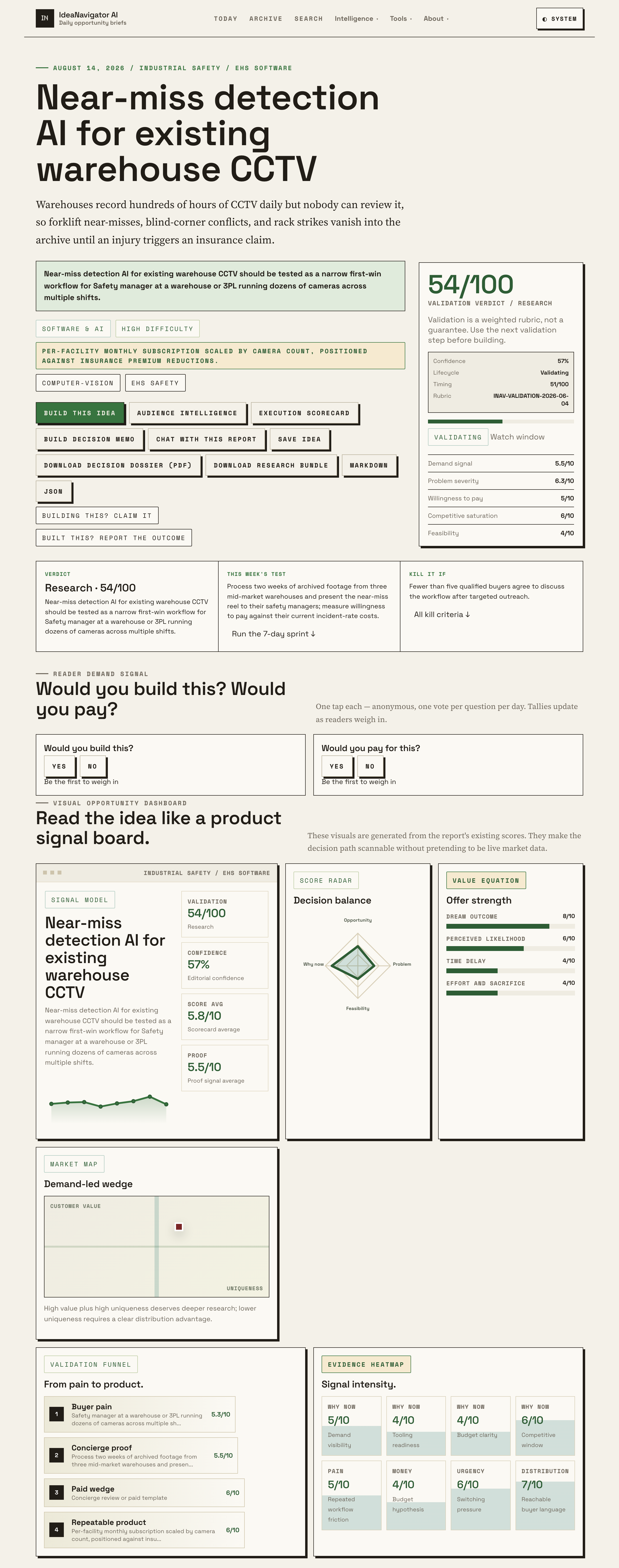
Safety managers at warehouses are trialing AI technology that reviews existing CCTV footage to detect near-misses involving forklifts and pedestrians. This development aims to enhance safety monitoring without extra hardware investments. The initiative is in testing phases, with potential to reduce injuries and insurance costs.
Warehouse safety managers are testing AI software that analyzes existing CCTV footage to identify near-misses involving forklifts and pedestrians. This innovation aims to improve safety monitoring efficiency and reduce workplace injuries, making it a significant development for industrial safety management.
The AI system, developed by IdeaNavigator AI, ingests real-time RTSP camera feeds from existing warehouse CCTV systems. It detects events such as forklift-pedestrian proximity, blind-corner near-misses, rack contact, and speed violations. The system then compiles a weekly digest of video clips, including dates, shifts, and severity levels, to assist safety teams in addressing hazards proactively.
This approach leverages recent advances in computer vision models capable of classifying unsafe interactions using commodity CCTV feeds. The initial testing involves processing two weeks of archived footage from three mid-market warehouses, with safety managers reviewing the near-miss reels to assess the system’s effectiveness and willingness to pay. The model’s deployment aims to complement existing safety protocols and potentially reduce insurance premiums tied to workplace injuries.
Potential Impact on Warehouse Safety and Insurance Costs
This technology could significantly enhance safety oversight by automatically identifying hazards that often go unnoticed in manual reviews of CCTV footage. By documenting near-misses systematically, warehouses can implement more targeted safety measures, potentially reducing injuries and associated costs. Additionally, insurers are increasingly rewarding documented safety initiatives, which could lead to lower insurance premiums for facilities adopting such AI solutions.
warehouse CCTV safety monitoring system
As an affiliate, we earn on qualifying purchases.
As an affiliate, we earn on qualifying purchases.
Growing Use of AI for Industrial Safety Monitoring
Traditionally, warehouse CCTV footage has been underutilized due to the volume of data and the labor-intensive process of manual review. Recent developments in AI and computer vision have made it feasible to analyze these feeds automatically. The concept of near-miss detection is gaining traction as a leading indicator for safety improvements, with insurers and safety regulators encouraging proactive hazard management. The current testing phase reflects a broader industry shift toward integrating AI into safety workflows, especially as companies seek cost-effective ways to enhance workplace safety without extensive hardware upgrades.
“Using existing CCTV feeds for near-miss detection could transform safety management by providing continuous, automated hazard identification.”
— an anonymous researcher
AI-powered near-miss detection camera
As an affiliate, we earn on qualifying purchases.
As an affiliate, we earn on qualifying purchases.
Unconfirmed Aspects of AI Effectiveness and Adoption
It is not yet clear how accurately the AI system will identify near-misses across different warehouse layouts and CCTV setups. The long-term effectiveness, integration challenges, and overall cost savings remain to be validated through extended testing. Additionally, the willingness of safety managers and insurers to adopt and pay for this technology is still being assessed, and regulatory considerations are not yet fully defined.
As an affiliate, we earn on qualifying purchases.
Next Steps in Pilot Testing and Industry Adoption
IdeaNavigator AI plans to expand the pilot to more warehouses, collecting data on accuracy, usability, and cost savings. Based on feedback, the company may refine the AI models and develop scalable deployment packages. Industry stakeholders will watch these developments closely to evaluate the potential for widespread adoption, especially if early results demonstrate significant safety improvements and insurance premium reductions.
As an affiliate, we earn on qualifying purchases.
Key Questions
How does the AI system detect near-misses in warehouse CCTV footage?
The system uses computer vision models trained to classify unsafe interactions, such as forklift-pedestrian proximity, blind-corner conflicts, rack contact, and speed violations, by analyzing existing CCTV feeds in real-time or from archived footage.
What are the benefits of using AI for near-miss detection in warehouses?
Benefits include continuous hazard monitoring without manual review, documentation of safety incidents for insurance and compliance, and the potential to prevent accidents before injuries occur, ultimately improving workplace safety and reducing costs.
Are there any limitations or challenges with implementing this AI system?
Current uncertainties involve the system’s accuracy across diverse warehouse layouts, integration with existing CCTV infrastructure, and acceptance by safety teams and insurers. Further testing is needed to validate its effectiveness and cost benefits.
When will this AI system be available for wider deployment?
Wider deployment depends on the outcomes of ongoing pilot testing. If results are positive, the company plans to scale the solution in the coming months, but a specific launch date has not yet been announced.
Source: IdeaNavigator AI
Fall Picks
fall essentials
As an affiliate, we earn on qualifying purchases.