
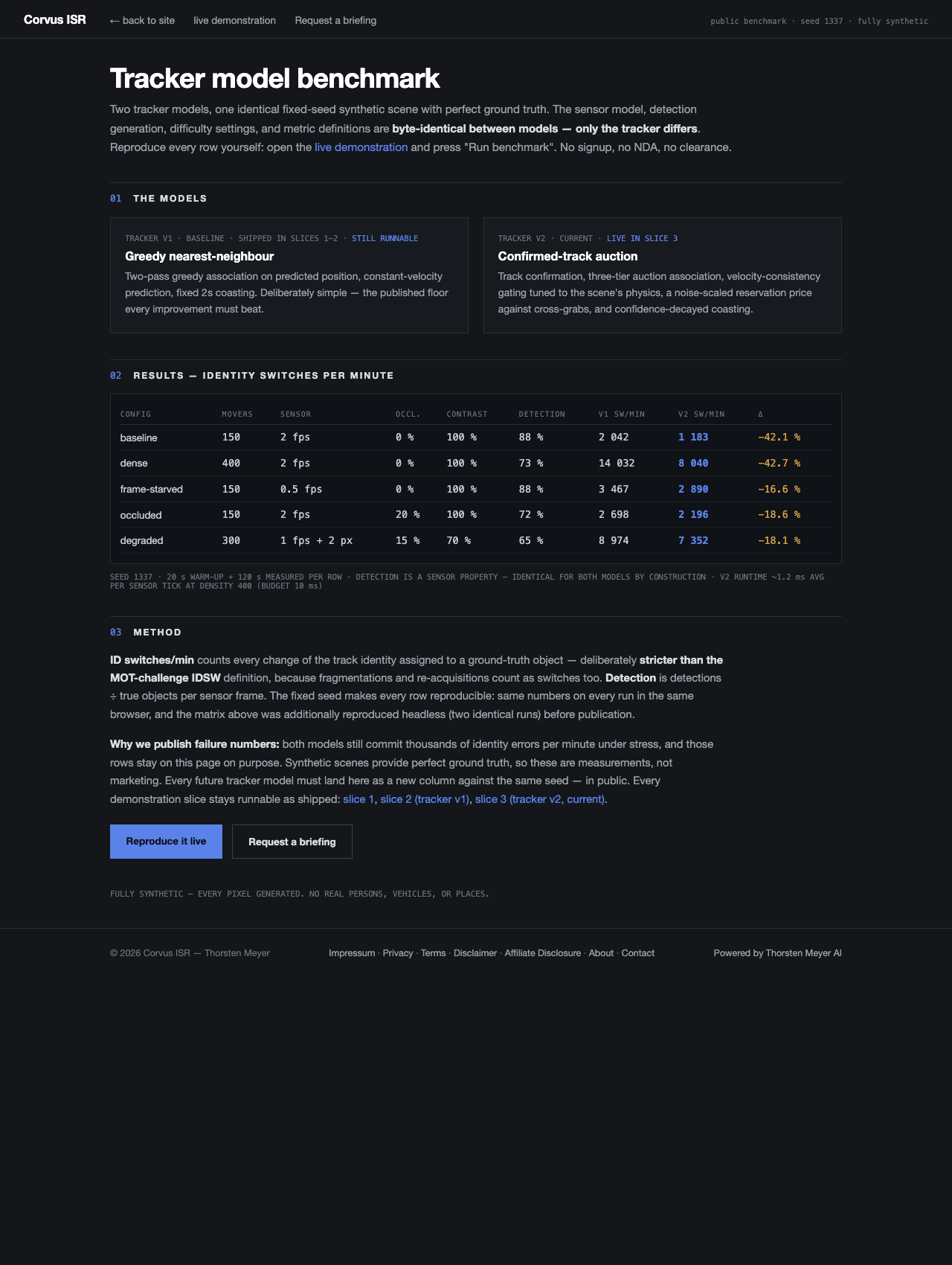
Corvus ISR, a leader in wide-area motion imagery (WAMI) exploitation, has published a detailed public tracker benchmark comparing two distinct tracker models. This benchmark utilizes an identical fixed-seed synthetic scene with perfect ground truth, ensuring a rigorous and reproducible testing environment. The seed 1337, along with a 20-second warm-up and 120 seconds of measured data per row, creates a controlled setting where detection and sensor models are byte-identical, isolating the tracker algorithms as the sole variable.

Get business pricing on monitors, keyboards and dev gear
- Business-only prices and quantity discounts
- Tax-exempt purchasing
- Multiple users, one account, clear invoices
The first model, v1, employs a “greedy nearest-neighbour” approach using a two-pass greedy association, constant-velocity prediction, and a fixed 2-second coasting period. In contrast, v2 introduces a “confirmed-track auction” algorithm, which features a three-tier auction association, velocity-consistency gating, noise-scaled reservation prices, and confidence-decayed coasting. These enhancements aim to reduce errors and improve track continuity, especially under challenging conditions.
Results show significant improvements with v2: for a baseline scenario of 150 movers at 2fps, ID switches per minute dropped from 2,042 to 1,183—a 42.1% reduction. Under denser conditions with 400 movers, the switch count decreased from 14,032 to 8,040, a 42.7% improvement. Additional stress tests, such as frame-starvation at 0.5fps, occlusion at 20%, and degraded conditions with jitter and reduced contrast, all demonstrated approximately 18% reductions in identity errors, confirming the robustness of the new approach.
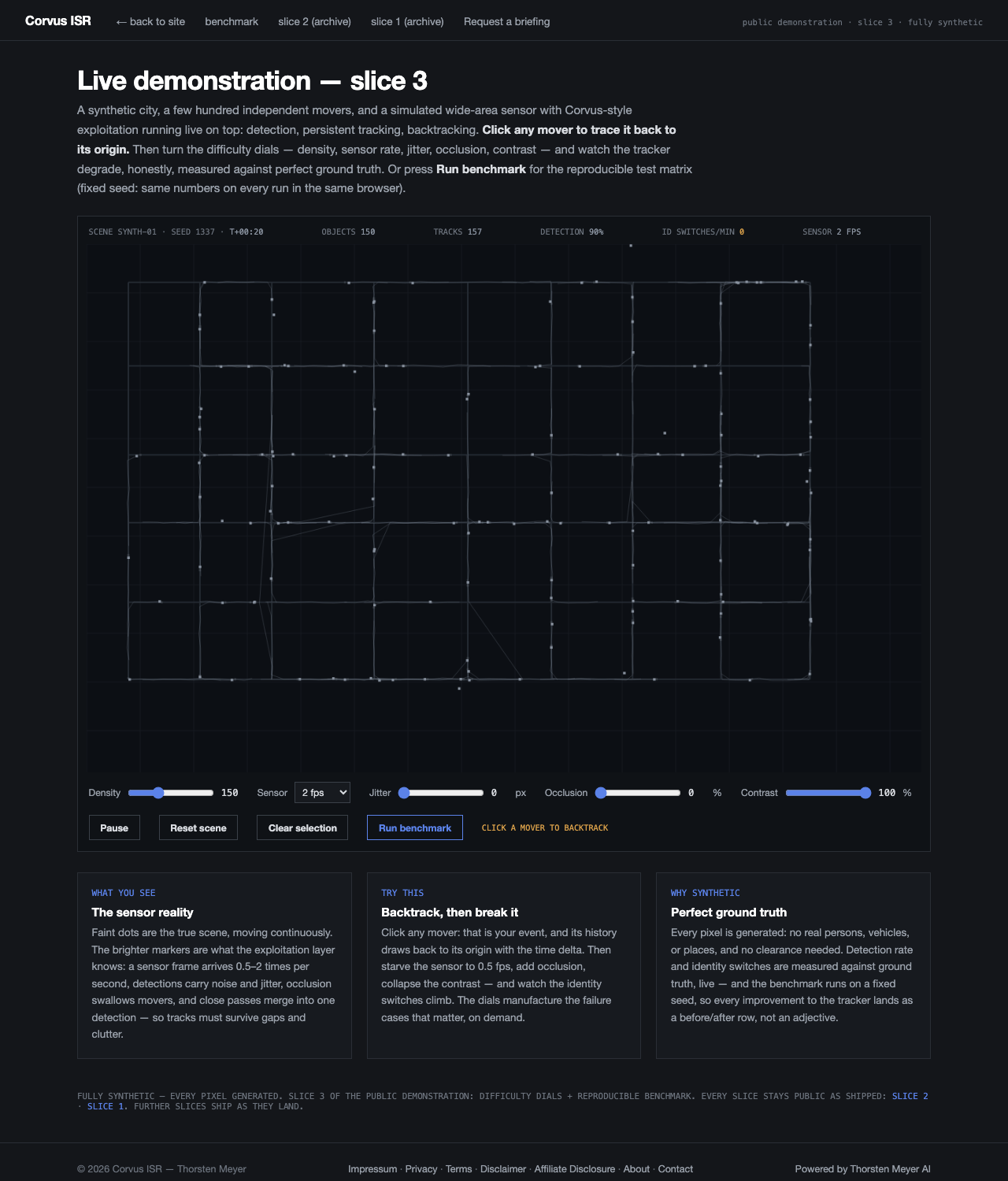
Notably, the ID switch metric used in this benchmark is deliberately strict, counting every change in the track identity assigned to a ground-truth object, including fragmentations and re-acquisitions. This rigorous methodology ensures that published failure numbers are honest and meaningful, especially given that the synthetic scenes provide perfect ground truth. Corvus ISR emphasizes transparency: every future tracker must produce a new public row against the same seed, fostering a culture of measurement over marketing.
From an engineering perspective, v2 demonstrates impressive real-time performance. Averaging around 1.2ms per sensor tick at 400 density, with the worst case about 5ms against a 10ms budget, it is fully capable of browser-based real-time execution. The benchmark can be easily reproduced by anyone through the live demo—simply click “Run benchmark,” with no signup or NDA required. This transparency is further reinforced by the fact that v2 was built by an AI executor under a written acceptance contract and independently reviewed before release.
Every pixel in this synthetic benchmark is computer-generated—no real persons, vehicles, or environments are involved—making it a fully synthetic environment designed explicitly for rigorous testing. These measures illustrate the importance of fixed-seed reproducibility and strict test harnesses for trustworthy evaluation in software development and QA disciplines.
Interested in seeing the improvements firsthand? You can explore the public benchmark results or reproduce the scenario yourself. Run the benchmark now and experience the full transparency of Corvus ISR’s testing methodology.
Popular right now

Vitamix Touch & Go Advance 32-Ounce Bar Blender, White

Apple AirPods Pro 3 Wireless Earbuds with Active Noise Cancellation

KitchenAid Artisan 5-Quart Tilt-Head Stand Mixer, Blue Velvet
As an affiliate, we earn on qualifying purchases.