📊 Full opportunity report: Liquid vs Air Cooling for 24/7 Inference Rigs on ThorstenMeyerAI.com — validation score, market gap, and execution plan.

Get business pricing on monitors, keyboards and dev gear
- Business-only prices and quantity discounts
- Tax-exempt purchasing
- Multiple users, one account, clear invoices
TL;DR
For 24/7 AI inference rigs, air cooling is generally more reliable, cost-effective, and quieter over time. Liquid cooling offers thermal headroom but introduces potential failure points. The choice depends on workload and case constraints.
For continuous AI inference setups running 24/7, air cooling remains the preferred choice due to its simplicity, reliability, and lower total cost of ownership, according to industry experts.
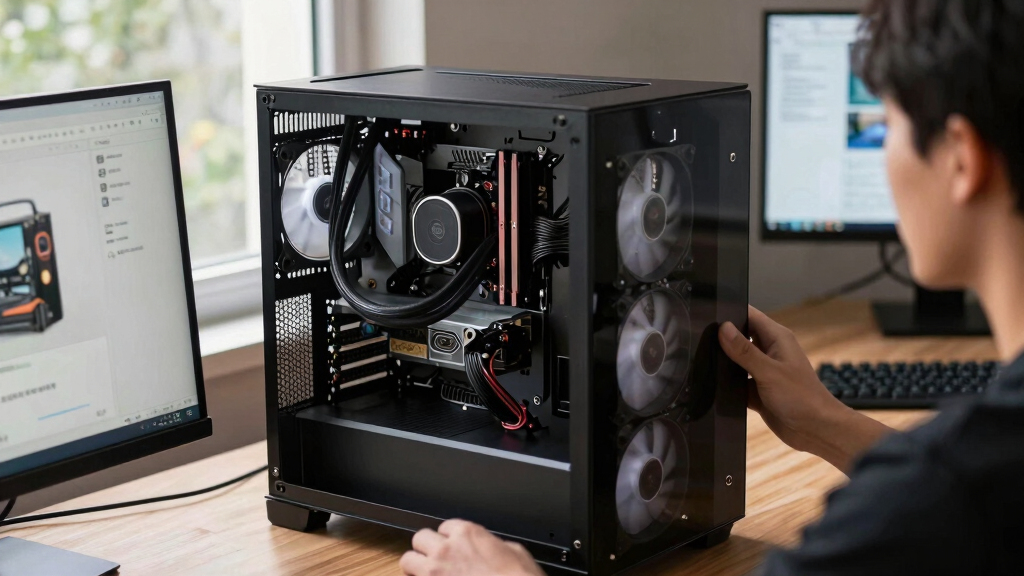
Most high-performance, always-on AI inference rigs opt for air cooling because it involves fewer failure points and requires less maintenance. A quality dual-tower air cooler can dissipate 200–250W, sufficient for many CPUs during sustained loads, and is often quieter than liquid cooling solutions. In contrast, all-in-one (AIO) liquid coolers, while offering higher thermal headroom for the hottest CPUs, depend on a pump that can fail over time, with a typical lifespan of 5–7 years. The coolant in AIOs gradually permeates rubber seals, reducing effectiveness over years and risking leaks, which could damage other components. Despite modern reliability improvements, the pump remains a critical single point of failure, making liquid cooling less ideal for unattended, long-term operation.
Cost is another factor: air coolers are significantly cheaper upfront and over the lifespan, with total ownership costs 2–3 times lower than AIOs. Noise levels also favor air cooling, which often produces less constant hum than the pump noise of AIOs. Maintenance is straightforward—cleaning dust from fins and reapplying thermal paste—whereas AIOs require monitoring for potential leaks or pump failures. When thermal headroom is necessary—for instance, in cases with very hot CPUs or limited case space—large AIOs can handle higher sustained TDPs and fit into compact builds, exporting heat directly outside the case and reducing internal temperatures.
Liquid vs air
for a 24/7 inference rig.
For an always-on machine the question isn’t “which cools better” — it’s which one still works in three years without you thinking about it. That reframing makes air the default for most rigs. Answer three questions in Part 2 to find yours.
- Nothing to fail — fan swaps in minutes
- Lasts a decade+; lower total cost
- Quieter floor — no pump hum (~40–45 dBA)
- Trivial maintenance — wipe & repaste
- Tall — can block RAM, dumps heat in case
- Best headroom — ~360W TDP sustained
- Compact block — fits tight cases, clears RAM
- Exports heat out the radiator & room
- Pump fails at 5–7 yrs; replace whole unit
- Costs 2–3× more over its life; pump hum
- You run it 24/7 and want set-and-forget.
- Your CPU is mainstream-to-high-end (or power-capped).
- A big tower fits your case.
- You value lower cost and a quieter floor.
- Your CPU is too hot for air under sustained all-core load.
- A big tower won’t fit (compact / multi-GPU case).
- You need to export heat out of a warm room.
- RAM clearance is tight.
Reliability and Cost Drive the Choice for 24/7 AI Rigs
Choosing the right cooling solution impacts the long-term stability and operational costs of AI inference systems. Air cooling’s simplicity and durability make it ideal for unattended operation, reducing downtime and repair costs. While liquid cooling offers higher thermal capacity, its potential for failure and higher maintenance needs can jeopardize continuous operation, making it less suitable for long-term, always-on workloads.
As an affiliate, we earn on qualifying purchases.
Cooling Options in AI Workstations and Inference Servers
Industry discussions and testing have consistently shown that for workloads requiring continuous operation, reliability outweighs the marginal thermal benefits of liquid cooling. Most workstation CPUs can be effectively cooled with high-end air coolers, which are proven to last longer and require less oversight. The trend toward larger AIOs is driven by the need to handle hotter CPUs or constrained case environments, but these solutions introduce additional failure points and costs over time.
"For set-and-forget AI inference rigs, the simplicity and reliability of air cooling make it the best choice. Liquid solutions, while appealing for thermal headroom, add complexity and potential failure risks."
— Thorsten Meyer, AI hardware expert
As an affiliate, we earn on qualifying purchases.
Long-Term Reliability of AIOs in 24/7 Use
While modern AIOs are reliable, their lifespan and failure modes under continuous operation are not fully documented over periods exceeding 5–7 years. The gradual loss of coolant and potential seal degradation remain concerns, and real-world long-term data is limited.
As an affiliate, we earn on qualifying purchases.
Monitoring and Future Testing of Cooling Solutions
Industry experts plan to conduct long-term testing of both cooling types in real-world AI inference scenarios to better understand failure rates and maintenance needs. Advances in pump technology and seal materials may also influence future reliability assessments.
As an affiliate, we earn on qualifying purchases.
Key Questions
Is liquid cooling worth it for a 24/7 AI inference rig?
Generally, no. Unless your CPU consistently exceeds the thermal capacity of air coolers or space constraints prevent large air coolers, air cooling offers better reliability and lower costs for continuous operation.
How often do AIO coolers need maintenance or replacement?
Most AIOs are designed to last 5–7 years, but the pump and seals can degrade sooner, especially under constant load, increasing the risk of leaks or reduced cooling performance.
Can I upgrade my cooling solution later?
Yes, but replacing an AIO with an air cooler or vice versa involves disassembly and compatibility considerations. For long-term reliability, choosing the right initial solution is advisable.
What about noise levels in continuous operation?
High-quality air coolers often produce less noise under load than AIOs, which have a constant pump hum. This can improve the working environment over years of operation.
Are there hybrid cooling options for AI rigs?
Some systems combine air and liquid cooling, but these tend to add complexity without clear advantages for 24/7 workloads, and reliability concerns remain similar to pure liquid solutions.
Source: ThorstenMeyerAI.com
Fall Picks
fall essentials
As an affiliate, we earn on qualifying purchases.