
📊 Full opportunity report: The City That Watches Itself: The Living Digital Twin, and the God’s-Eye View We’re Building on ThorstenMeyerAI.com — validation score, market gap, and execution plan.

Get monitors, keyboards and dev gear delivered free — and shop member deals
- Fast, free delivery on millions of items
- Access to Prime Big Deal Days deals on October 6–7
- Prime Video, Amazon Music and more included
TL;DR
Cities are creating dynamic digital twins that mirror real-time urban activity using advanced sensors and AI. These models enhance planning but also raise significant surveillance concerns. The development is ongoing and rapidly evolving.
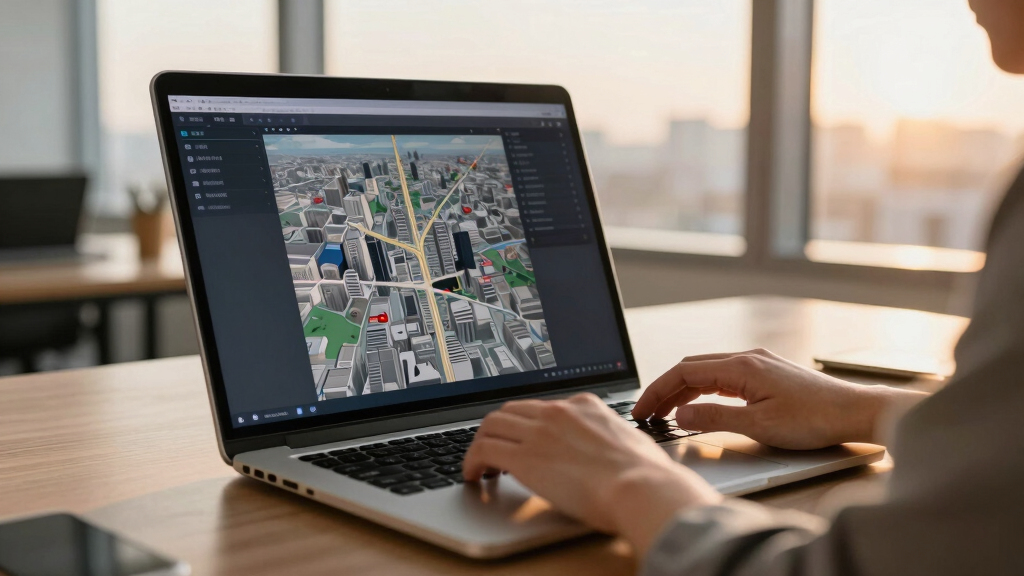
Urban digital twins are evolving into real-time, AI-powered models that can monitor, simulate, and answer questions about city activity with unprecedented detail. This development combines sensor networks, satellite data, and advanced AI to create a living replica of urban environments, transforming city management and surveillance.
These digital twins are virtual, three-dimensional representations of cities that integrate data from IoT sensors, satellite imagery, GIS, and utility networks. They reflect real-time conditions and support predictive simulations, helping planners optimize infrastructure, traffic, and resource management. Singapore’s Virtual Singapore exemplifies this, modeling every building, road, and utility with live overlays, and extending underground to map subsurface infrastructure.
The recent technological convergence includes Wide-Area Motion Imagery (WAMI), which captures and archives every moving object in the city, and synthetic-aperture radar (VigilSAR), which sees through weather and darkness. When fused with frontier AI capable of understanding complex data, these sensors enable a continuously updated, queryable city model—an ‘oracle’ that can answer detailed questions in natural language and simulate scenarios like levee failures or traffic disruptions.
While these advancements promise improved urban planning, disaster response, and rural management, they also introduce significant surveillance capabilities. Cities can now monitor individual vehicles and pedestrians, raising privacy and sovereignty concerns, especially if such data is stored or processed abroad or controlled by foreign entities.
The city that watches itself: the living digital twin, and the god’s-eye view we’re building
Soon most cities will exist twice — once in concrete, once as a live data model you can rewind, simulate, and question in plain language. Persistent sensing + frontier AI turn the planner’s digital twin into an oracle. The most useful thing we’ve built — and the most powerful surveillance instrument. Both at once.
- Plan better — cities & rural: traffic, zoning, energy, land use
- Emergency response — route crews, one live picture, ~50% faster
- Disaster resilience — simulate, track live, assess damage in hours
- Mass surveillance — track everyone, retroactively, forever
- Pattern-of-life — AI links movements, infers associations
- Social control — no warrant, no suspicion (cf. Baltimore, 2021 ruling)
We’re building a city that watches itself, remembers everything, and can be asked anything. The technology won’t choose between saving lives and ending privacy — we will, through the rules we write now, while the twin is still under construction and the defaults haven’t yet hardened into permanence. WAMI and the living twin open our lives to a view from the heavens that, from the dawn of civilization until a heartbeat ago, was reserved for gods and stars. The question is no longer whether we can see everything — it’s who gets to look, and who watches the watchers.
Impacts of Autonomous, AI-Driven Urban Monitoring
The development of AI-enhanced digital twins represents an advancement in urban management and monitoring technologies. These models facilitate improved planning, quicker emergency responses, and more efficient resource utilization. However, their ability to support continuous, detailed observation of urban environments also raises concerns related to privacy, civil liberties, and sovereignty. The potential for misuse of surveillance capabilities necessitates careful oversight, data security measures, and international cooperation.
For residents, this could mean more efficient city services but also increased levels of observation. Policymakers are tasked with balancing the advantages of these technologies with the protection of individual rights and national security considerations.
IoT sensors for smart city infrastructure
As an affiliate, we earn on qualifying purchases.
As an affiliate, we earn on qualifying purchases.
Technological Foundations and Recent Advances in Urban Digital Twins
Urban digital twins have been under development for several years, with pilot projects such as Singapore’s Virtual Singapore demonstrating their potential for urban planning and infrastructure management. The core idea involves creating a static, three-dimensional map of a city that is integrated with real-time data streams.
Recent technological advancements include the integration of wide-area sensing technologies like WAMI, which can track moving objects across an entire urban area and archive the data for analysis. When combined with all-weather radar and high-resolution satellite imagery, these sensors generate comprehensive, layered datasets. The introduction of advanced AI models capable of understanding and querying this data in natural language has expanded the functionality of digital twins from static visualizations to interactive, data-driven tools.
These developments have supported the deployment of operational city digital twins in multiple urban centers, enhancing both planning and monitoring capabilities.
“The convergence of sensors and AI is enabling the development of dynamic city models that can be queried and simulated in real time.”
— Thorsten Meyer, AI researcher
As an affiliate, we earn on qualifying purchases.
Legal and Security Risks of Self-Monitoring Cities
The extent of adoption and the regulatory landscape for these surveillance tools remain uncertain. Discussions around privacy protections, data sovereignty, and international governance are ongoing, and the balance between utility and civil liberties continues to be evaluated.As an affiliate, we earn on qualifying purchases.
Future Developments and Policy Challenges for Urban Digital Twins
As these technologies mature, their adoption is expected to increase across various cities globally. Policymakers and technologists will need to develop frameworks to regulate data access, security, and privacy. Advances in AI may also lead to increased automation in urban management, which presents both opportunities and challenges for oversight and accountability.
As an affiliate, we earn on qualifying purchases.
Key Questions
How do digital twins improve city planning?
They enable simulation of urban changes, prediction of potential outcomes, and optimization of infrastructure development, which can help reduce costs and improve accuracy.
What are the privacy concerns associated with city digital twins?
Continuous data collection and monitoring can track individual movements and behaviors, raising issues related to surveillance, data security, and civil liberties.
Can these technologies be controlled or limited by governments?
Regulatory approaches are still developing; some governments may impose restrictions or guidelines, but international standards are not yet established.
Are these city models accessible to the public?
Access is generally limited to authorized agencies and officials, though future policies may promote increased transparency and public access.
What happens if the AI or sensors fail or are compromised?
Failures or breaches could disrupt city operations or compromise privacy, underscoring the importance of security measures and oversight.
Source: ThorstenMeyerAI.com
Halloween Picks
halloween
As an affiliate, we earn on qualifying purchases.