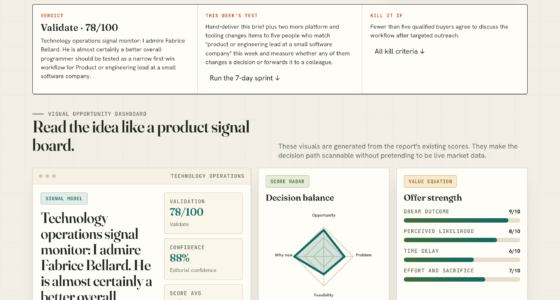

📊 Full opportunity report: The Inner Workings Of Claude’s AI Text Watermarking System on ThorstenMeyerAI.com — validation score, market gap, and execution plan.

Get monitors, keyboards and dev gear delivered free — and shop member deals
- Fast, free delivery on millions of items
- Access to Prime Big Deal Days deals on October 6–7
- Prime Video, Amazon Music and more included
TL;DR
Anthropic announced that future Claude AI models will incorporate an invisible watermark based on a secret key, as detailed in the internal article about watermarking AI text enabling detection of AI involvement without altering text. The system aligns with EU transparency rules and leverages a statistical pattern rather than hidden characters.
Anthropic has publicly explained how future versions of its Claude AI models will embed an invisible statistical watermark using a secret key during text generation. This development aims to meet European Union transparency regulations and provide a detectable signal for authorized detectors, without inserting visible or hidden markers into the text. The system does not alter the content’s appearance or add extra tokens, maintaining text quality while enabling AI involvement detection.
The watermarking method, based on a version of Google DeepMind’s SynthID-Text approach, involves using a secret key combined with preceding words to influence the randomness in word selection when multiple options are equally appropriate. For a technical overview, see How Claude’s Text Watermarking Works – Anthropic. Over long passages, this creates a statistical pattern that detectors with access to the key can compare with expected Claude outputs. Anthropic emphasizes that no metadata, hidden characters, or extra tokens are added—the mark is purely statistical and invisible to readers.
Supported models, including Claude, Claude API, Claude Code, and others, will apply this watermark, with plans for global deployment. Learn more about the implications of watermarking in the original analysis on AI trust and watermarking. The system is designed to be compatible with images in PNG, JPG, and SVG formats through cryptographically signed C2PA provenance metadata. The company states that the watermark has negligible impact on speed and does not carry any user, organization, or conversation identifiers. However, independent evaluations of the system’s effectiveness and detection thresholds have not yet been published.
Implications for AI Detection and Regulation
This development is significant because it offers a provider-backed, technical method to identify AI-generated text, supplementing existing stylistic detection software. It aligns with EU regulations mandating AI transparency and could influence how AI involvement is disclosed across industries such as publishing, education, and compliance. The system’s ability to signal probable AI involvement without proving authorship or origin raises questions about its reliability and legal implications, especially given that detection effectiveness and false-positive rates remain undisclosed.
As an affiliate, we earn on qualifying purchases.
EU Regulations Drive AI Watermarking Adoption
The announcement follows the EU’s AI Act, specifically Article 50 and the Code of Practice on Transparency of AI-Generated Content, which came into effect on August 2, 2026. These regulations require AI providers serving the European market to implement marking systems that indicate AI involvement. Anthropic’s approach is part of broader efforts by AI companies to comply with legal transparency demands while maintaining user privacy and content integrity. The company plans to extend watermark support to older Claude models in the coming months, although current responses do not all carry the mark.
“Nothing is added to the text and there are no hidden characters.”
— Anthropic spokesperson
AI content authenticity verification software
As an affiliate, we earn on qualifying purchases.
As an affiliate, we earn on qualifying purchases.
Detection Accuracy and Practical Limitations
Anthropic has not published specific detection thresholds, false-positive or false-negative rates, or independent evaluations of its watermarking system. The effectiveness may vary depending on the length of the text, extent of editing, or translation, which can weaken or remove the statistical signal. A positive detection indicates probable AI involvement but does not confirm authorship or origin, especially if the text is heavily edited or rewritten.
As an affiliate, we earn on qualifying purchases.
Upcoming Detection Tools and Broader Deployment
Anthropic plans to release a dedicated API for detecting the watermark, publish technical guidelines, and include marking in older Claude models over the next few months. These steps aim to enhance transparency and detection reliability, though the effectiveness of the system in real-world scenarios remains to be fully tested and validated. The company also intends to clarify detector access, supported platforms, and interpretation of results in future documentation.
As an affiliate, we earn on qualifying purchases.
Key Questions
Can users see Claude’s text watermark?
No. The watermark is an imperceptible statistical pattern that contains no visible label or hidden characters.
Does the watermark identify the Claude user?
No. It only signals probable Claude involvement, not who submitted the prompt or owns the content.
Can editing remove the watermark?
Light editing or paraphrasing may preserve the signal, but extensive rewriting or translation can weaken or eliminate it.
Does detection prove Claude authored the text?
No. It indicates probable AI involvement but does not establish authorship or responsibility.
Source: ThorstenMeyerAI.com
Halloween Picks
halloween
As an affiliate, we earn on qualifying purchases.