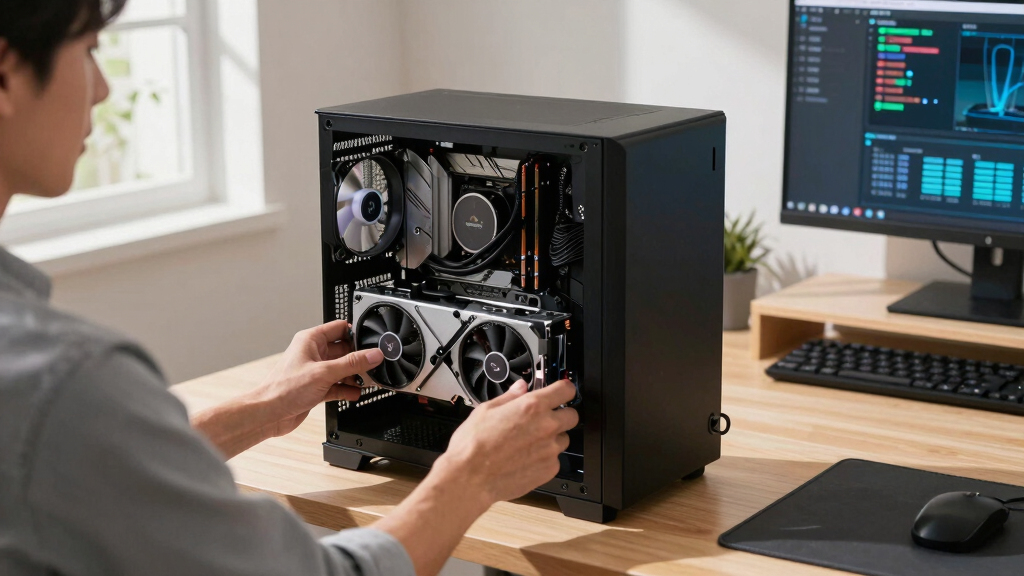

📊 Full opportunity report: Undervolting Your GPU for Local Inference: Lower Heat, Same Tokens/sec on ThorstenMeyerAI.com — validation score, market gap, and execution plan.

Get business pricing on monitors, keyboards and dev gear
- Business-only prices and quantity discounts
- Tax-exempt purchasing
- Multiple users, one account, clear invoices
TL;DR
Undervolting your GPU through power limiting can cut heat and noise substantially during local AI inference, with minimal impact on performance. This approach is simple, reversible, and highly effective for inference workloads.
Recent tests and expert guidance confirm that undervolting GPUs via power limiting during local AI inference significantly reduces heat and noise without notable performance loss.
Modern GPUs, including NVIDIA’s RTX series, are typically factory-tuned for maximum benchmark performance, often resulting in high heat output due to conservative voltage settings. However, during AI inference, the GPU’s bottleneck is often memory bandwidth rather than compute power. This means that reducing power and voltage through simple settings like power limiting does not substantially impact tokens per second.
Recent measurements on an RTX 4090 show that lowering the power limit from 100% (390W) to around 70% (300W) results in only a 6-7% performance decrease while dropping temperature by about 5°C and power consumption by 90W. Similar results are observed with higher-tier cards like the RTX 5090, where a 25% power reduction causes minimal performance loss (~2%) but significantly reduces heat and noise.
This approach is reversible, safe, and requires no complex modifications. The recommended starting point is using tools like MSI Afterburner to set a power cap, which automatically adjusts voltage and clocks to stay within the limit. For those seeking further optimization, undervolting the GPU’s voltage-frequency curve directly can yield better efficiency but requires more technical skill and stability testing.
Undervolt for inference:
lower heat, same tokens/sec.
Local inference is memory-bound — the GPU core spends much of its time waiting on VRAM, not maxing out compute. So when you cap its power, heat falls fast while throughput barely moves. Drag the slider in Part 2 to see the trade for yourself.
(the real limit)
(often waiting)
you pay for in heat
| Power limit | Power draw | Temp | Speed kept | Efficiency |
|---|---|---|---|---|
| 100% (stock) | 390 W | 72°C | 100% | baseline |
| 80% | 330 W | 70°C | 98.6% | +17% |
| 70%recommended | 300 W | 67°C | 93.4% | +22% |
| 60% | 260 W | 62°C | 91.5% | +37% |
| 55%peak efficiency | 240 W | 60°C | 89.2% | +45% |
| 50% | 220 W | 58°C | 82.6% | +46% |
| 40% (too far) | 180 W | 52°C | 61.3% | falls off |
- One slider, 100% → 70%. The card reduces voltage and clocks on its own.
- Can’t damage anything — you’re restricting the card, not pushing it.
- No stability testing needed.
- Captures most of the available benefit.
- Edit the voltage-frequency curve — hold a clock at lower voltage.
- Target around 0.9–0.95V to start; better chips go lower.
- Keeps more performance for the same heat cut.
- Test under your real workload — a curve stable for 10 min can fail on hour 3.
MSI Afterburner (works on any brand). Headless Linux: nvidia-smi or LACT.sudo nvidia-smi -pl 300.Impact of Power Limiting on AI Inference Efficiency
Applying power limits during AI inference workloads offers a straightforward way to reduce heat, noise, and power consumption without sacrificing near-maximum throughput. This is especially valuable for long-running inference tasks, where thermal management and system noise are concerns. It allows users to optimize their existing hardware for better efficiency and quieter operation, potentially extending hardware lifespan and reducing energy costs.
As an affiliate, we earn on qualifying purchases.
GPU Factory Tuning and Workload Bottlenecks in AI Inference
GPUs are factory-tuned for maximum benchmark performance, often with conservative voltage settings to ensure stability across all units. During AI inference, the main bottleneck is typically memory bandwidth rather than compute power, meaning the GPU core does not need to run at full speed. This disconnect allows for safe undervolting and power limiting to improve efficiency without impacting throughput significantly.
Previous guides focused on gaming performance, where lowering core clocks can cause noticeable frame drops. In contrast, inference workloads are less sensitive to core speed reductions, enabling more aggressive power management strategies.
"Most inference workloads are memory-bound, so reducing GPU power and voltage can cut heat and noise with minimal performance impact."
— Thorsten Meyer, AI tuning expert
GPU undervolting tool MSI Afterburner
As an affiliate, we earn on qualifying purchases.
As an affiliate, we earn on qualifying purchases.
Uncertainties in Long-Term Stability and Compatibility
While current data shows that power limiting is safe and effective for inference workloads, long-term stability and hardware longevity under aggressive undervolting are still being studied. Variations between GPU models and manufacturing batches may also affect results. Users should proceed cautiously and monitor system stability after adjustments.
As an affiliate, we earn on qualifying purchases.
Next Steps for Optimizing GPU Performance and Efficiency
Future developments may include more refined undervolting profiles, manufacturer-validated tools for easier power management, and comprehensive testing across different GPU models. Users interested in further optimization should consider experimenting with undervolting beyond simple power limits, but only after establishing system stability and performance consistency.
As an affiliate, we earn on qualifying purchases.
Key Questions
Does undervolting affect GPU lifespan?
Undervolting generally reduces heat and stress on GPU components, which can extend lifespan. However, aggressive undervolting should be tested carefully to ensure stability over time.
Can I use undervolting for gaming as well?
Undervolting for gaming is more delicate because games are often compute-bound, and reducing core clocks can impact frame rates. The method described here is optimized for inference workloads.
What tools do I need to undervolt or limit power?
Tools like MSI Afterburner for Windows can set power limits easily. For undervolting, more advanced tools that modify voltage-frequency curves are required, along with stability testing software.
Is this method safe for all GPU models?
While generally safe, results may vary between models and manufacturers. Always monitor system stability and temperatures after adjustments.
How much performance do I lose by undervolting?
On inference workloads, performance loss is typically under 10%, often closer to 2-5%, especially when using power limiting techniques.
Source: ThorstenMeyerAI.com
Fall Picks
fall essentials
As an affiliate, we earn on qualifying purchases.