
🔍 Read the full analysis: What Makes NeoMME The Leading Multimodal-native And Multilingual AI Encoder on ThorstenMeyerAI.com

Get business pricing on monitors, keyboards and dev gear
- Business-only prices and quantity discounts
- Tax-exempt purchasing
- Multiple users, one account, clear invoices
TL;DR
Hugging Face has launched NeoMME, a family of 260M- and 800M-parameter multimodal encoders that process text and images within a single Transformer. Early reports suggest competitive retrieval performance and significant storage savings, but independent validation is pending.
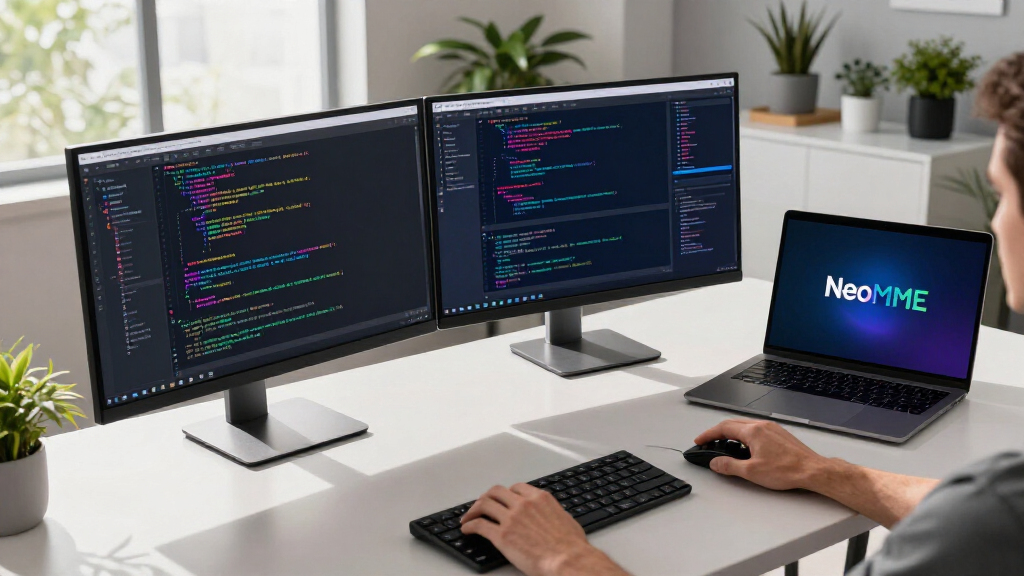
Hugging Face has introduced NeoMME, a family of multimodal encoders designed to process text tokens and raw image patches within a single bidirectional Transformer architecture. Learn more about multimodal models in the original analysis. The models, available under the Apache 2.0 license, aim to simplify multilingual visual-document retrieval by eliminating the need for separate vision and language components, offering potential improvements in efficiency and deployment.
NeoMME comes in two sizes: 260 million and 800 million parameters, supporting a 16,384-token context window and dynamic image resolution. For more technical details, see the original analysis of NeoMME’s architecture. Unlike traditional systems that rely on separate vision encoders and language models, NeoMME processes images by dividing them into non-overlapping 32-by-32 pixel patches projected through a small multilayer perceptron, then integrated into the same computational path as text. This shared path is intended to streamline pretraining, fine-tuning, and inference, reducing computational overhead.
Both models were trained from scratch using a masked discrete-diffusion objective, where text tokens are masked at varying rates to encourage reliance on visual evidence. The training dataset included approximately 524 billion input tokens, covering multilingual text, code, mathematics, natural images, and document images. For visual-document retrieval, Hugging Face fine-tuned NeoMME into a variant called NeoMME-Retriever, which directly ranks page images, preserving layout and visual elements without OCR. Early reports state that NeoMME encodes about 51 pages per second on an NVIDIA L40S GPU, roughly doubling the throughput of comparable models, and achieves a significant reduction in storage requirements—up to 255-fold—while maintaining high retrieval quality. This efficiency is discussed in detail in the original analysis.
Impact on Multilingual Visual-Document Retrieval Efficiency
NeoMME’s architecture could significantly influence how multilingual visual-document retrieval systems are built and deployed. By consolidating image and text processing into a single encoder, it reduces system complexity, potentially lowering deployment costs and increasing processing speed. The reported throughput and storage savings address key bottlenecks in large-scale document retrieval, especially for applications requiring real-time responses or operating on resource-constrained hardware. If these early performance claims hold under independent testing, NeoMME could set a new standard for efficient, integrated multimodal retrieval systems.
As an affiliate, we earn on qualifying purchases.
Background on Multimodal and Multilingual Retrieval Systems
Traditional visual-document retrieval systems often rely on separate vision encoders—such as CLIP or SigLIP2—and language models, which are combined through various projection layers. These systems typically process images and text separately, then fuse features for retrieval tasks. Recent advances have sought to improve efficiency and accuracy, but many still depend on complex pipelines involving optical character recognition (OCR), multiple model components, and separate training processes. Hugging Face’s NeoMME aims to unify these steps by training a single, shared encoder from scratch, processing both modalities simultaneously. This approach builds on prior work like ModernVBERT, which used an efficient bidirectional text architecture but retained a separate vision component, and earlier multimodal models that often relied on pretraining separate encoders before integration.
“NeoMME simplifies multimodal processing by using a shared encoder for text and images, reducing complexity and improving throughput.”
— Hugging Face team
As an affiliate, we earn on qualifying purchases.
Performance Validation and Real-World Deployment Challenges
Currently, the performance figures provided by Hugging Face are vendor-reported and have not yet undergone independent validation. It remains unclear how NeoMME will perform across different hardware configurations, document types, languages—including handwritten or low-quality scans—and in real-world deployment conditions. Details about end-to-end operational costs, such as preprocessing, index construction, memory use, and query latency, are also not fully disclosed. The robustness of the model’s retrieval quality on complex or visually rich documents is still unverified.
As an affiliate, we earn on qualifying purchases.
Independent Testing and Broader Benchmarking of NeoMME
The immediate next step involves external researchers and developers evaluating the released checkpoints through Hugging Face Transformers. Expect to see independent benchmarks measuring latency, memory usage, retrieval accuracy across various document types and languages, and deployment scenarios. Further, comparisons with OCR-based systems, dual-tower encoders, and generative models will clarify NeoMME’s practical advantages. As more results emerge, the community will determine whether NeoMME’s reported efficiency and quality improvements can be generalized beyond initial tests.
AI model for text and image analysis
As an affiliate, we earn on qualifying purchases.
As an affiliate, we earn on qualifying purchases.
Key Questions
What makes NeoMME different from existing multimodal encoders?
NeoMME combines text and image processing into a single shared encoder, eliminating the need for separate vision and language models, which simplifies architecture and potentially improves efficiency.
Can NeoMME handle multiple languages and document types?
Yes, the models are trained on multilingual data, including natural language, code, and mathematical content, as well as natural and document images, aiming for broad multilingual visual-document retrieval.
What are the reported performance benefits of NeoMME?
Early reports suggest higher throughput—about twice as fast as comparable models on certain hardware—and significant storage savings—up to 255-fold—while maintaining high retrieval accuracy.
Has NeoMME been independently validated?
No, performance results are currently vendor-reported. Independent testing is needed to confirm these claims across different settings and datasets.
What are the potential applications of NeoMME?
NeoMME could be used for multilingual document search, visual question answering, visual retrieval in legal or scientific documents, and other applications requiring integrated text-image understanding.
Primary source: Hugging Face · via ThorstenMeyerAI.com
Halloween Picks
halloween
As an affiliate, we earn on qualifying purchases.