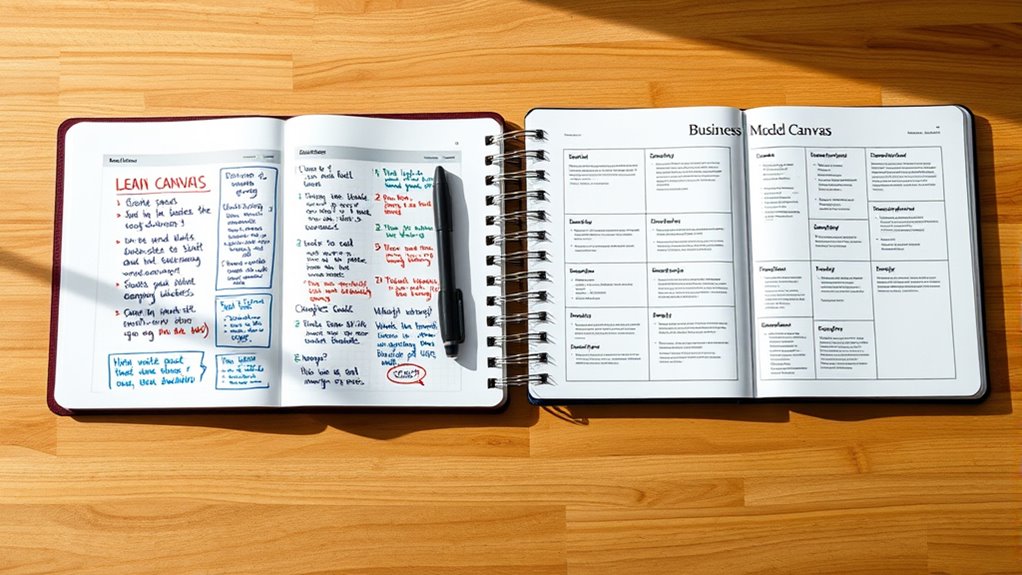

Choosing between the Lean Canvas and the Business Model Canvas depends on your startup’s stage and goals. If you need rapid testing and value flexibility, lean toward the Lean Canvas, ideal for early validation and innovation. If your focus is detailed planning and scaling, the Business Model Canvas provides a broader view of your business components. Understanding their differences helps you pick the right tool for your needs, and exploring further reveals how to maximize each one effectively.
Open a free Amazon Business account
Business pricing, bulk buying and tax-exempt orders.
As an affiliate, we earn on qualifying purchases.
Key Takeaways
- Choose Lean Canvas for early-stage startups focused on rapid testing and customer validation.
- Opt for Business Model Canvas when aiming for detailed strategic planning and scaling.
- Lean Canvas emphasizes quick, single-page iteration; Business Model Canvas offers comprehensive business structure.
- Use Lean Canvas to identify riskiest assumptions and pivot quickly; Business Model Canvas for operational clarity.
- Match the tool to your business stage: Lean Canvas for innovation; Business Model Canvas for growth and maturity.
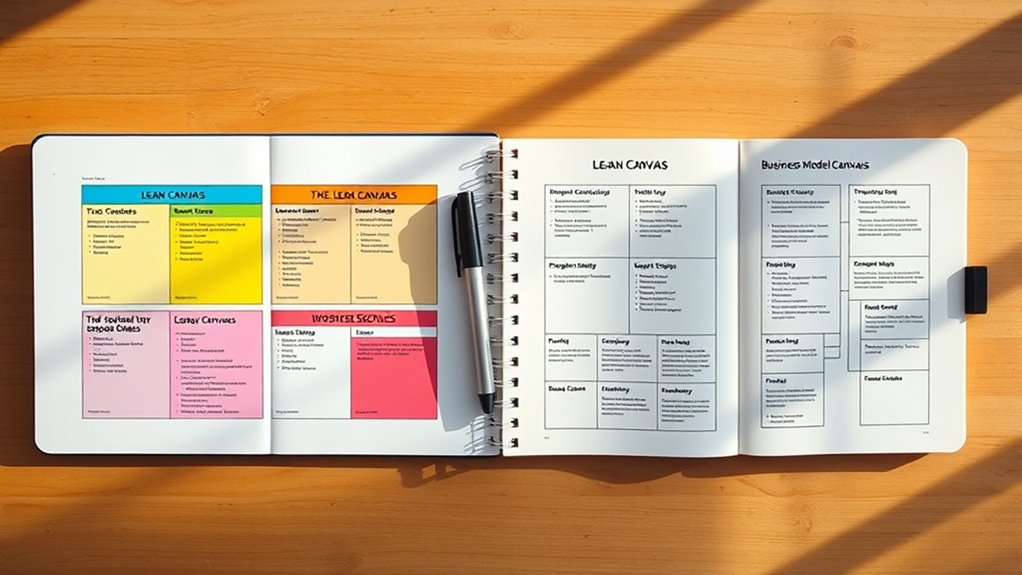
When you’re developing a new business or startup, choosing the right planning tool is essential. It can shape your approach to startup planning and determine how effectively you identify opportunities, test ideas, and adapt to market changes. Two popular frameworks are the Lean Canvas and the Business Model Canvas, each designed to help you visualize and refine your business model. But understanding which one suits your needs best requires considering how they differ in focus and application.
The Lean Canvas was created specifically for startups and entrepreneurs aiming to implement innovation strategies quickly and efficiently. Its design emphasizes rapid iteration and customer validation, making it ideal for startups that need to pivot or refine their ideas without wasting time or resources. When you lean towards a startup planning approach that prioritizes experimentation, the Lean Canvas helps you map out key elements like customer segments, problem statements, unique value propositions, and channels in a concise, single-page format. This focus on identifying the riskiest assumptions and testing them aligns perfectly with innovation strategies aimed at finding product-market fit early.
The Lean Canvas is ideal for startups focused on rapid iteration and customer validation.
In contrast, the Business Model Canvas, developed by Alexander Osterwalder, offers a broader view suitable for established businesses or those with a clearer understanding of their market. Its extensive layout covers various aspects of a business, such as key activities, resources, partnerships, and revenue streams, providing a holistic picture. If your goal is to develop a detailed, long-term strategy that encompasses not only startup planning but also scaling and sustaining growth, the Business Model Canvas offers the depth and structure needed. It encourages you to think through every component of your business, making it easier to communicate and align your team around a comprehensive plan.
Your choice between these tools largely depends on your stage of development and your strategic priorities. If you’re still testing ideas, iterating rapidly, and focusing on innovation strategies, the Lean Canvas is likely the better fit. It keeps your planning lean, flexible, and aligned with the fast-paced nature of startups. On the other hand, if your business is more established or you’re preparing for scale, the Business Model Canvas can serve as a detailed blueprint to guide growth and operational efficiency. Both tools are valuable, but selecting the right one depends on your specific needs, your stage, and how you want to approach startup planning for success. Additionally, understanding the contrast in focus between these frameworks can help you make a more informed decision.
Lean Canvas startup planning book
As an affiliate, we earn on qualifying purchases.
As an affiliate, we earn on qualifying purchases.
Frequently Asked Questions
Which Tool Is Better for Startups?
You should choose the Lean Canvas for startups because it emphasizes quick market validation and resource allocation. It helps you identify risks early and pivot fast, saving time and money. The Lean Canvas’s focus on problem-solution fit makes it ideal for early-stage ventures, enabling you to test assumptions rapidly. This way, you can adapt your business model efficiently, ensuring your resources are directed toward the most promising opportunities.
Can Both Canvases Be Used Together?
Yes, you can definitely use both canvases together. They complement each other well during collaborative brainstorming, allowing your team to explore different aspects of your business. The Lean Canvas’s focus on startup risks pairs with the Business Model Canvas’s visual storytelling of your overall model. Using both enhances clarity, helps identify gaps, and fosters innovative thinking, giving you a detailed view to refine your business strategy effectively.
How Do I Choose Based on Industry?
You should choose your canvas based on industry-specific adaptations that match your sector focused strategies. If your industry demands detailed customer insights and flexible problem-solving, lean towards the Lean Canvas. For broader business models with complex value propositions, the Business Model Canvas works better. Consider your industry’s unique needs and challenges—this will guide you to pick the most effective tool for crafting tailored, impactful strategies.
Are There Costs Associated With These Tools?
You’ll find there are minimal costs involved with these tools, but it’s worth doing a cost comparison. Both lean and business model canvases often come with free templates or low-cost software options. Licensing fees may apply if you choose specialized platforms or premium features. Overall, most entrepreneurs can access these tools without significant expense, making them affordable options to visualize and refine your business ideas effectively.
How Do These Canvases Evolve Over Time?
Think of these canvases as a garden that grows with your ideas. Over time, you’ll go through iteration cycles, pruning and nurturing different parts based on new insights. Their flexibility in design allows you to adapt quickly, adding or removing elements as your business evolves. This ongoing process helps you stay aligned with your goals, ensuring your canvas remains a vibrant reflection of your evolving strategy.
As an affiliate, we earn on qualifying purchases.
Conclusion
Choosing between Lean Canvas and Business Model Canvas is like picking the right compass for your journey—you need the one that guides your startup’s unique path. Lean Canvas cuts through the noise, helping you quickly navigate risks and test ideas, while Business Model Canvas offers a broad map of your entire business landscape. Trust your destination, and let the right tool be your guiding star, steering you confidently toward success.
As an affiliate, we earn on qualifying purchases.
As an affiliate, we earn on qualifying purchases.
Flea & tick season Picks
flea and tick prevention
As an affiliate, we earn on qualifying purchases.