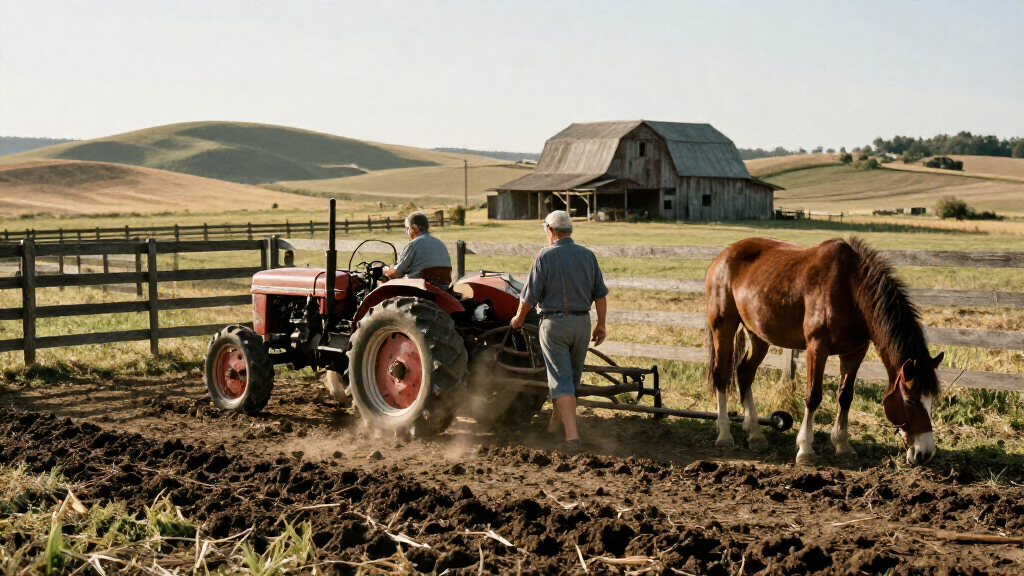

🔍 Read the full analysis: A Look Back At The Shift From Horsepower To Tractors on ThorstenMeyerAI.com

Get business pricing on monitors, keyboards and dev gear
- Business-only prices and quantity discounts
- Tax-exempt purchasing
- Multiple users, one account, clear invoices
TL;DR
American farm horses and mules peaked at 26.7 million in 1918, while tractors rose from about 1,000 on farms in 1910 to 4.7 million in 1960. The shift reduced demand for draft animals and farm labor, but the history is an analogy—not proof of what automation will do to workers today.
The figures cited in the retrospective come from the U.S. Census Bureau’s Historical Statistics of the United States, Colonial Times to 1970, which reprints Department of Agriculture estimates. Horses alone peaked at 21.4 million in 1915; horses and mules together reached 26.7 million on January 1, 1918. In 1915, about 93 million acres of harvested cropland—more than a quarter of the total—grew feed for those animals.
Tractor numbers grew as the draft-animal population declined. The account estimates about 1,000 tractors in 1910, 246,000 in 1920 and 4.69 million in 1960. Around 1955, tractors slightly outnumbered farm horses and mules, according to the historical series. By 1960, the animal count had fallen to 3.1 million. The source notes that tractor counts come from census years with somewhat different dates, and that the government’s horse-and-mule counts were combined from 1951.
The tractor was part of a broader move toward mechanized farming. The retrospective says U.S. farms had about 4,000 combine harvesters in 1920, rising to more than 1 million by 1960. Department of Agriculture estimates cited in the account put the number of people supplied by each farm worker at 7.1 in 1910 and 47.1 in 1970; the latter figure includes people abroad supplied through exports.
Mechanization Reshaped Farm Work
The shift changed more than the machinery farmers used. Fewer acres had to be devoted to animal feed: the source puts that land at about 5 million acres in 1960, down from 93 million in 1915. In principle, land once supporting work animals could instead produce crops for people or for sale. Tractors also helped farms produce more with fewer workers.
That productivity came alongside a major decline in agricultural employment. U.S. farm employment, according to the account, peaked at 13.6 million in 1916 and stood at 4.5 million in 1970, while the overall U.S. labor force doubled. The account says new jobs were concentrated in cities, making migration part of the transition. The figures describe a long economic change, not evidence that every former farm worker moved directly into a particular new job.
For readers weighing current automation, the episode shows that technology can eliminate demand for a kind of work while the wider economy and workforce change around it. It also underscores the human difference: horses were not retrained or represented in politics; people can organize, vote and shape policy. Historical analogy can help frame questions, but it cannot settle how future jobs will change.
Popular right now

KitchenAid Artisan 5-Qt Tilt-Head Stand Mixer – Dried Rose (KSM150PS)

TCL 65-Inch T7 Series 4K QLED Smart Google TV, 144Hz (65T7)

Philips 2200 Series Fully Automatic Espresso Machine with Classic Milk Frother, 2 Coffee Varieties, Intuitive Touch Display, Ceramic Grinder
As an affiliate, we earn on qualifying purchases.
From Draft Animals to Tractors
Before tractors became common, horses and mules powered ploughs, seed drills, reapers and wagons. Their feed imposed a large land requirement, and animals needed care whether or not they were working. The source says early gasoline tractors existed before World War I, but they were heavy, expensive and better suited to large farms.
A key development came in 1917, when Ford introduced the Fordson. The Henry Ford museum describes it as “the first mass-produced and inexpensive lightweight tractor,” designed to meet small farmers’ needs. The museum also says it rapidly became America’s most popular tractor. On February 21, 1920, the 100,000th Fordson left the assembly line, according to the retrospective.
Other machinery followed, including combines, corn pickers, balers and milking machines, alongside changes in fertilizer and seed. In 1983, economist Wassily Leontief compared workers to horses displaced by tractors. The retrospective notes that Leontief also pointed to a major distinction: horses could not vote. That qualification matters when using the history to discuss modern labor and technology.
What the Historical Comparison Leaves Open
The retrospective’s historical counts document a change in farm machinery and animal populations, but they do not show exactly what happened to each worker displaced from farming. The account describes employment falling and new jobs arising in cities; it does not provide individual tracking or establish that mechanization alone caused every job change.
Nor does the horse analogy establish how today’s automation will affect employment. The source points to modern agricultural technology, including a John Deere 16-camera autonomy kit announced in February 2025 for tillage on select large tractors, and says China reported that about 74% of ploughing, sowing and harvesting was mechanized in 2023. Those figures do not establish that fully autonomous farms are widespread, or how many jobs such systems may displace. The source does not provide independent evaluation of the kit’s performance or a detailed method for China’s mechanization figure.
The Next Test for Farm Automation
The next developments to watch are the practical reach of autonomous equipment, the tasks it can perform reliably and the pace at which farms adopt it. The source describes current tractor autonomy as limited to particular equipment and work, rather than as a replacement for all farm labor. It gives no schedule for broader deployment.
For a clearer picture of labor effects, future reporting would need comparable employment data, information about which jobs change or disappear, and evidence about where affected workers find work. The historical record offers a useful baseline: tractors spread over decades, alongside other farm technologies and a wider shift of employment toward cities. Whether current automation follows a similar path remains unresolved.
Key Questions
When did tractors outnumber horses and mules on U.S. farms?
According to the historical figures cited in the retrospective, the counts crossed around 1955: about 4.35 million tractors compared with 4.31 million horses and mules.
How many horses and mules worked on U.S. farms at the peak?
The combined total reached 26.7 million on January 1, 1918, according to the Department of Agriculture series reproduced in the U.S. Census Bureau’s historical statistics.
Did tractors cause farm employment to fall?
Farm employment declined during the period when mechanization expanded, but the retrospective does not establish that tractors alone caused the decline. Other machinery, agricultural changes and movement of jobs into cities were also part of the broader shift.
Does the horse-to-tractor story predict what AI will do to jobs?
No. It is a historical analogy, not a law or forecast. The comparison highlights how machinery can change work, but people differ from draft animals in their ability to retrain, organize and influence public policy.
Source: ThorstenMeyerAI.com