📊 Full opportunity report: How To Rehearse IEP Negotiations As A Parent: Simulator Basics on IdeaNavigator AI — validation score, market gap, and execution plan.

Get business pricing on monitors, keyboards and dev gear
- Business-only prices and quantity discounts
- Tax-exempt purchasing
- Multiple users, one account, clear invoices
TL;DR
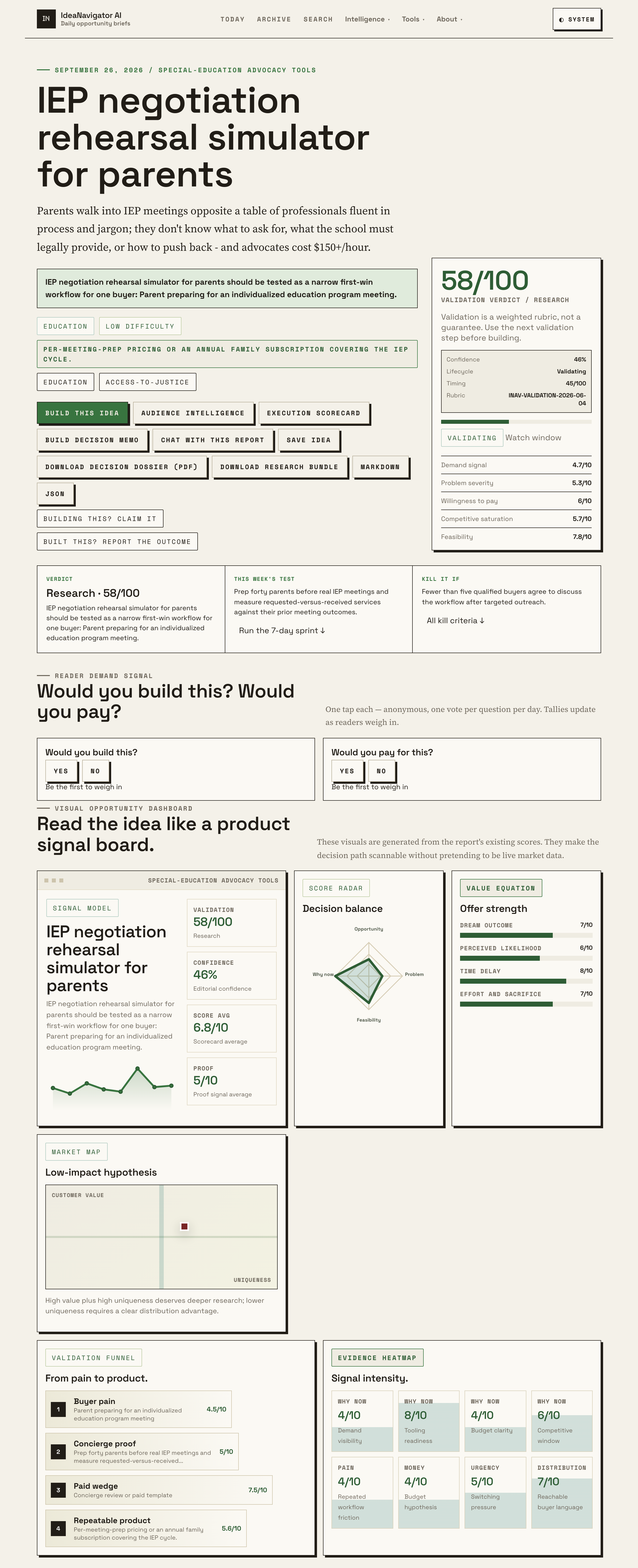
A proposed IEP negotiation simulator would help parents review education plans, prepare requests and rehearse responses to school staff. The idea has not been shown to improve meeting outcomes; its proposal calls for testing it with 40 parents before real IEP meetings.
IdeaNavigator AI has proposed an IEP meeting preparation simulator that would help parents review their child’s education documents, build a list of requests and rehearse a meeting with simulated school staff. The concept targets parents preparing for an individualized education program (IEP) meeting, but no product launch, completed trial or evidence of improved outcomes has been reported.
The proposed tool would let a parent upload a current IEP and evaluation reports. It would then explain relevant entitlements in plain language, produce a request list with legal grounding and run a role-play that includes realistic pushback. The stated aim is to help parents prepare to maintain their positions during discussions with school personnel.
The proposal identifies parents as the initial customer group and suggests charging per meeting or through an annual family subscription covering an IEP cycle. It presents the product as a potential entry into the special-education advocacy tools market. Those pricing models and the market opportunity are proposals; no customer uptake, pricing research or operating business is described.
For validation, the proposal recommends preparing 40 parents ahead of actual IEP meetings and comparing requested services with services received. It also calls for comparison with those families’ outcomes in previous meetings. No pilot results, measurement details or comparison data are available yet.
Preparing Parents for IEP Meetings
IEP meetings can require families to discuss evaluations, services and educational supports using processes and terminology that school professionals know well. A rehearsal tool could give parents a structured way to organize questions and practice explaining what they are seeking before they enter the meeting. That potential is the central case for testing the idea.
The proposal says advocates can cost $150 or more per hour, making paid support difficult for some families. That figure is presented as part of the opportunity case, without a location, date or pricing survey. If a simulator proves useful and costs less than individual advocacy, it could offer another preparation option; whether it would do so depends on its accuracy, usability and price.
The tool would also handle sensitive education records and provide information tied to legal rights. Parents would need to know how uploaded documents are stored and used, and whether legal explanations fit their circumstances. The proposal does not specify safeguards or show that a simulated negotiation can replace individualized advice.
Top picks for "rehearse negotiation parent"
As an affiliate, we earn on qualifying purchases.
The Proposed Pilot and Product
The concept is framed as a narrow first product for one user need: a parent preparing for an IEP meeting. Rather than describing a broad service for schools or all special-education decisions, it focuses on document review, request preparation and practice conversations. Its role-play premise relies on language models being able to simulate realistic exchanges, but no specific model, version or performance evidence is identified.
The proposal places the idea against two trends: rising special-education identification rates and tighter district resources. It does not provide figures, dates or a geographic scope for either trend, so their scale and relationship to more adversarial meetings cannot be independently assessed from the information presented. The proposed 40-parent exercise is a suggested next step, not a completed study.
Evidence and Legal Accuracy
It is not yet clear whether a simulator can identify relevant issues in varied IEPs and evaluations, explain legal entitlements accurately or prepare parents for the range of responses they may hear. The proposal provides no test results, error rates, expert review or details about how the legal grounding would be maintained as rules and circumstances vary.
It also remains unknown how the suggested pilot would measure success. Comparing requested with received services could describe an outcome, but the proposal does not set out how it would account for differences between families, schools, prior plans or meeting circumstances. No evidence establishes that using the simulator would cause any change in services received.
Other unanswered questions include the eventual price, who would review the tool’s explanations, how it would protect uploaded records and whether families would be told when an answer is uncertain. The proposal does not name a developer, launch date or partner organizations.
Testing the Meeting Preparation Idea
The next step described is a pilot with 40 parents preparing for real IEP meetings. A useful evaluation would need to define the preparation process and outcomes in advance, explain how prior meeting results would be compared and report limitations alongside results. No start date or recruitment plan has been announced.
Until such testing is reported, the simulator remains a product proposal. Any future account of its performance would need to distinguish participant feedback from measured changes in requested or received services, and explain how legal accuracy and document privacy are handled.
Source: IdeaNavigator AI
Key Questions
What would the proposed IEP simulator do?
It would let parents upload an IEP and evaluation reports, review explanations and suggested requests, and rehearse a meeting through role-play with simulated school staff.
Is the simulator available now?
No launch or availability information is provided. The concept is presented as a proposal, with a 40-parent pilot suggested as a way to test it.
Has it been shown to improve services?
No results are reported. The proposal recommends comparing requested and received services with families’ prior meeting outcomes, but that validation has not been described as completed.
Would the tool replace an advocate?
The proposal presents it as a preparation aid and does not establish that it can replace an advocate or provide individualized legal advice.
Source: IdeaNavigator AI
Fall Picks
fall essentials
As an affiliate, we earn on qualifying purchases.