📊 Full opportunity report: Monitoring Hormone Therapy: A Tracker For TRT Patients on IdeaNavigator AI — validation score, market gap, and execution plan.

Get business pricing on monitors, keyboards and dev gear
- Business-only prices and quantity discounts
- Tax-exempt purchasing
- Multiple users, one account, clear invoices
TL;DR
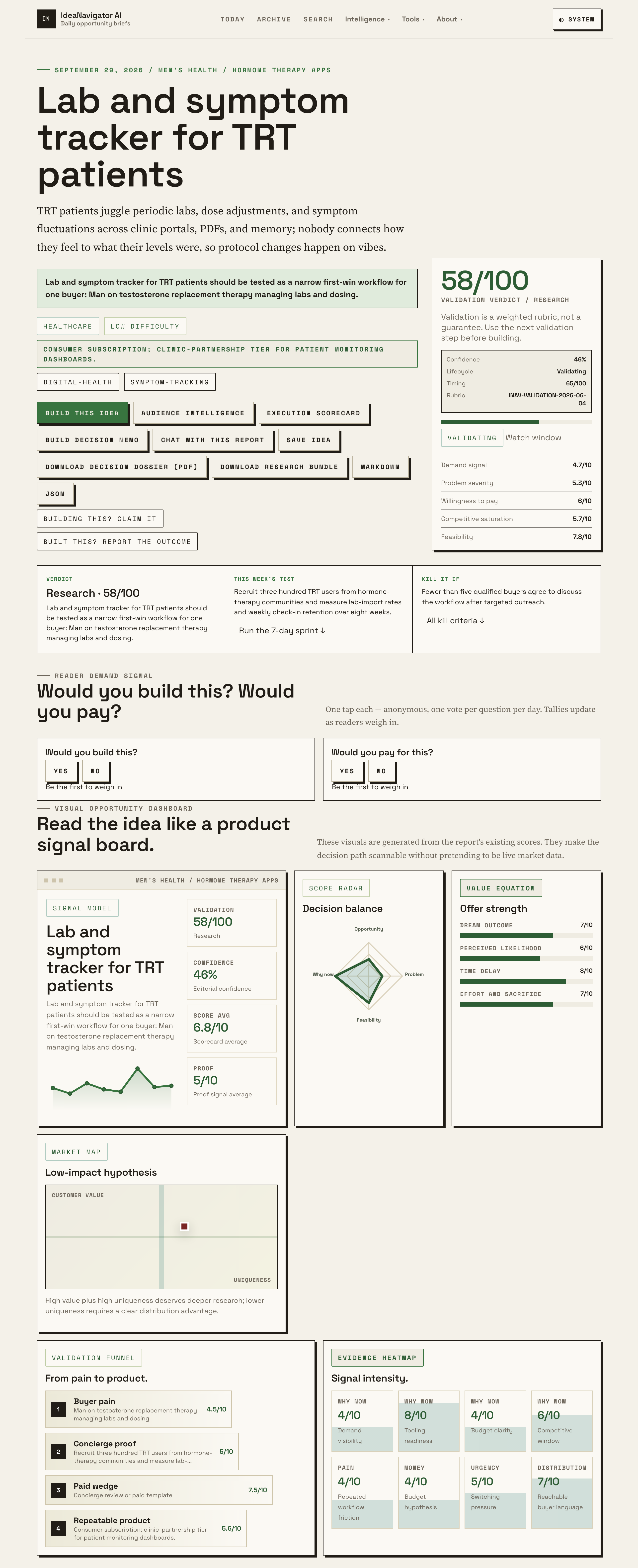
IdeaNavigator AI has outlined a proposed tracker for men receiving testosterone replacement therapy, combining imported lab results, dose changes and daily symptom check-ins. The proposal describes an eight-week test with 300 users; no app launch, completed trial or clinical validation is reported.
IdeaNavigator AI has outlined a proposed tracker for men receiving testosterone replacement therapy (TRT), designed to bring lab results, dose changes and symptom reports into one timeline. The concept matters because patients may have to piece together information from clinic portals, PDFs and memory, but no product launch, user study or clinical evaluation is reported, according to the IdeaNavigator AI proposal.
According to IdeaNavigator AI’s proposal, the app would let users import lab-report PDFs and chart hormone measurements over time alongside dose changes. It would also collect daily symptom check-ins, generate summaries for clinic appointments and flag measurements that move outside user or clinic target ranges. The proposal does not describe a finished product or explain how those target ranges would be set.
IdeaNavigator AI frames the intended user as a man managing TRT labs and dosing. Its account of the problem is that lab measurements and changes in how patients feel are often recorded in separate places, making it difficult to review them together during care. The concept aims to give patients and their clinicians a more organized record; it does not establish that the app would improve treatment decisions or health outcomes.
The proposed business model has two parts: a consumer subscription and a clinic partnership tier with monitoring dashboards. To assess demand, IdeaNavigator AI’s proposal calls for recruiting 300 TRT users through hormone-therapy communities and tracking lab-import rates and weekly check-in retention over eight weeks. Those figures describe a proposed validation plan, not completed research or observed user behavior.
Connecting Patient Records to Visits
For a patient receiving ongoing hormone therapy, measurements, dose instructions and day-to-day experiences can accumulate between appointments. A shared timeline could make it easier to review when a lab test was taken, what dose was recorded at the time and how the patient reported feeling. That could help structure a clinic conversation, particularly when records are spread across multiple portals and documents.
The idea also raises a practical question for clinicians: whether a patient-generated summary is accurate, relevant and easy to review. A tracker can organize information, but organization alone does not show that its alerts are medically appropriate or that a reported symptom was caused by a particular hormone level or dose. The proposed product is best understood as a recordkeeping and visit-preparation tool until evidence supports broader claims.
IdeaNavigator AI’s proposal includes a clinic dashboard that could give care teams a way to review patient-entered records between visits. Its usefulness would depend on whether clinics adopt it, how staff handle incoming information and whether the dashboard fits existing workflows. The proposal supplies no evidence yet about clinic interest, subscription demand or the time required to maintain patient records.
A Proposal for Fragmented TRT Care
IdeaNavigator AI says in its proposal that TRT prescriptions and telehealth clinics have grown, creating a larger population of patients managing care across providers. The proposal provides no figures, timeframe or comparison baseline for that claim, so the scale and pace of growth cannot be assessed from the information presented.
The concept focuses on a specific workflow: collecting lab results and symptom reports around dose changes. IdeaNavigator AI does not describe it as a prescribing service, a diagnostic system or a replacement for clinician oversight. The outline also does not specify which hormone measurements would be included, how often users would check in, or whether the app would connect directly to clinic systems. Those product details could affect how useful the tracker is in routine care.
IdeaNavigator AI’s proposed eight-week test would measure whether participants import lab reports and continue weekly check-ins. These are engagement measures: they could indicate whether users interact with the app, but would not by themselves establish improved care, accurate interpretation of results or safer dosing. The proposal does not say how participants would be recruited beyond hormone-therapy communities or how their privacy would be protected.
Testing and Clinical Safeguards
IdeaNavigator AI’s proposal identifies no completed test results, named development team, release date or participating clinic. It is unclear whether the app exists, whether any users have tried it or whether the proposed 300-person test has been approved or scheduled. The eight-week plan remains a proposal, and no retention or lab-import results are available.
The outline also leaves open how the app would handle differences in laboratory methods, missing records and changes in a patient’s treatment plan. It does not say who defines the target ranges behind its alerts, how an out-of-range result would be communicated, or whether a clinician would review alerts. Without those details, the alert feature’s intended role and limits are uncertain.
Privacy and data handling are also unspecified in the proposal. Lab reports and symptom logs contain personal health information, yet IdeaNavigator AI does not explain where data would be stored, who could access it or how a clinic dashboard would obtain permission to display patient records. The material makes no claim that the concept has undergone clinical or regulatory review.
From Concept to User Test
The next step described by IdeaNavigator AI is to recruit 300 TRT users and track lab-import rates and weekly check-in retention across eight weeks. The proposal does not provide a start date, recruitment link or results timetable. Any later report would need to distinguish participation and app use from evidence about clinical value.
Before clinics or patients could judge the idea, further details would be needed about the app’s data protections, target-range settings, alert handling and clinician access. It is also not clear whether IdeaNavigator AI plans to build the product itself, seek a development partner or use the outline to test commercial interest. For now, the reported development is a product proposal with a suggested validation plan, rather than a launched service.
Source: IdeaNavigator AI
Key Questions
Has the TRT tracker launched?
The available description presents a product concept. It does not report a launch, public app listing or completed user test.
What would the proposed app track?
It would combine imported lab PDFs, recorded dose changes and daily symptom check-ins in a timeline, then prepare summaries for clinic visits and flag measurements outside target ranges.
Has the proposed 300-person study started?
No start date or recruitment results are given. The 300-user, eight-week test is described as a way to validate the concept, not as research already completed.
Would the tracker recommend TRT doses?
The outline describes recordkeeping, trend summaries and flags. It does not say that the app would prescribe or recommend dose changes, and it provides no evidence that the tool has been clinically evaluated.
Source: IdeaNavigator AI
Fall Picks
fall essentials
As an affiliate, we earn on qualifying purchases.