
📊 Full opportunity report: Why AMIE’s AI Medical System Is A Game-Changer For Live Video Patient Consultations on ThorstenMeyerAI.com — validation score, market gap, and execution plan.

Get business pricing on monitors, keyboards and dev gear
- Business-only prices and quantity discounts
- Tax-exempt purchasing
- Multiple users, one account, clear invoices
TL;DR
Google Research and DeepMind showcased their AI system, AMIE, conducting real-time video simulations with patient actors. While evaluators rated it favorably, the system remains experimental and unapproved for clinical use. Further validation is needed before deployment.
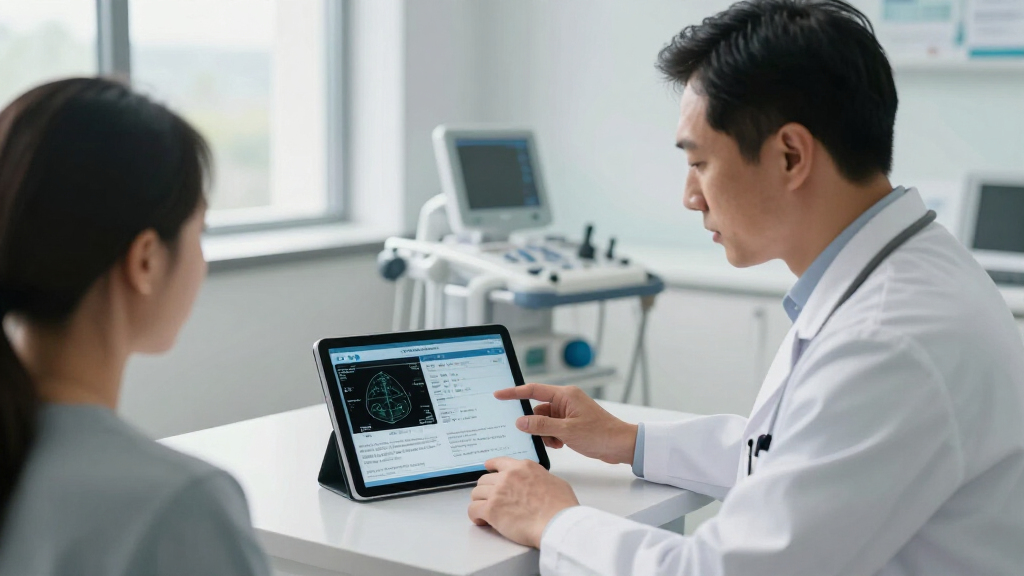
Google Research and DeepMind announced that their experimental AI system, AMIE, can now conduct real-time clinical video consultations with patient actors. This demonstration extends AI capabilities beyond text chat, showcasing potential for future telemedicine applications, though the system is not yet approved for clinical use. The development highlights significant progress in AI-mediated medical interactions, but remains in the research phase.
According to Google, AMIE was evaluated in a randomized study involving patient actors and primary care physicians. The evaluators rated the system favorably across key clinical competencies such as history-taking, diagnostic reasoning, management decisions, and communication quality. Google also reported that patient actors preferred the video consultation experience over text-based interactions, suggesting improved engagement. However, Google did not disclose the sample size, detailed performance metrics, or statistical results, leaving questions about the robustness of the findings.
The system leverages Google’s Gemini and Project Astra within a multi-agent architecture, enabling it to process speech, visual cues, and patient behavior in real time. This allows AMIE to interpret symptoms, guide virtual physical examinations, and reason about diagnoses dynamically. The move from text to video provides access to clinical signals like movement, appearance, and visible discomfort—factors that are typically omitted in text-only systems.
Google emphasized that this demonstration is a research milestone, not a clinical tool. The company stated that further research is needed to validate safety, accuracy, and efficacy before considering any deployment in real-world healthcare settings. No clinical trial schedules or deployment timelines have been announced.
Potential Impact on Telemedicine and AI Diagnostics
If subsequent studies confirm these findings, systems like AMIE could transform remote healthcare by enabling more accurate, engaging, and comprehensive virtual consultations. Access to visual and auditory cues could improve diagnostic accuracy and patient experience, particularly in primary care and telehealth contexts. However, the current research status means that AI-driven video consultations remain experimental, and significant validation, regulation, and oversight are required before they can be integrated into routine medical practice.
telemedicine video consultation equipment
As an affiliate, we earn on qualifying purchases.
As an affiliate, we earn on qualifying purchases.
Advances in AI-Driven Medical Video Interactions
Previous work on AI in healthcare focused mainly on text-based interactions, where models could gather patient history and suggest diagnoses without visual input. Google’s recent demonstration marks a shift toward multimodal AI systems capable of interpreting live video signals during consultations. While AI tools have shown promise in assisting diagnosis and triage, real-time video interaction with clinical reasoning remains a frontier. Google’s research builds on ongoing developments in multimodal AI architectures, aiming to emulate expert-level clinical reasoning in simulated environments.
This demonstration follows earlier research efforts but is the first to showcase a system reasoning in real time during live video interactions. It underscores the potential for AI to augment, rather than replace, human clinicians, pending further validation and regulatory approval.
“This demonstration shows that AI can interpret visual and auditory cues in real time, which is a significant step toward more natural virtual consultations.”
— an anonymous researcher
As an affiliate, we earn on qualifying purchases.
Unanswered Questions About Clinical Validation and Safety
It remains unclear how AMIE performs across diverse patient populations, medical conditions, and real-world scenarios. The study involved actors rather than actual patients seeking treatment, limiting conclusions about clinical outcomes. Google has not released detailed performance metrics, error rates, or independent validation results. The safety, privacy, and regulatory implications of deploying such systems are still under consideration, and no peer review or regulatory approval has been announced.
As an affiliate, we earn on qualifying purchases.
Next Steps for Validation and Regulatory Approval
Google plans to conduct further research involving broader patient groups and real clinical settings to validate AMIE’s performance. Future work will include publishing detailed methodologies, assessing safety and accuracy, and establishing oversight protocols. The company has not announced a timeline for commercial deployment or regulatory approval, indicating that the system remains in the experimental phase for now.
video consultation cameras for healthcare
As an affiliate, we earn on qualifying purchases.
As an affiliate, we earn on qualifying purchases.
Key Questions
What is AMIE?
AMIE is a research AI system developed by Google that can conduct simulated clinical video consultations, interpreting visual and auditory cues to assist in diagnosis and patient management. It is not yet approved for clinical use.
Can AMIE replace doctors in telemedicine?
No. Currently, AMIE is an experimental system used in research settings. It has not been validated for safe or effective clinical deployment.
What are the main capabilities demonstrated by AMIE?
AMIE can interpret speech, visual symptoms, and patient movements in real time, guide patients through physical examinations, and reason about diagnoses during simulated video consultations.
When will AMIE be available for real-world use?
There is no announced timeline. Further validation, regulatory approval, and safety assessments are needed before any deployment.
What are the risks or concerns associated with systems like AMIE?
Key concerns include patient privacy, data security, diagnostic accuracy, bias, accountability, and the potential for missed subtle signs or incorrect guidance. These issues require careful regulation and oversight.
Source: ThorstenMeyerAI.com
Evergreen bestsellers Picks
bestsellers
As an affiliate, we earn on qualifying purchases.