🔍 Read the full analysis: How The Clock Guides The Last Moments Of “Nightmarket — Mercado De Medianoche” (FABLE/175) on ThorstenMeyerAI.com

Get business pricing on monitors, keyboards and dev gear
- Business-only prices and quantity discounts
- Tax-exempt purchasing
- Multiple users, one account, clear invoices
TL;DR
A ThorstenMeyerAI.com design guide examines how “Nightmarket — Mercado de Medianoche” uses a clock-driven sequence to shift a digital market from busy and warm to nearly empty. The material describes the design approach, but does not provide technical implementation details, measured results or a specific closing-time schedule.
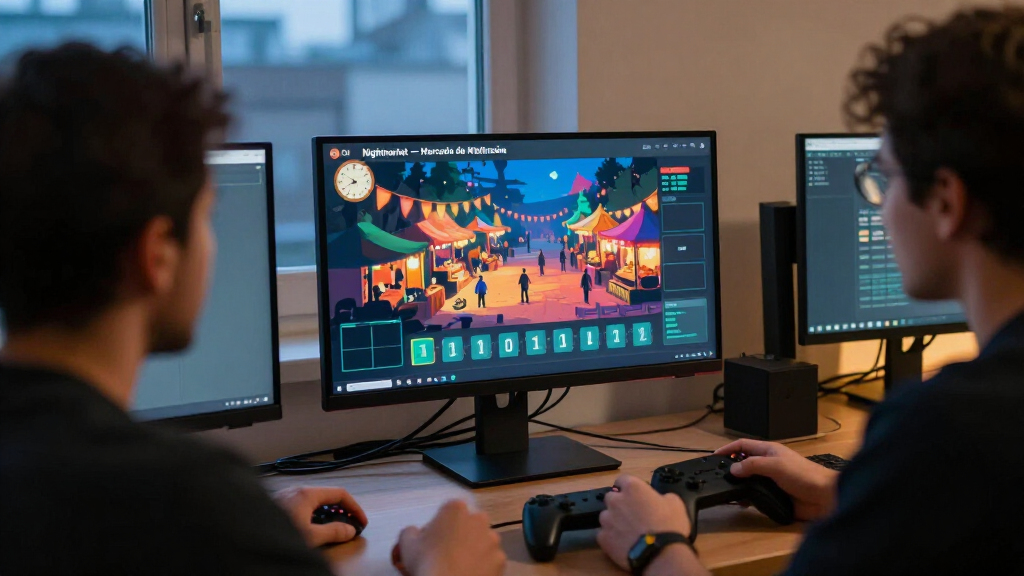
ThorstenMeyerAI.com has published the original design guide to “Nightmarket — Mercado de Medianoche”, describing how a clock-driven sequence makes its digital market shift from a lively scene toward closing. The approach treats time as part of the environment’s design, with changes to light, steam and the presence of stalls helping signal that the night is winding down.
According to the ThorstenMeyerAI.com guide, the market is built from lantern-like warmth, imperfect neon and steam rising into the night. Rather than keeping those details fixed as a decorative backdrop, the scene lets them change as time passes. The guide describes the intended effect as gradual: the room moves from busy to nearly gone, with the final stalls beginning to disappear.
The guide presents the clock as a design mechanism, not just a way to display the time. It describes a sequence in which small changes accumulate, allowing the setting to communicate a shift in activity without relying only on a written status update. The guide says it follows how the effects are built and how they work together to make the market feel lived-in rather than polished and static.
ThorstenMeyerAI.com presents the work as a field guide and design teardown and links to both the full guide and a live room. The published description does not specify the underlying code, the duration of the cycle, how the time is set, or whether the live scene changes in real time. It also offers no user testing or other evidence measuring how visitors respond.
How the Clock Guides Nightmarket’s Last Moments
“Nightmarket — Mercado de Medianoche” uses a clock-driven sequence to shift a digital market from busy and warm toward nearly empty. The published guide describes the visual idea; technical details and measured results remain unspecified.
A gradual wind-down, told through the scene
The guide frames the clock as a design mechanism: accumulated visual shifts signal that the market is approaching its close.
Market alive
A busy digital room establishes the sense of an active night market.
Details shift
Light, steam and atmosphere change as time passes.
Stalls recede
The final stalls begin to disappear and visible activity thins.
Near closing
The market becomes quieter and nearly empty; the exact final state is not described.
A market that feels lived in
The teardown links tactile visual cues with a sense of activity. Their precise timing and behavior are not included in the published description.
Lantern-like glow
Warm light helps establish the market’s welcoming nighttime atmosphere, then participates in the scene’s gradual transition.
Imperfect neon
Neon with a handmade, irregular feel supports a setting that seems atmospheric rather than polished and static.
Steam in the night
Rising steam adds motion and depth to the market scene as its activity winds down.
Activity becomes part of the interface.
A changing environment can make time legible through the place itself. Visitors encounter a transition in activity rather than only an announcement that the scene’s status has changed. The guide presents this as a design example for generative environments and responsive interfaces, not as evidence of improved usability or engagement.
The visual idea is clear; the specification is not
The published account describes intended effects but does not give an implementation or evaluation.
From clock to atmosphere
This summarizes the guide’s described intent; the published material does not specify the technical sequence or establish its measured effects.
What readers can take away
ThorstenMeyerAI.com presents a live room alongside a full design teardown.
What is Nightmarket — Mercado de Medianoche?
A digital market scene accompanied by a design guide about how the environment changes as it approaches closing.
What changes as the clock advances?
The guide highlights shifts in light, atmosphere and visible activity, with stalls beginning to disappear.
Can readers see the room or learn how it was made?
The publisher links to a live room and a full teardown. Operating hours and a technical specification are not stated.
What is confirmed?
A published field guide describes a time-shaped digital market. Cycle length, implementation, final state and audience results remain unreported.
Time as Part of the Interface
The design points to one way digital environments can make time legible: by changing the place itself, rather than simply announcing that its status has changed. A shift in lighting, atmosphere and visible activity can give visitors cues about what is happening and what may be about to end. In its guide, ThorstenMeyerAI.com describes Nightmarket’s closing through the setting’s gradual transformation.
For people working on generative environments and responsive interfaces, the idea is relevant as a design example, not as proof of a broadly tested method. A clock can organize small visual changes into a larger progression, giving an interface a sense of rhythm. The guide does not establish whether that approach improves usability or engagement, but it shows how time can be treated as a component of the experience rather than a background measurement.
The closing sequence also makes the last moments part of the scene’s meaning. The guide says stalls disappear and the market becomes quieter, so visitors encounter a transition in activity rather than an abrupt end screen. What is left behind becomes part of the design question: the published description raises it, but does not say what the final state contains.
digital clock with light and atmosphere control
As an affiliate, we earn on qualifying purchases.
As an affiliate, we earn on qualifying purchases.
A Market Built to Wind Down
ThorstenMeyerAI.com presents the project under the bilingual title “Nightmarket — Mercado de Medianoche” and frames it as a live digital room accompanied by a design teardown. The guide’s focus is not simply the market’s appearance, but how that appearance changes as the scene approaches its close. It links visual details—warm light, imperfect neon and steam—to an unfolding sense of activity.
That distinction matters to the guide’s central idea. A static image can suggest a night market, while a changing environment can suggest that people have been there and are beginning to leave. The guide describes an accumulating sequence intended to create that impression. It connects the approach to possible uses in generative spaces and interfaces, but does not claim that Nightmarket is a deployed commercial system or provide a comparison with other projects.
smart ambient lighting for mood setting
As an affiliate, we earn on qualifying purchases.
As an affiliate, we earn on qualifying purchases.
Implementation Details Still Missing
ThorstenMeyerAI.com’s description explains the intended visual effect but leaves several practical details unspecified. It does not say which programming tools or automation systems drive the changes, whether the clock follows real-world time or a scripted cycle, or how long the closing sequence lasts. It is also unclear whether visitors can affect the timing or whether each visit follows the same sequence.
The guide’s account of the market becoming nearly empty describes the design, not a reported measurement of audience behavior. The material provides no results for visitor response, performance or accessibility, and no claims about those outcomes can be confirmed from the published description. The final state of the room—and what, if anything, remains after the stalls disappear—is also left open.
LED neon sign for digital market display
As an affiliate, we earn on qualifying purchases.
As an affiliate, we earn on qualifying purchases.
The Live Room and Full Teardown
ThorstenMeyerAI.com directs readers to the full design teardown and invites them to visit the live room. Those links are the next available steps for readers seeking to see the sequence or learn more about how its details were assembled. The published description does not announce a launch date, planned update or follow-up study, so no further milestone is confirmed.
Questions for any fuller account include how the clock is implemented, how the scene behaves across a complete cycle and what appears after the last stalls begin to vanish. Until those details are available, the confirmed development is the publication of a guide describing a time-shaped digital market, rather than a documented technical specification or evaluation.
Source: ThorstenMeyerAI.com
automated scene transition lighting
As an affiliate, we earn on qualifying purchases.
As an affiliate, we earn on qualifying purchases.
Key Questions
What is Nightmarket — Mercado de Medianoche?
ThorstenMeyerAI.com presents it as a digital market scene with a live room and a design guide. The guide focuses on how the environment changes as it approaches closing.
How does the clock shape the scene?
According to the guide, time-driven visual changes build gradually, shifting the market from busy toward nearly empty. The published description does not detail the timing system or its technical implementation.
What visual details change?
The guide highlights warm, lantern-like light, imperfect neon and rising steam, alongside stalls that begin to disappear as the scene winds down. It does not specify exactly how each element changes.
Can readers see the market or learn how it was made?
ThorstenMeyerAI.com invites readers to visit the live room and links to a full design teardown. The published description does not state the room’s operating hours or provide a technical specification.
What remains unknown about the project?
The guide description does not identify the tools, cycle length, clock behavior or final scene state. It also provides no user testing or measured results about the experience.
Source: ThorstenMeyerAI.com
Halloween Picks
halloween
As an affiliate, we earn on qualifying purchases.