📊 Full opportunity report: A Practical Look At Consent Management For Services Used By Kids on IdeaNavigator AI — validation score, market gap, and execution plan.

Get business pricing on monitors, keyboards and dev gear
- Business-only prices and quantity discounts
- Tax-exempt purchasing
- Multiple users, one account, clear invoices
TL;DR
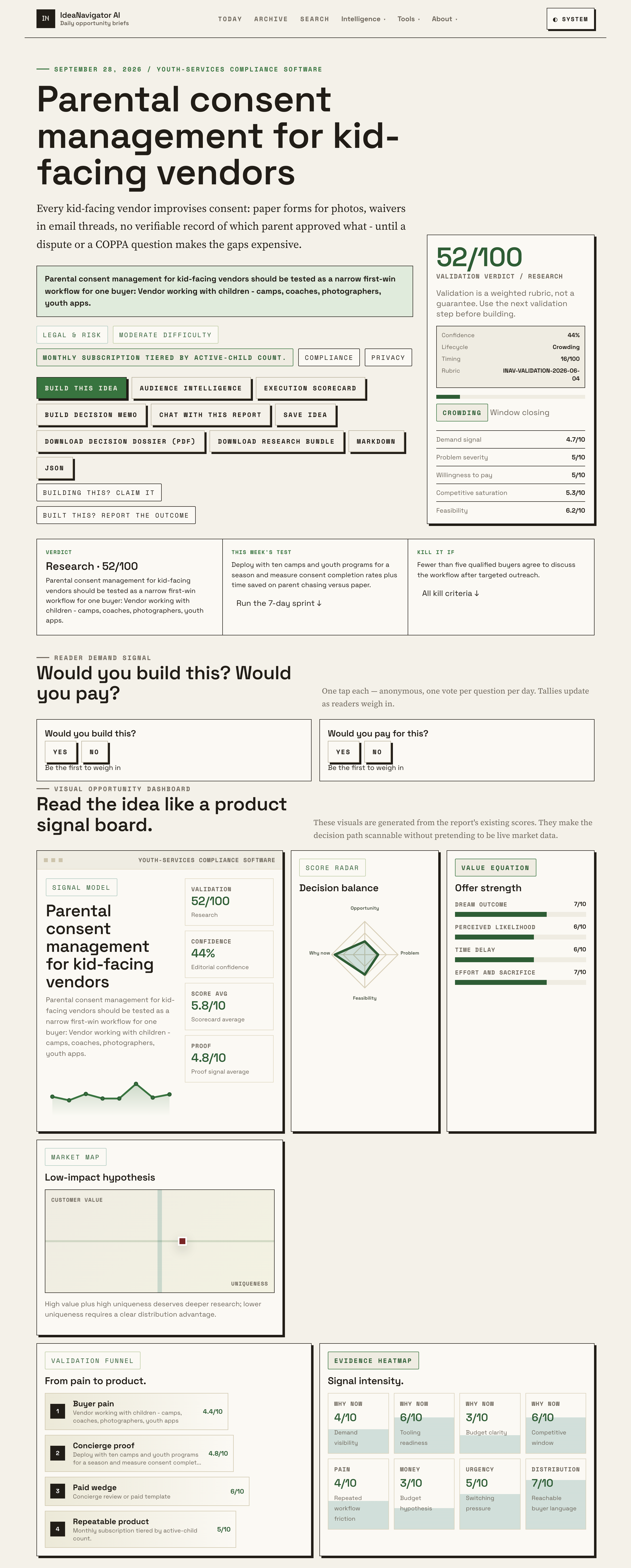
IdeaNavigator AI proposes testing a parental consent management service with camps and youth programs. The suggested pilot would track consent completion and time spent following up with parents; no pilot results or product launch are reported.
IdeaNavigator AI has proposed a parental consent management service for camps and other organizations working with children, paired with a suggested pilot at ten camps and youth programs. The proposal targets vendors that currently manage permissions through forms and email, but it reports no launch, trial results or measured demand.
The proposed service would let vendors send branded consent forms for parents to complete on their phones. The forms could cover photo use, data collection, medical information and liability. The plan also calls for identity checks matched to the risk of each permission, records organized by child, expiry tracking and an audit export vendors could use to retrieve consent records.
IdeaNavigator AI describes the current problem as a lack of consistent, verifiable records: photo permissions may sit on paper, while waivers may be buried in email threads. It argues that this can leave a vendor unsure which parent approved which use. These are claims in the proposal; it does not provide research measuring how often such gaps occur or document a specific dispute.
The suggested business model is a monthly subscription priced by active-child count. To test whether the service solves a practical problem, the proposal recommends using it with ten camps and youth programs for a season, then measuring how many consents are completed and how much staff time is saved on parent follow-ups compared with paper processes.
Consent Records Could Reduce Friction
For a small camp, coach or photographer, getting and retrieving permissions can add administrative work and create uncertainty about a child’s photo or data use. A shared digital record could make it easier to see who gave permission, for which purpose and when it expires. That could help staff answer parent questions and locate records when a concern arises.
The proposal also points to children’s privacy rules and parental challenges as reasons vendors may seek more defensible records. It does not establish that the proposed product would meet any particular legal requirement, prevent disputes or reduce enforcement risk. Those outcomes would depend on how the product is designed and used, as well as the rules that apply to each organization.
A Proposal for Small Youth Vendors
The concept is aimed at a defined customer group: camps, coaches, photographers and youth-focused apps that collect permissions from parents. Its proposed scope combines several types of consent in one workflow, rather than describing a general-purpose compliance system. The plan identifies youth-services compliance software as its market.
IdeaNavigator AI cites changing children’s privacy requirements and parents’ concerns about photo and data use as the reasons to consider the idea now. It does not name a specific law change, provide an implementation timeline or describe a product already being used by vendors. The proposal should therefore be read as a product opportunity and validation plan, not as evidence of a completed service or a regulatory finding.
Pilot Evidence Is Still Missing
No pilot has been reported, and the proposal gives no completion-rate targets, time-savings estimates, subscription prices or evidence that vendors would pay for the service. It is also unclear how identity checks would vary by risk tier, how a parent’s authority would be verified, or how records would be handled when permissions change or a child moves between programs.
The proposal does not specify how the product would address different legal requirements, protect sensitive medical information or integrate with vendors’ existing registration systems. Those details would shape whether a digital ledger is useful in practice and whether organizations can rely on it for their own recordkeeping.
A Seasonal Trial Would Test Demand
The next step described in the proposal is a season-long trial with ten youth programs. A useful report from that test would show consent completion rates, staff time spent following up, comparison methods and participant feedback. No start date or participating programs are identified.
Until a trial or product announcement provides those details, the concept remains unvalidated. Evidence on ease of use for parents, vendor willingness to pay and the handling of sensitive records would help establish whether the workflow can work beyond a proposed pilot.
Key Questions
Has the consent management service launched?
The proposal does not report a launch or an available product. It outlines features and a suggested pilot.
Who is the proposed service for?
It is aimed at vendors working with children, including camps, coaches, photographers and youth apps.
What would the proposed platform track?
It would collect parent permissions for matters such as photos, data, medical information and liability, with records organized by child and expiry tracking.
How would the idea be tested?
IdeaNavigator AI proposes a season-long pilot with ten camps and youth programs, measuring consent completion and staff time spent pursuing parent responses against paper processes.
Source: IdeaNavigator AI
Fall Picks
fall essentials
As an affiliate, we earn on qualifying purchases.