
TL;DR

Get business pricing on monitors, keyboards and dev gear
- Business-only prices and quantity discounts
- Tax-exempt purchasing
- Multiple users, one account, clear invoices
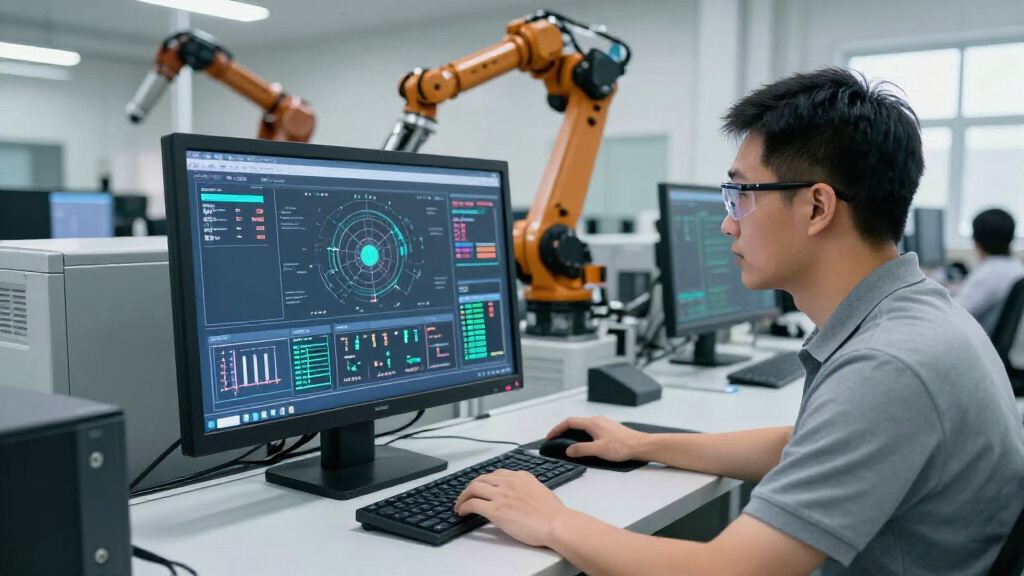
Siemens is pioneering a new wave of industrial AI focused on physical manufacturing processes, partnering with NVIDIA to develop an ‘Industrial AI Operating System.’ This move aims to embed AI into design, engineering, and factory operations, marking a shift from chat-based AI to physical-world applications.
Siemens has revealed a comprehensive strategy to embed artificial intelligence into manufacturing processes, including the development of its Industrial Foundation Model (IFM) and a partnership with NVIDIA to create an Industrial AI Operating System. This initiative aims to transform factory automation, design, and supply chains, marking a significant shift toward physical-world AI applications that leverage Siemens’ extensive industrial data and domain expertise.
At CES 2026, Siemens announced its plan to leverage AI beyond chatbots and language models, focusing instead on processing and contextualizing 3D models, engineering drawings, sensor telemetry, and automation logic. The company’s Industrial Foundation Model (IFM), first introduced at Hannover Messe 2025, is designed to optimize engineering and automation by training on proprietary industrial data, setting it apart from general-purpose AI models.
Alongside this, Siemens is expanding its partnership with NVIDIA to develop an Industrial AI Operating System. This platform will support GPU-accelerated simulation, generative digital twins, and autonomous factory operations, with the first fully AI-driven manufacturing site slated to open in Erlangen, Germany, in 2026. Early implementations include PepsiCo’s facility simulations and nine industrial copilots across the value chain.
Siemens emphasizes that its data advantage—collected over decades—gives it a competitive edge, as well as its deep domain expertise in manufacturing. However, critics point out that much of the AI infrastructure relies heavily on NVIDIA’s technology, raising questions about dependence and sovereignty, especially for European clients.
Why Siemens’ Industrial AI Strategy Matters for Manufacturing
This development signifies a fundamental shift in industrial AI, moving from generic models to specialized, physically grounded systems that can directly optimize manufacturing and engineering processes. Siemens’ focus on proprietary data and domain expertise could enable more precise, efficient, and autonomous factories, potentially reshaping global manufacturing competitiveness. However, reliance on NVIDIA’s hardware and software raises strategic questions about independence and technological sovereignty for European industries.
As an affiliate, we earn on qualifying purchases.
Industrial AI’s Evolution and Siemens’ Position in the Market
Traditional industrial automation has relied on fixed logic and manual oversight. Recent advances in AI have introduced digital twins and predictive maintenance, but these have often been limited by the scope of general-purpose models. Siemens’ move to develop a dedicated Industrial Foundation Model and partner with NVIDIA reflects a strategic effort to harness AI’s full potential in physical manufacturing, building on its long history in industrial automation and digitalization. The announcement aligns with broader industry trends toward AI-driven manufacturing but marks a notable shift toward specialized, domain-specific AI systems.
“Industrial AI is no longer a feature; it’s a force that will reshape the next century.”
— Roland Busch, Siemens CEO
As an affiliate, we earn on qualifying purchases.
Unconfirmed Performance Metrics and Deployment Timelines
While Siemens has announced ambitious plans, specific performance metrics, validation results, and detailed deployment timelines for the Industrial AI Operating System and digital twin implementations remain unconfirmed. The Erlangen factory is targeted for 2026, but the readiness and scalability of these solutions are still to be demonstrated in real-world settings.
As an affiliate, we earn on qualifying purchases.
Next Steps and Expected Milestones in Siemens’ AI Roadmap
Siemens will likely begin pilot implementations of its AI platform, including the Erlangen lighthouse factory, with broader deployment expected in late 2026. The company will also roll out Digital Twin Composer and expand its industrial copilots. Monitoring these developments will be key to assessing the practical impact and performance of Siemens’ physical AI systems.
GPU-accelerated simulation software
As an affiliate, we earn on qualifying purchases.
As an affiliate, we earn on qualifying purchases.
Key Questions
How is Siemens’ approach to industrial AI different from other companies?
Siemens emphasizes domain-specific, proprietary data and physics-based models tailored to manufacturing, unlike general-purpose AI models that focus on language or broad data sets.
What role does NVIDIA play in Siemens’ industrial AI strategy?
NVIDIA provides the hardware, simulation libraries, and frameworks that underpin Siemens’ AI platform, including GPU acceleration and generative simulation capabilities.
When will the fully AI-driven factory in Erlangen be operational?
Siemens aims to launch the fully AI-driven, adaptive factory in Erlangen in 2026, but detailed performance results and operational readiness are still pending.
What are the potential risks of Siemens’ reliance on NVIDIA technology?
The dependence on NVIDIA’s infrastructure raises concerns about technological sovereignty, especially for European clients wary of reliance on American silicon and software.
Will Siemens’ industrial AI solutions be accessible to smaller manufacturers?
While initially targeted at large industrial clients, Siemens’ scalable platform could eventually be adapted for smaller manufacturers, but specific plans have not yet been disclosed.
Source: ThorstenMeyerAI.com
Fall Picks
fall essentials
As an affiliate, we earn on qualifying purchases.