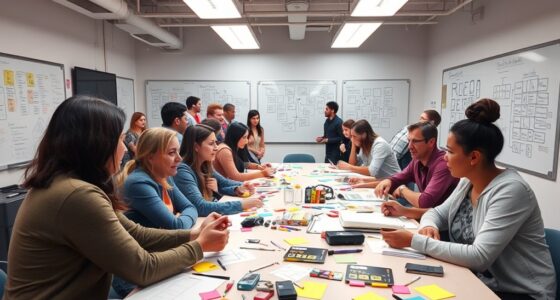

Experience prototyping lets you immerse users in a tangible version of your concept early, so they can “live” the idea and provide real feedback. By creating interactive models, you reveal how your design functions in real life, uncover usability issues, and gather insights that drive improvements. This hands-on approach encourages user involvement, fosters innovation, and reduces risks later in development. Keep exploring to discover how this process can shape your product’s success.

Get business pricing on monitors, keyboards and dev gear
- Business-only prices and quantity discounts
- Tax-exempt purchasing
- Multiple users, one account, clear invoices
Key Takeaways
- Prototyping allows users to interact with a tangible version, enabling early experiential insights into the concept.
- User engagement with prototypes uncovers practical usability issues before full-scale development.
- Early user experiences provide valuable feedback to refine features and improve overall design.
- Live testing fosters collaboration, aligning the product more closely with user needs and expectations.
- Experiencing the prototype early reduces risks, saves resources, and enhances market relevance.

Prototyping experience is vital for turning your ideas into tangible, testable models that reveal how your design works in real life. When you create a prototype, you give users the chance to interact with a rough version of your concept. This interaction provides invaluable user feedback, highlighting what works well and what needs improvement. Instead of guessing how users might respond, you see firsthand their reactions, preferences, and pain points. This real-world insight helps you refine your design more effectively than relying solely on assumptions or abstract ideas.
By embracing an iterative design process, you make your prototype a living document of your development journey. Each round of user testing uncovers new insights, prompting you to make adjustments and test again. This cycle guarantees you’re continuously aligning your product with user needs and expectations. It’s about creating a feedback loop where each iteration gets you closer to the ideal solution. You learn what features resonate, which interfaces confuse users, and where you can simplify or enhance the experience. The more you iterate, the more polished and user-centric your final design becomes.
When you involve users early in the process, you’re not just gathering feedback—you’re fostering a sense of collaboration. Users become partners in shaping the product, which often leads to more innovative solutions. Their input can challenge your assumptions and push you to think outside the box. Plus, early testing helps identify potential usability issues before investing heavily in final development, saving time and resources in the long run.
Prototyping also encourages you to be flexible and open-minded. Instead of sticking rigidly to your initial ideas, you learn to adapt based on real user experiences. This mindset shift is vital for creating products that truly meet user needs. Remember, the goal isn’t to produce a perfect prototype right away but to learn and evolve through each version. This approach not only improves the design but also builds confidence in your final product.
Additionally, understanding jet boat features and user preferences can inspire innovative design elements during prototyping, ensuring the final product aligns with market needs. In essence, experiencing your prototype through user feedback and iterative design transforms how you develop. It shifts the focus from theoretical concepts to practical, user-centered solutions. As you let users “live” the concept early on, you gain clarity, reduce risks, and increase the chances of creating something that genuinely resonates with your audience. This hands-on process makes your design stronger, more intuitive, and ultimately more successful.
As an affiliate, we earn on qualifying purchases.
Frequently Asked Questions
How Can Experience Prototyping Improve User Engagement?
Experience prototyping boosts user engagement by creating an emotional connection through immersive storytelling. When you let users “live” the concept early, they become active participants, feeling more invested. This hands-on approach helps you gather real feedback, making them feel valued. As a result, users develop stronger emotional ties, increasing their interest and loyalty, ultimately making your product more appealing and memorable.
What Are the Common Challenges Faced During Experience Prototyping?
You might worry that experience prototyping is too time-consuming, but the biggest challenges often involve managing iterative feedback and maintaining stakeholder alignment. It’s easy to get sidetracked by endless revisions or conflicting opinions. To overcome this, set clear goals, communicate regularly, and prioritize feedback that aligns with your vision. Staying organized helps you keep the prototype focused and ensures everyone’s on the same page, making the process smoother and more effective.
Which Tools Are Most Effective for Experience Prototyping?
You should consider using Virtual Reality and Interactive Mockups for experience prototyping. Virtual Reality immerses users, allowing them to live the concept early, providing valuable insights. Interactive Mockups enable you to test the flow and functionality quickly, making adjustments easier. These tools are effective because they facilitate real-time feedback and engagement, helping you refine your design efficiently and create a better user experience from the start.
How Do You Measure Success in Experience Prototypes?
You’ll find that 70% of projects see improved user satisfaction when you measure success through usability metrics and A/B testing. To gauge your experience prototype’s success, focus on how users interact, identifying pain points and engagement levels. Track task completion rates, time spent, and user feedback. If these metrics show positive trends, you’re on the right track, confirming your prototype effectively captures user needs and expectations.
When Is the Best Time to Incorporate User Feedback?
You should incorporate user feedback early in the process, ideally during initial prototypes, to guide your design decisions. This allows for iterative design, where you refine the experience based on real user insights. Gathering early feedback helps identify issues before they become costly or ingrained, ensuring your final product truly meets user needs. Continuously engaging users throughout development leads to a more successful, user-centered experience.
As an affiliate, we earn on qualifying purchases.
Conclusion
By letting users “live” the concept early, you bridge the gap between idea and reality. It’s like giving them a sneak peek into the future, yet still holding onto the present. This contrast reveals what works and what falls short, guiding you to refine your design. Embrace experience prototyping, where imagination meets action, and watch your concept evolve from a mere idea into a tangible, user-centered reality.
As an affiliate, we earn on qualifying purchases.
As an affiliate, we earn on qualifying purchases.
Halloween Picks
halloween
As an affiliate, we earn on qualifying purchases.