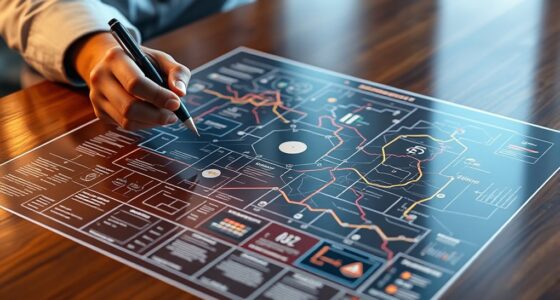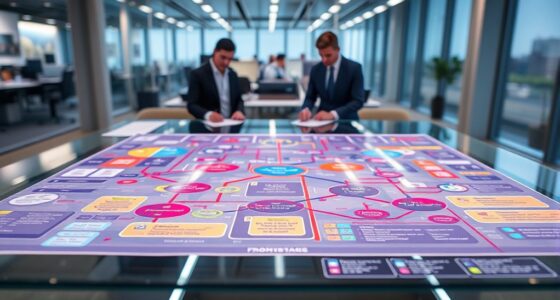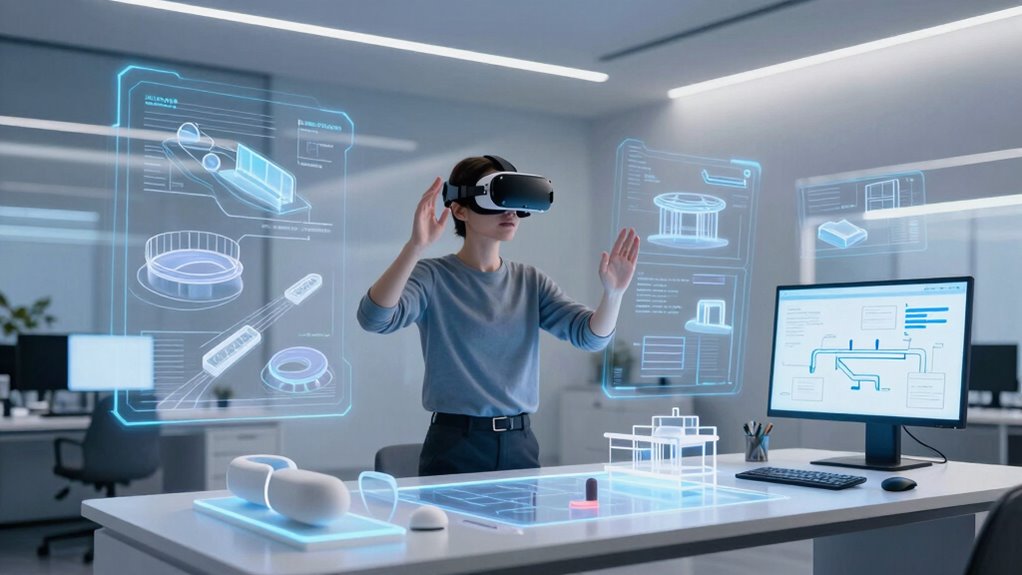

VR is a powerful tool in service design and spatial prototyping that lets you immerse yourself in customer journeys, test service interactions, and optimize layouts before building. It helps you visualize spaces, gather stakeholder feedback, and create realistic training experiences. Plus, VR reduces costs, speeds up revisions, and guarantees your designs are user-centered and inclusive. Keep exploring to discover how these applications can transform your projects even further.
Key Takeaways
- VR allows immersive customer journey mapping to identify pain points and enhance service experience.
- It enables early testing and optimization of service interactions and touchpoints in realistic virtual environments.
- VR facilitates spatial prototyping of physical spaces, revealing design issues before construction, saving costs.
- It supports collaborative stakeholder engagement and real-time feedback during design development.
- VR enhances training and onboarding by simulating real-world scenarios for faster, more effective learning.
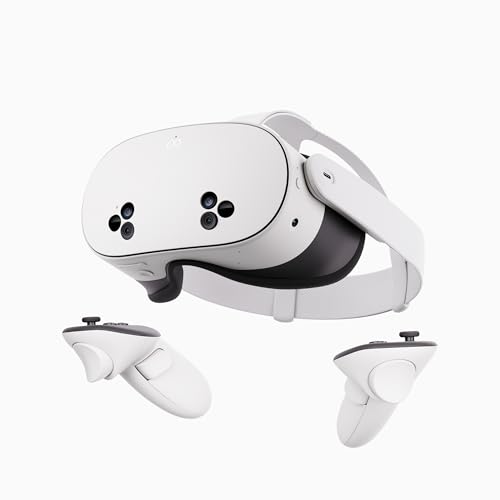
Meta Quest 3S 128GB | VR Headset — Thirty-Three Percent More Memory — Virtual Reality Without Wires — Access to 40+ Games with a 3-Month Trial of Meta Horizon+ Included (Renewed Premium)
- Wireless VR Experience: Untethered gaming and exploration
- Enhanced Graphics Power: Twice the processing for smooth visuals
- Immersive Virtual Reality: Blend virtual objects with real space
As an affiliate, we earn on qualifying purchases.
As an affiliate, we earn on qualifying purchases.
How Can VR Improve Customer Journey Mapping?
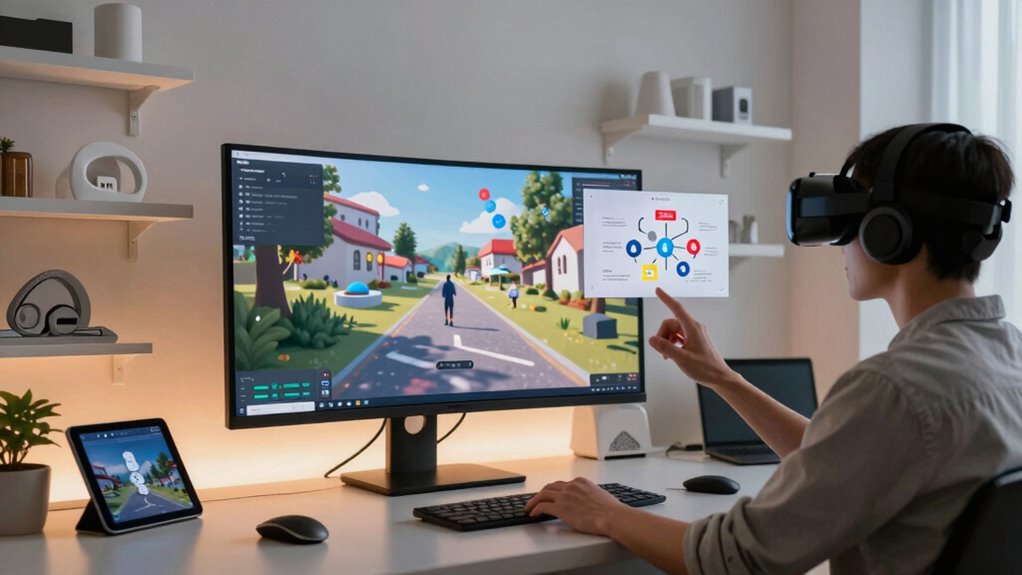
Virtual reality transforms customer journey mapping by immersing you directly into the user experience. It allows you to gather deeper customer insights by enabling you to see and feel what users encounter at each touchpoint. With VR, journey visualization becomes more intuitive; you can step into your customers’ shoes and experience their interactions firsthand. This immersive approach highlights pain points and moments of delight more effectively than traditional methods. By exploring the customer’s perspective in a realistic environment, you can identify opportunities for improvement and refine your service design accordingly. VR makes the entire mapping process more engaging and accurate, helping you develop solutions that truly resonate with users. Additionally, understanding the importance of ethical considerations in new technologies ensures that immersive tools like VR are used responsibly and transparently. Recognizing the role of long-term adaptability in digital content allows for continuous improvement and innovation in service design. It also supports the creation of sustainable solutions that can evolve with changing user needs and technological advancements. Incorporating projector technology insights can further enhance the realism and effectiveness of virtual prototypes, making the experience even more impactful. Moreover, integrating user-centered design principles ensures that the immersive experience remains aligned with actual user needs and preferences. Ultimately, it turns abstract data into tangible, actionable insights.

Figma for Spatial UI Design: AR, VR, XR, and Immersive Interface Design with Design Systems, Component Libraries, and Prototyping for Web and Mobile Apps (DevTech series)
As an affiliate, we earn on qualifying purchases.
As an affiliate, we earn on qualifying purchases.
Using VR for Spatial Prototyping of Physical Environments
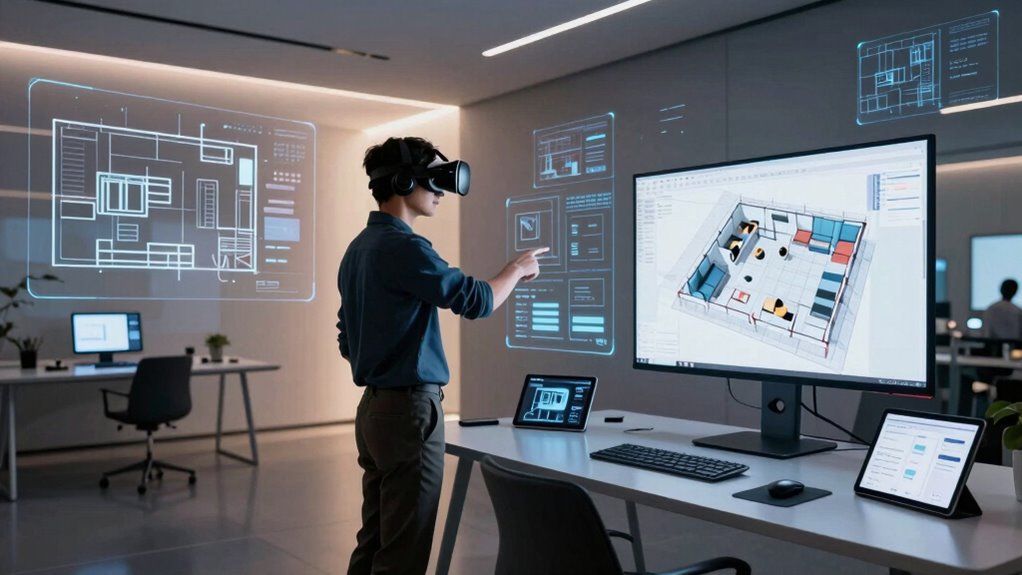
When designing physical spaces, VR offers a powerful way to create and test prototypes before committing to construction. Virtual walkthroughs allow you to experience the environment in a realistic, immersive way, revealing design issues early. Spatial visualization helps you understand how different elements interact within the space, making adjustments easier and more cost-effective. Using VR for spatial prototyping enables you to explore layout options, lighting, and furniture placement without physical models. This approach reduces errors and accelerates decision-making. By immersing yourself in a virtual version of the environment, you gain insights that static drawings can’t provide. Ultimately, VR enhances your ability to refine physical spaces efficiently, ensuring the final design aligns with user needs and functional requirements.

Meta Quest 3S 256GB | VR Headset — Thirty-Three Percent More Memory — 2X Graphical Processing Power — Virtual Reality Without Wires — Get Batman: Arkham Shadow Included Plus Access to 40+ Games
- Wireless VR Experience: Untethered gaming and exploration
- Enhanced Graphics Power: Twice the processing for smooth visuals
- Immersive Virtual Reality: Blend virtual objects with real space
As an affiliate, we earn on qualifying purchases.
As an affiliate, we earn on qualifying purchases.
How VR Facilitates Collaboration and Feedback From Stakeholders
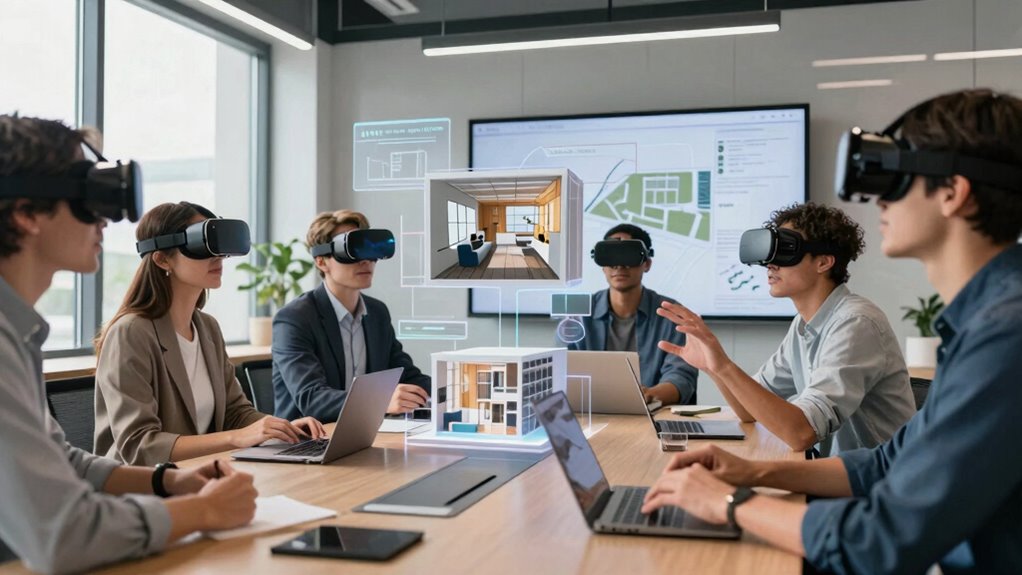
VR transforms stakeholder collaboration by providing an immersive platform where everyone can experience and evaluate designs in real time. This enhances stakeholder communication, making it easier to share ideas and gather immediate feedback. With VR, you can involve clients, team members, and other stakeholders simultaneously, fostering a truly collaborative design process. Instead of relying on static drawings or 2D plans, everyone can explore the space together, identify issues, and suggest improvements on the spot. This shared experience reduces misunderstandings and accelerates decision-making. VR also allows for iterative adjustments, so your team and stakeholders can see changes instantly. Overall, VR streamlines collaboration, promotes transparency, and guarantees that all voices are heard, leading to better, more aligned service designs.

WonderFitter M9 Professional Shooting Simulator (Mobile Edition) – Realistic Recoil & Detachable Magazine Reload – Dry Fire Training System for iOS/Android – VR & Screen Casting Ready
- High-Precision Dry Fire Training: Transform smartphone into shooting range
- Realistic Tactical Reloading: Detachable magazine with authentic feel
- Ultra-Low Latency Response: Sub-10ms instant hit registration
As an affiliate, we earn on qualifying purchases.
As an affiliate, we earn on qualifying purchases.
Testing Service Interactions and Touchpoints With VR
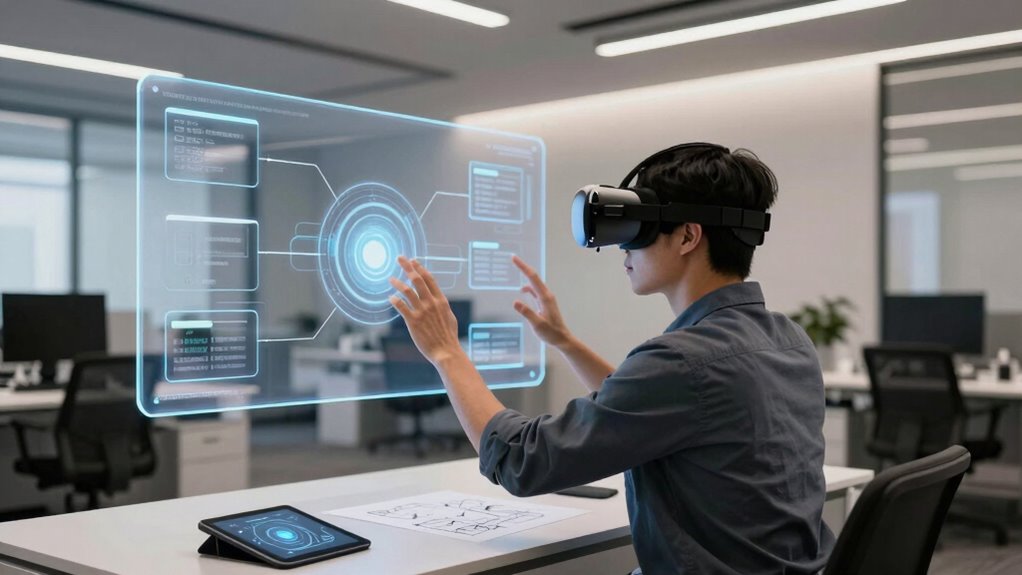
Testing service interactions and touchpoints in a virtual environment allows you to simulate real-world experiences with precision and flexibility. Virtual walkthroughs let you experience service flows firsthand, revealing potential issues and areas for improvement before deployment. You can observe how users navigate spaces, interact with touchpoints, and respond to environmental cues. Sensory testing in VR enables you to evaluate how different stimuli—lighting, sound, or tactile feedback—affect user experience. This approach helps identify friction points and optimize service design effectively. By testing these interactions early, you reduce costly revisions later and guarantee a seamless, engaging experience for your users. VR provides a practical, immersive platform to refine service interactions with accuracy and confidence. Incorporating spatial awareness into your testing process ensures a more comprehensive understanding of user behavior in the environment.
Creating Immersive VR Training and Onboarding Experiences
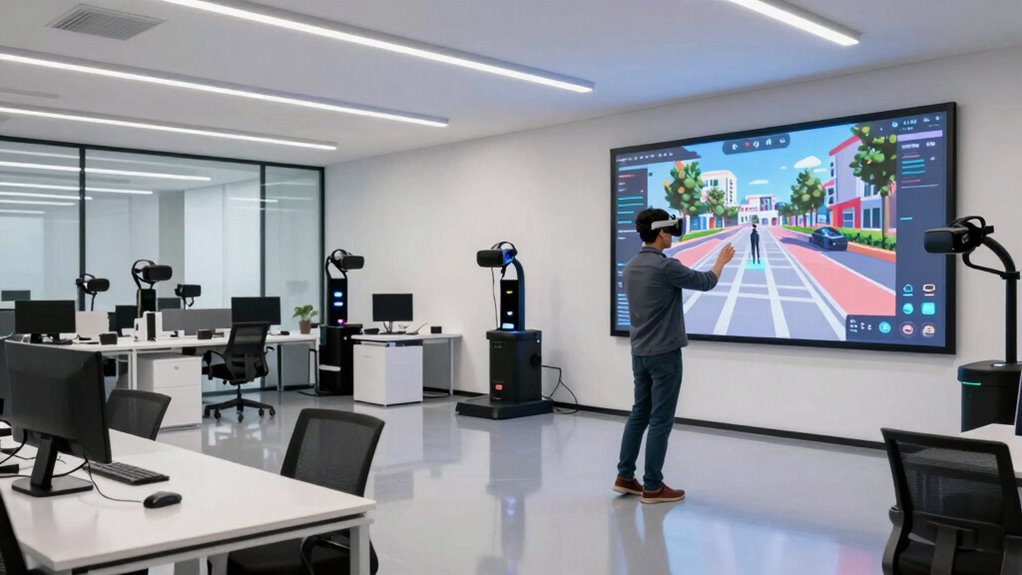
Creating immersive VR training and onboarding experiences leverages enhanced engagement techniques to keep learners actively involved. By using realistic scenario simulation, you can replicate real-world challenges and workflows effectively. This approach helps new team members become confident and competent faster, improving overall service quality.
Enhanced Engagement Techniques
Immersive VR training and onboarding experiences captivate employees by engaging them directly within realistic environments, making complex concepts easier to grasp and remember. To boost engagement, you can leverage interactive storytelling to create compelling narratives that draw users into the experience. This approach fosters emotional engagement, helping employees connect with the material on a deeper level. Additionally, you can incorporate gamification elements, such as challenges and rewards, to motivate participation. Incorporating real-time feedback allows learners to adjust and improve their skills instantly. Finally, personalized scenarios tailored to individual roles or learning styles enhance relevance and retention. Emphasizing natural integration within the virtual environment can further improve immersion and comfort, making the experience feel more authentic and less disconnected from real-world settings. Incorporating visual and auditory cues can also aid in reinforcing learning and improving retention. In line with effective storytelling techniques, integrating narratives that resonate with users increases engagement and facilitates knowledge retention. Creating multi-sensory experiences can deepen immersion, making training sessions more memorable and impactful. Additionally, ensuring that the VR environment simulates real-world conditions accurately can significantly enhance spatial realism, leading to more effective skill transfer. These techniques make training more dynamic, memorable, and effective, ensuring employees stay engaged and absorb critical information efficiently.
Realistic Scenario Simulation
When designing VR training and onboarding programs, realistic scenario simulation plays an essential role in preparing employees for actual workplace challenges. Using virtual storytelling, you create immersive storytelling experiences that mirror real-life situations, helping learners practice responses in a safe environment. This approach boosts confidence and competence by immersing users in scenarios they’re likely to encounter, such as customer interactions or safety procedures. By simulating these scenarios with high fidelity, you enable trainees to develop muscle memory and decision-making skills. The power of immersive storytelling keeps users engaged and attentive, making learning more effective. Ultimately, realistic scenario simulation in VR bridges the gap between theory and practice, ensuring employees are better equipped to handle real-world challenges confidently and efficiently.
How VR Saves Costs and Increases Efficiency in Service Design
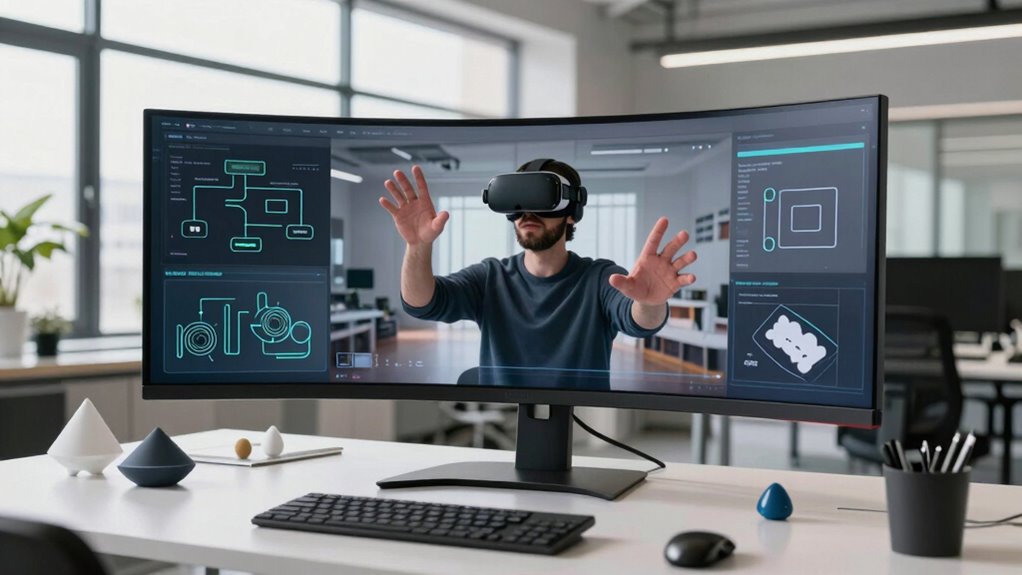
Virtual reality streamlines service design processes by allowing you to identify and address issues early, saving both time and money. By creating immersive prototypes, you reduce the need for costly physical models and extensive revisions. VR promotes process optimization, enabling quick iterations and stakeholder feedback without delays. This approach minimizes errors and prevents costly rework later in development. Additionally, VR helps you visualize spatial layouts and service flows more accurately, cutting down on trial-and-error.
- Reduces material and manufacturing costs
- Accelerates decision-making and approvals
- Enhances collaboration across teams
- Streamlines revisions and updates
Personalizing User Experiences and Optimizing Layouts With VR
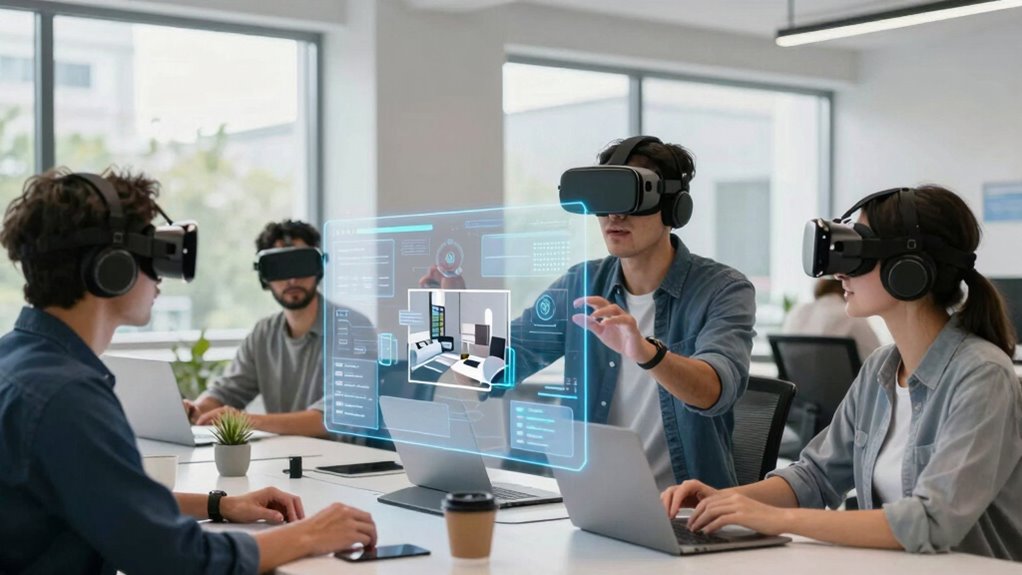
Building on how VR streamlines the design process, it also empowers you to create highly personalized user experiences and refine spatial layouts with greater precision. By leveraging personalization strategies, you can tailor environments to meet specific user needs and preferences. VR enables real-time user behavior analysis, giving you valuable insights into how people interact within a space. This data allows you to adjust layouts and features for maximum comfort, efficiency, and engagement. You can simulate different scenarios, observe user reactions, and iterate designs quickly. As a result, VR helps you develop more intuitive, user-centered environments that enhance overall satisfaction. This combination of personalized experiences and optimized layouts ultimately leads to more effective service delivery and improved user loyalty.
Future of VR and AI in Service Design and Spatial Prototyping
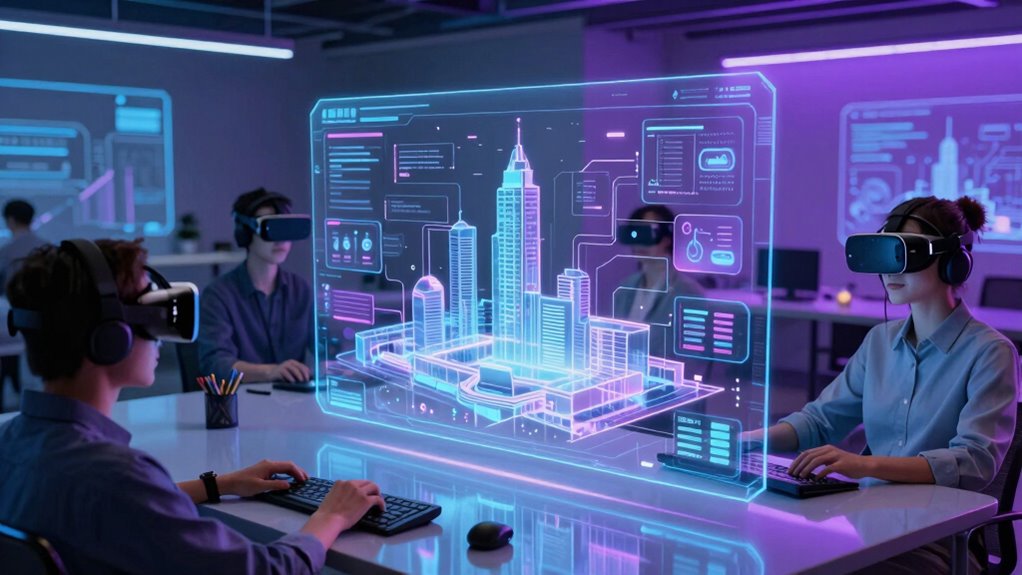
The future of VR and AI in service design and spatial prototyping promises to revolutionize how you create and refine environments. With advancements, AI integration will enable smarter simulations, automating complex tasks and offering real-time feedback. You’ll see more immersive experiences, blending virtual ethics considerations—like privacy and user consent—into design processes. AI-driven analytics will help you understand user behaviors deeply, optimizing spaces more effectively. Additionally, virtual ethics will guide responsible tech use, ensuring inclusivity and safety.
- Smarter AI-powered prototypes for faster iteration
- Enhanced virtual ethics for responsible design
- Adaptive environments reacting to user inputs
- Integration of AI to personalize experiences seamlessly
Frequently Asked Questions
What Are the Limitations of VR in Service Design?
The limitations of VR in service design include virtual immersion challenges, where it can be hard to replicate real-world interactions, and sensory limitations, like restricted tactile feedback or limited sensory input. You might find it difficult to fully experience textures or smells, which can impact your understanding of a space or service. These gaps can hinder your ability to make fully informed design decisions based solely on VR experiences.
How Accessible Is VR Technology for Small Businesses?
Coincidentally, VR technology is becoming more accessible for small businesses, though cost barriers still exist. You can now find affordable VR headsets and software, making it easier to incorporate VR into your service design. However, user accessibility remains a concern, especially for staff or clients unfamiliar with the tech. While not yet universal, advancements are steadily lowering entry points, helping small businesses leverage VR’s benefits without overwhelming resources.
Can VR Replace Traditional Service Design Methods Entirely?
VR can’t fully replace traditional service design methods yet, but it markedly enhances them. You can leverage immersive storytelling to better communicate ideas and use virtual collaboration to gather diverse feedback in real-time. These features make the design process more engaging and efficient. However, combining VR with traditional techniques guarantees thorough insights, ultimately leading to more innovative and user-centered service solutions.
What Are the Best VR Hardware Options for Service Prototyping?
For service prototyping, you should consider VR hardware like the Oculus Quest 2, HTC Vive, or Valve Index, which excel in immersive storytelling and hardware compatibility. These options offer high-quality visuals, precise tracking, and user-friendly interfaces. You’ll find them ideal for simulating real-world interactions, enabling you to prototype effectively, refine your designs, and gather valuable feedback, all while maintaining an accessible and seamless VR experience.
How Do Users Generally Respond to Vr-Based Service Experiences?
You’ll find that users generally respond positively to VR-based service experiences, especially when they include immersive storytelling and sensory engagement. These elements captivate attention and foster emotional connections, making the experience memorable. However, some users might feel overwhelmed or disoriented if the experience isn’t well-designed. Overall, with thoughtful implementation, VR can considerably enhance user engagement and provide valuable insights during service design and spatial prototyping.
Conclusion
While some may think VR is too costly or complex, its benefits in service design and spatial prototyping outweigh the hurdles. You’ll find that VR streamlines collaboration, reduces physical prototypes, and personalizes user experiences, ultimately saving time and money. Embracing VR isn’t just about cutting costs—it’s about creating more engaging, efficient, and adaptable environments. With ongoing advancements, VR becomes an indispensable tool, empowering you to innovate confidently without the limitations of traditional methods.