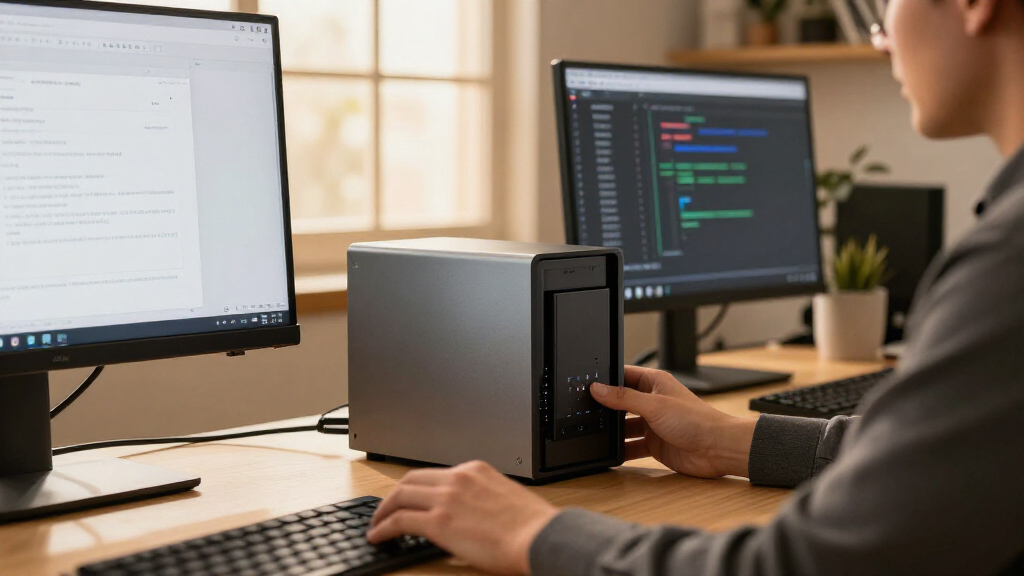

🔍 Read the full analysis: Does The UGREEN NAS DXP4800 Pro Make Sense For AI Data? on ThorstenMeyerAI.com

Get business pricing on monitors, keyboards and dev gear
- Business-only prices and quantity discounts
- Tax-exempt purchasing
- Multiple users, one account, clear invoices
TL;DR
The UGREEN NAS DXP4800 Pro is a four-bay network-attached storage device with an Intel Core i3-1315U, expandable memory, 10GbE and 2.5GbE ports, and on-device AI photo organization. It could suit users managing large media libraries or running self-hosted services, but the advertised storage capacity depends on drives bought separately, and the supplied information does not establish how its AI features perform on specific workloads.
The UGREEN NAS DXP4800 Pro combines four drive bays, an Intel Core i3-1315U, expandable memory and 10GbE networking in a home-focused NAS that can also run Docker services and virtual machines. Its hardware may appeal to people managing large media collections or experimenting with self-hosted AI-related tools, but the supplied product information describes on-device AI photo organization rather than establishing performance for broader AI data workloads. The drives are not stated to be included.
The system includes 8GB of DDR5 memory, expandable to 96GB, and has four 3.5-inch drive bays plus two PCIe 4.0 M.2 slots. UGREEN lists a maximum capacity of 144TB across four hard drives and two M.2 SSDs; that figure depends on the configuration and should not be read as storage included with the unit. The assessment says the product listing does not specify that drives are supplied.
Networking comprises one 10GbE port and one 2.5GbE port, with a stated maximum transfer speed of 1.25GB/s. Actual transfers depend on the NAS drives, client computer, cabling, switches and workload. A standard gigabit network would constrain the benefit of the faster connection. UGOS Pro includes media, photo and cloud-sync functions, and the NAS can organize photos using on-device AI, according to the supplied product material.
The assessment describes the DXP4800 Pro as a more capable and configurable option than basic two-bay models such as the Synology DS223 and DS223j. It says that extra capacity and processing power could suit users running several services or handling large files, while adding little for people who mainly need automatic backups and shared folders. The assessment does not provide independent benchmark results or a price comparison.

UGREEN NAS DXP4800 Pro 4-Bay Network Attached Storage
- ✔ Processor: Intel Core i3-1315U, 6 cores, 8 threads, up to 4.5GHz
- ✔ Memory: 8GB DDR5, expandable to 96GB
- ✔ Graphics: 13th Gen Intel UHD Graphics
The 1 picks
- 1
 UGREEN NAS DXP4800 Pro 4-Bay Desktop NAS with Intel Core i3-1315U, 8GB DDR5,…View on Amazon →
AI Photo Tools Need a Clear Use Case
For buyers considering a NAS for AI-related data, the distinction between storing data and processing it matters. The listed on-device AI feature is photo organization; the source does not describe general-purpose AI model training, inference benchmarks, supported models or a dedicated accelerator. The device’s CPU and memory make it more flexible than a basic file server, but those specifications alone do not establish how well it will handle a particular AI workload.
The more readily supported case is a central storage and services hub: keeping a growing photo or video library, sharing files over a faster local network, and running containers or virtual machines. That flexibility may reduce the need for separate home-lab hardware. It also carries added costs and decisions, including drives, possible memory upgrades, network equipment and storage configuration. A simpler two-bay NAS may be more practical for routine backups.
Storage resilience also needs careful framing. The product material lists RAID 0, 1, 5 and 10 configurations, which provide different trade-offs in capacity and drive-failure tolerance. RAID is not a separate backup; users still need an independent copy of important files to guard against deletion, damage or other data loss.
A NAS Beyond Basic File Storage
A network-attached storage device places files on a storage system accessible to computers and other devices on a local network. Many entry-level models focus on backups and shared folders. The DXP4800 Pro adds four drive bays, M.2 slots and a Core i3 processor, positioning it for a wider set of tasks, including media serving and self-hosted services.
The supplied assessment contrasts it with two-bay Synology models, describing the UGREEN as more expandable and faster on compatible networks. That is a hardware comparison, not a claim that every user will see faster everyday performance: the rest of the network and the workload can set the limit. Tool-free drive trays may ease installation, but buyers still have to choose drives and configure the system.
The assessment also notes an aluminum chassis and a two-year warranty. It does not establish long-term reliability or noise levels, so those should not be inferred from the listed materials or warranty period.
AI Workloads and Costs Remain Unspecified
The available information does not specify AI performance measurements, which photo-organizing tasks the on-device AI supports, or whether those functions require particular software settings. It also does not establish whether the NAS is suitable for model training or other compute-heavy AI work. Those uses should not be assumed from the processor, memory ceiling or marketing description alone.
Other details are missing from the supplied material, including the product’s price, whether any drives are bundled, real-world transfer tests, power use, and measured noise. The 144TB maximum is configuration-dependent, and a buyer’s usable capacity will depend on the drives and RAID arrangement selected. The full cost therefore cannot be assessed from the stated specifications alone.
Check Price, Drives and Software Fit
Prospective buyers should confirm the current price and package contents, then budget for the drives needed to build their chosen array. Those planning to use 10GbE should check that their computer, cabling and switch support it; users considering containers or virtual machines should assess whether the included 8GB of memory suits their workload or whether an upgrade is needed.
Before treating the DXP4800 Pro as an AI-data platform, buyers should look for specific documentation or testing of the UGOS Pro photo AI features and any intended AI applications. The supplied assessment offers an early suitability judgment, not independent performance testing. Whether the system makes sense depends on the user’s storage, networking and software requirements, as well as the total cost after drives and any upgrades.
Key Questions
Does the UGREEN DXP4800 Pro include hard drives?
The supplied product information does not state that drives are included. The 144TB figure depends on the drives installed, so buyers should check the package contents and budget for storage separately.
Can it run AI workloads?
The described feature is on-device AI photo organization. The supplied material does not provide benchmarks or confirm support for general AI model training or inference, so buyers should verify compatibility with their intended workload.
Will the 10GbE port make file transfers faster?
Only if the rest of the connection can support it. The NAS, client computer, cabling, switch, drives and workload all affect transfer speeds; a gigabit network will limit the benefit of the 10GbE port.
Is it a good choice for basic home backups?
It can handle backups, but the assessment says its extra bays and processing power may be more than basic backup and file-sharing needs require. A simpler two-bay NAS may be a better fit for those uses.
Does RAID replace a backup?
No. RAID can help maintain access after some drive failures, depending on the configuration, but it does not protect against every cause of data loss. Keep an independent backup of important files.
Source: ThorstenMeyerAI.com