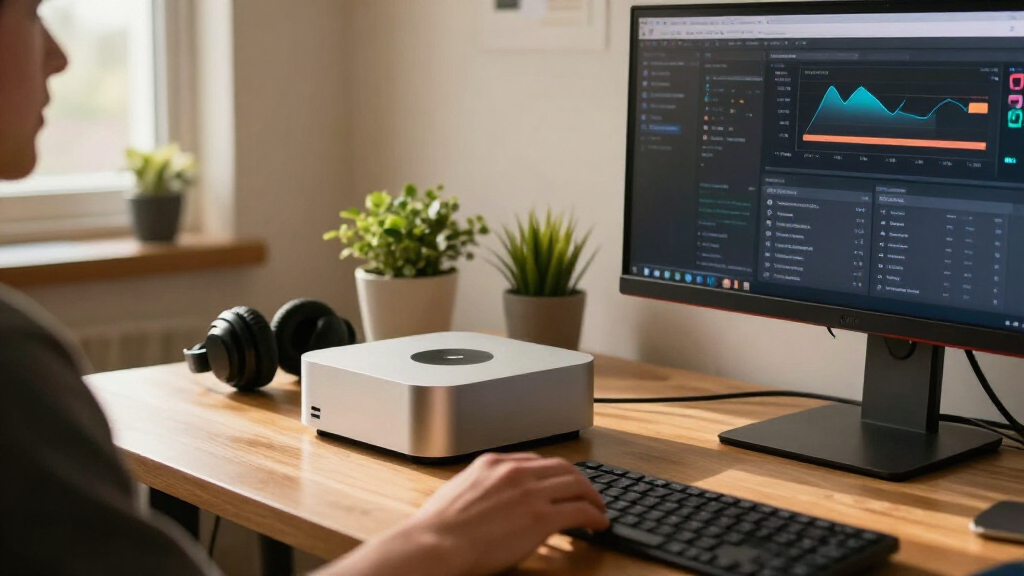
🔍 Read the full analysis: Local AI On Mac Mini: How Memory Shapes Your Options on ThorstenMeyerAI.com

Get business pricing on monitors, keyboards and dev gear
- Business-only prices and quantity discounts
- Tax-exempt purchasing
- Multiple users, one account, clear invoices
TL;DR
Apple is positioning the Mac mini for always-on AI, but its unified memory sets the practical limits: smaller open models can run locally, while larger ones need more memory than the computer offers. Running a model on the machine can offer offline use and keep data local, but memory bandwidth and model size leave data-center hardware better suited to larger or faster workloads.
Apple is positioning its Mac mini as a desktop for always-on AI agents, but the amount of unified memory in each configuration determines which models can run on it. Published specifications indicate that smaller and some mid-size open models can fit, while larger models exceed the mini’s maximum 64 GB of memory or run with substantially less bandwidth than a data-center GPU.
Apple announced the new Mac mini on August 25, 2026, describing it in its press release as “the leading desktop for always-on agentic computing.” The source report says U.S. prices listed by Apple on November 16 start at $899 for a 16 GB M6 model and reach $3,199 for a 64 GB M5 Pro configuration. Memory is selected at purchase rather than upgraded later, according to the report’s summary of Apple’s configuration options.
Memory matters because a model’s weights—the numerical values it uses to generate responses—need to remain available while it runs. Apple’s MLX documentation says its chips use unified memory, shared by the CPU and GPU. The Mac mini models in the source have 16 to 32 GB with the M6 chip and 24 to 64 GB with the M5 Pro. That pool is also used by macOS and other applications, so its full stated capacity is not available to a model.
Model publishers’ figures illustrate the range. Google lists 17.5 GB to load Gemma 4 31B at 4-bit precision and 34.9 GB at 8-bit. OpenAI says gpt-oss-20b runs “within 16GB of memory,” while its gpt-oss-120b is sized for a single 80 GB GPU. These are published requirements or sizing claims, not guarantees of a particular speed or user experience on a Mac mini.
Memory Sets the Local AI Ceiling
For people considering local AI, the key purchase decision is not just which processor to choose: it is how much unified memory to order. A 16 GB configuration may accommodate some compact models, while a 32 GB or 64 GB model can leave room for larger weights and more context. Users who expect to work with long documents or conversations need additional memory beyond the model’s stated weight size.
Running a model locally can mean no per-token cloud bill, offline access and data that stays on the computer. Those advantages may matter to developers, businesses handling sensitive material and people who want an always-available agent. But they do not mean local operation is automatically cheaper overall or faster: the purchase price, power use, model quality, setup and performance all affect the decision.
Speed is a separate limit. Apple lists memory bandwidth of 307 GB/s for the M5 Pro. Nvidia lists 3.35 TB/s for the H100 SXM GPU, about 11 times as much bandwidth by the figures in the source report. That comparison does not establish the relative speed of every model or task, but it helps explain why fitting a model is not the same as matching a data center’s output rate.
Popular right now

Dyson V15 Detect Origin Cordless Vacuum

Bose QuietComfort Headphones (2nd Gen), Wireless Over-Ear Noise-Cancelling Headphones, Black

iRobot Roomba 105 Robot Vacuum with LiDAR Navigation
As an affiliate, we earn on qualifying purchases.
What the Published Specs Show
Apple’s April 30 earnings call offered an earlier sign of demand. Tim Cook said the company could not build enough Mac mini and Mac Studio computers to meet interest in AI and agentic tools. The statement, reported by MacRumors and quoted in the source article, was Apple’s account of customer demand; it does not disclose how many units were short or how much demand came specifically from local AI users.
Google’s Gemma figures also need to be read with their limitations. They describe static model weights, and Google says larger context windows require additional memory. Lower-bit quantization can reduce the memory needed, but it can also affect model quality. In a mixture-of-experts model such as Gemma 4 26B A4B, only four billion parameters are activated per token, yet Google says all 26 billion parameters must be loaded into memory.
The source report says Apple points to Thunderbolt 5 clustering as a way to connect multiple Mac minis for larger on-device models. That is a different setup from a single desktop, and the cited material does not establish what performance users should expect from a cluster in practice.
““The leading desktop for always-on agentic computing.””
— Apple press release, August 25, 2026
Performance Depends on the Workload
The cited specifications do not show real-world generation speeds for each model and Mac mini configuration. Results can vary with model version, quantization, context length, software and the amount of memory used by other applications. The source provides bandwidth figures but not a like-for-like benchmark against an H100.
It is also unclear how much additional memory a given user’s context and applications will consume, or what performance a Thunderbolt-connected Mac mini cluster delivers. Prices and product details in the report are dated November 16, 2026 and may change. The available information does not establish that local AI is more economical for every user once hardware costs and usage patterns are counted.
Check Model Needs Before Buying
People choosing a Mac mini for local AI should compare the model maker’s memory requirements with the computer’s configurable memory, then leave room for macOS, applications and context. They should also check whether the software supports the desired model and reduced-precision format. Apple’s published prices and specifications are the immediate reference points; future model releases or updated configurations could change which workloads fit.
For workloads that exceed 64 GB or require higher throughput, the source material points to larger GPU systems or Apple’s proposed multi-Mac approach rather than a single mini. Until comparable benchmarks and more details on clustered performance are available, buyers will need to judge local operation against cloud access based on privacy, offline needs, speed and total cost.
Key Questions
Can a Mac mini run AI models locally?
Yes. Published requirements indicate that some open models can fit in the Mac mini’s 16 GB to 64 GB of unified memory. Whether a model runs well also depends on software, context length and memory used by the operating system and other applications.
Which Mac mini memory size is suitable for local AI?
There is no single answer for every model. The source figures show some smaller models fitting within 16 GB, while larger models need more. Check the model’s memory requirements and allow additional room for context and other programs before choosing a configuration.
Does a model’s listed memory requirement include long conversations?
Not necessarily. Google says its Gemma figures cover static model weights; larger context windows need additional memory. Long conversations and documents can therefore raise memory needs beyond the base figure.
Can the Mac mini run OpenAI’s gpt-oss-120b?
OpenAI sizes gpt-oss-120b for a single 80 GB GPU, while the Mac mini in the source material tops out at 64 GB. The cited information does not show that this model fits on one Mac mini; Apple points to connecting multiple minis as an on-device option for larger models.
Is local AI faster than using the cloud?
The source does not provide a direct, like-for-like speed test. It reports Mac mini memory bandwidth below the cited H100 figure, but actual performance depends on the model, task and software. Local AI may still suit users who value offline access or data kept on-device.
Source: ThorstenMeyerAI.com