To visualize your customer’s experience, start with tools like customer personas to understand their needs and motivations, and touchpoint analysis to identify every interaction they have with your brand. Use journey mapping to create a visual story of their experience from start to finish, highlighting emotions and pain points at each stage. These tools help you spot gaps and improve customer satisfaction. Keep exploring to uncover more strategies that turn insights into action.
Key Takeaways
- Utilize visual tools like flowcharts and diagrams to map customer interactions across all touchpoints.
- Implement software solutions such as Lucidchart, Smaply, or Microsoft Visio for interactive journey maps.
- Incorporate emotional and sensory insights to understand customer feelings at each stage.
- Use customer personas to personalize and enrich the journey visualization.
- Analyze data-driven touchpoint insights to identify pain points and opportunities for improvement.
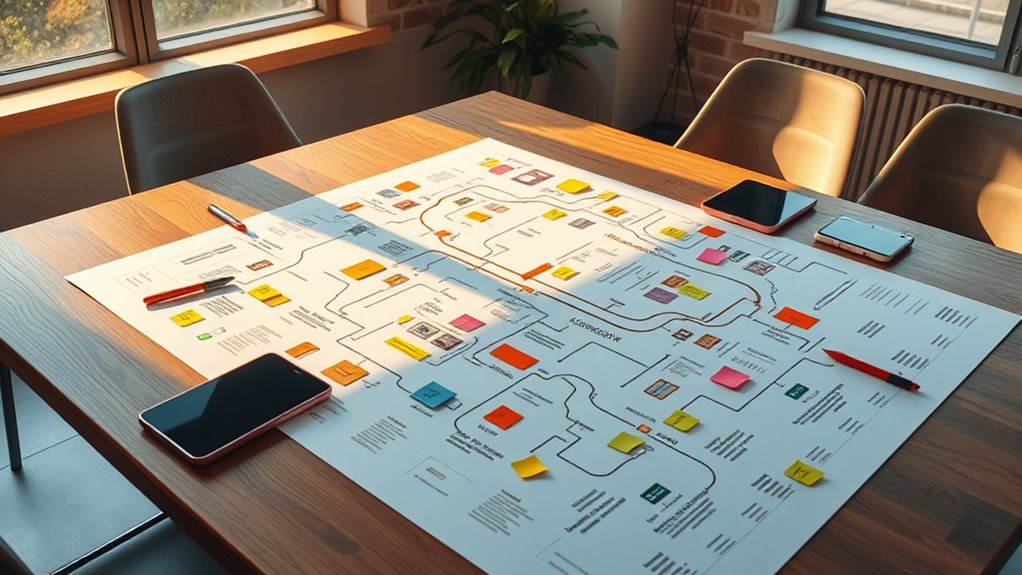
Have you ever wondered how businesses understand what customers experience at each step of their interaction? It all begins with creating detailed customer personas. These personas are fictional yet data-driven representations of your typical customers, capturing their needs, preferences, frustrations, and motivations. By developing these personas, you gain a clear picture of who your customers are, which helps you anticipate their behaviors and expectations throughout their journey. When you combine customer personas with touchpoint analysis, you start to see the complete picture of the customer experience. Touchpoint analysis involves identifying every moment your customer interacts with your brand—whether it’s visiting your website, speaking with support, or receiving a product. This process reveals which touchpoints matter most and how each influences the overall experience.
Creating detailed customer personas and analyzing touchpoints reveal the full customer experience.
Once you’ve established your customer personas, you can map out their journey by pinpointing these touchpoints along each stage. Think of journey mapping as creating a visual story that charts your customer’s experience from initial awareness to post-purchase follow-up. You’re not just listing steps; you’re understanding the emotions, questions, and pain points your customers encounter at every point of contact. For example, at the awareness stage, your customer might be browsing online, reading reviews, or seeing an advertisement. During consideration, they might contact support or compare products. Post-purchase, they may seek help with setup or look for ways to provide feedback. By analyzing each touchpoint, you identify gaps, bottlenecks, or moments where the experience could be enhanced.
Touchpoint analysis is essential because it helps you see where your business excels and where it falls short. It’s about understanding not only what your customers do but also how they feel at each moment. For instance, if a customer feels frustrated during the checkout process, you can pinpoint that specific touchpoint and focus on streamlining or improving it. Using journey maps, you can visualize these insights, making it easier to communicate problems and brainstorm solutions with your team. These visual tools serve as a reference point for designing better customer experiences, ensuring every interaction aligns with customer needs and expectations.
In addition, incorporating insights from music therapy for autism can help you better understand sensory sensitivities and emotional responses that influence customer interactions. These insights can guide you in creating more empathetic and accessible touchpoints. By analyzing each touchpoint, you can also foster a more human-centered approach to your customer experience strategy. These visual tools serve as a reference point for designing better customer experiences, ensuring every interaction aligns with customer needs and expectations.
In short, understanding your customers through detailed personas and analyzing each touchpoint is the foundation of effective journey mapping. It empowers you to see your customers’ experience from their perspective, allowing you to make data-driven improvements. By mapping out the journey, you’ll be better equipped to create seamless, satisfying experiences that foster loyalty and trust. Ultimately, this process turns complex customer interactions into manageable, actionable insights, helping your business grow and thrive in a competitive landscape.

User Experience Mapping: Enhance UX with User Story Map, Journey Map and Diagrams
As an affiliate, we earn on qualifying purchases.
As an affiliate, we earn on qualifying purchases.
Frequently Asked Questions
How Do I Start Creating a Customer Journey Map?
To start creating a customer journey map, first define your customer personas to understand their needs and behaviors. Then, conduct a touchpoint analysis to identify every interaction they have with your business. Map out these touchpoints step-by-step, noting emotions and pain points. This approach helps visualize the entire customer experience, allowing you to identify opportunities for improvement and deliver a smoother, more engaging journey.
What Are the Common Mistakes to Avoid in Journey Mapping?
Avoid common mistakes like customer bias and overgeneralization, which 60% of businesses overlook. You might assume all customers behave the same, but that skews your insights. Focus on specific, data-driven details instead of broad generalizations. Don’t let your assumptions cloud the map. Keep it rooted in real customer feedback to create an accurate, useful journey map that genuinely improves their experience.
How Often Should I Update My Customer Journey Maps?
You should update your customer journey maps regularly, ideally every 6 to 12 months, or whenever you gather new customer feedback or data analytics. This helps you stay aligned with evolving customer behaviors and expectations. Keep an eye on trends and pain points from recent feedback, and adapt your maps accordingly. Regular updates ensure your strategies remain relevant and effective in delivering a seamless customer experience.
Can Journey Mapping Be Used for Internal Team Alignment?
Yes, journey mapping is great for internal alignment and fostering cross-department collaboration. You can use it to visualize the customer experience, making everyone understand their role in delivering value. By involving different teams in the mapping process, you guarantee clear communication and shared goals. This alignment helps identify gaps, streamline processes, and improve overall customer satisfaction, creating a cohesive approach across your organization.
What Tools Are Best for Complex Multi-Channel Journeys?
Think of your customer journey as a sprawling cityscape—you’ll need the right tools to see every street and alley clearly. For complex multi-channel journeys, use data visualization tools like Tableau or Power BI to map omni-channel integration seamlessly. These tools help you connect touchpoints, identify bottlenecks, and understand customer flow across platforms, giving you a crystal-clear view of the entire experience and enabling smarter, more cohesive strategies.

Mapping Experiences: A Complete Guide to Creating Value through Journeys, Blueprints, and Diagrams
As an affiliate, we earn on qualifying purchases.
As an affiliate, we earn on qualifying purchases.
Conclusion
Now that you know the essentials of journey mapping and the tools to bring your customer’s experience to life, you’re ready to transform how you see your business. By visualizing every touchpoint, you’ll uncover insights that can revolutionize your approach—like discovering a secret map to customer loyalty. Don’t underestimate the power of these tools; they’re your secret weapon to crafting unforgettable experiences that can propel your brand to legendary status. Get started and watch your customer relationships thrive!
touchpoint analysis diagrams
As an affiliate, we earn on qualifying purchases.
As an affiliate, we earn on qualifying purchases.

Customer Persona: A Practical guide to Marketing and Business Growth for Entrepreneurs with templates (Launch & Grow: The essential guide series for entrepreneurs)
As an affiliate, we earn on qualifying purchases.
As an affiliate, we earn on qualifying purchases.