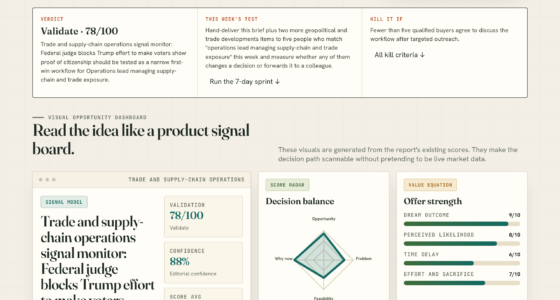

📊 Full opportunity report: Is Artificial Intelligence The Future Of Ukraine’s Resistance To Russia’s Amazon? on ThorstenMeyerAI.com — validation score, market gap, and execution plan.

Get business pricing on monitors, keyboards and dev gear
- Business-only prices and quantity discounts
- Tax-exempt purchasing
- Multiple users, one account, clear invoices
TL;DR
Ukraine is employing advanced AI and cyber tactics to strike at Russia’s Wildberries logistics network, disrupting military supply chains and impacting the civilian economy. The strategy aims to hinder decentralized procurement and degrade Russia’s war effort.
Ukraine is actively using cyber and artificial intelligence (AI) tools to target Russia’s logistics network centered around Wildberries, Russia’s largest online marketplace, in a bid to weaken its military supply chain and economic stability. This development signals a shift toward digital and AI-enabled tactics in the ongoing conflict, with significant implications for both military operations and civilian infrastructure.
Since July 2023, Ukrainian cyber operations have focused on disrupting Wildberries’ logistics hubs across Russia, aiming to impair the decentralized procurement of military equipment and supplies. Ukrainian officials and independent analysts suggest that these strikes are not only damaging physical warehouse capacity but also creating friction in the supply chain by delaying or increasing the cost of critical components such as fibre-optic cables, drones, and electronic parts.
According to sources familiar with Ukrainian military strategy, the use of AI-driven cyber tools allows Ukraine to identify and target key logistical nodes more precisely, reducing the need for conventional military engagement. Ukrainian President Volodymyr Zelensky has publicly acknowledged the importance of disrupting supply chains that facilitate the transfer of military gear, including tactical equipment and drone components, through commercial platforms like Wildberries.
Since 18 July, Ukrainian drones have hit ~20 Wildberries logistics sites. It looks like an odd target — until you see that one strike can hit three systems at once: the battlefield supply chain, the civilian economy, and the banks.
Wildberries is a consumer marketplace, a national logistics network, a decentralised military-supply channel, and an increasingly important node in Russia’s banking system. Hit a warehouse and the cost propagates outward.
Impact of AI and Cyber Tactics on Russia’s War Effort
The use of AI and cyber operations to target Russia’s logistics network represents a strategic evolution in Ukraine’s resistance efforts. By disrupting the decentralized procurement system, Ukraine aims to increase logistical costs, delay supplies, and weaken Russia’s capacity to sustain prolonged military campaigns. These tactics also threaten to erode the economic stability of Russia’s civilian sector, as widespread warehouse damage impacts millions of independent sellers and consumers, further complicating Russia’s war economy.
cybersecurity tools for supply chain protection
As an affiliate, we earn on qualifying purchases.
As an affiliate, we earn on qualifying purchases.
Digital Warfare and Supply Chain Disruption in Ukraine-Russia Conflict
Since the onset of the Ukraine conflict, Kyiv has increasingly employed cyber warfare alongside conventional military tactics. The recent focus on Wildberries, Russia’s dominant e-commerce platform, underscores a broader strategy to target the infrastructure that underpins Russia’s military logistics and civilian economy. Ukrainian strikes on warehouses have damaged over a million square meters of storage, with implications for both military supplies and everyday commerce.
Historically, Ukraine’s cyber operations have targeted critical infrastructure, but recent efforts leverage AI to enhance precision and impact. The focus on fibre-optic cables and electronic components highlights a shift toward disrupting the supply chain of materials essential for modern drone warfare and military technology, which rely heavily on civilian infrastructure.
"Our cyber operations aim to slow down and complicate Russia’s ability to supply its military and sustain its economy. Disrupting these networks is a key part of our strategy."
— Ukrainian Defense Official
AI-powered logistics management software
As an affiliate, we earn on qualifying purchases.
As an affiliate, we earn on qualifying purchases.
Extent and Effectiveness of AI-Driven Disruption Unclear
It is not yet clear how effective Ukraine’s AI and cyber tactics have been in significantly impairing Russia’s logistics or whether these strikes have caused long-term disruptions. Details about the specific technological methods used and the scale of impact remain limited, and Russia’s response measures are still unknown.
electronic component testing tools
As an affiliate, we earn on qualifying purchases.
As an affiliate, we earn on qualifying purchases.
Expected Developments in Ukraine’s Digital Resistance Tactics
Ukraine is likely to continue expanding its cyber and AI operations targeting Russian logistics, with potential escalation to more sophisticated digital attacks. Monitoring the impact on supply chains and civilian infrastructure over the coming months will be critical, alongside diplomatic and military responses from Russia.
As an affiliate, we earn on qualifying purchases.
Key Questions
How is Ukraine using AI in its cyber operations?
Ukraine employs AI to identify key logistical nodes, analyze supply chain vulnerabilities, and execute targeted cyber strikes on Russian warehouses and infrastructure.
Are these tactics effective against Russia’s military supply chain?
While the full impact is still being assessed, Ukraine’s strikes have caused delays and increased costs for critical components, potentially weakening Russia’s decentralized procurement system.
Could these cyber tactics escalate the conflict?
There is potential for escalation, especially if Russia responds with its own cyber or military countermeasures, but the current focus remains on disrupting logistics and economic stability.
What are the risks of civilian infrastructure being affected?
Since many logistics hubs serve both military and civilian markets, strikes could impact millions of civilians by disrupting supply chains and economic activity.
Source: ThorstenMeyerAI.com
Fall Picks
fall essentials
As an affiliate, we earn on qualifying purchases.