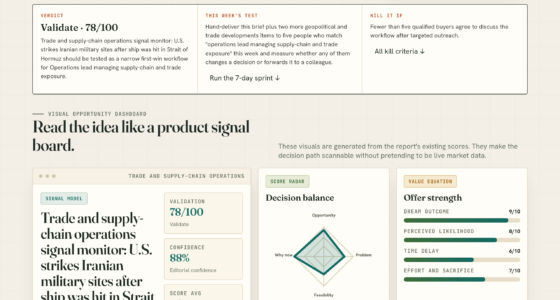

📊 Full opportunity report: The Fallacy Of Regulating An Intelligence Outside Our Reach on ThorstenMeyerAI.com — validation score, market gap, and execution plan.

Get business pricing on monitors, keyboards and dev gear
- Business-only prices and quantity discounts
- Tax-exempt purchasing
- Multiple users, one account, clear invoices
TL;DR
A drone carrying explosives was intercepted near Leipzig/Halle airport, highlighting hybrid threats. Europe’s AI regulation lags behind, risking its ability to defend against such attacks, which depend on advanced AI tools.
On Tuesday overnight, a drone carrying explosives was spotted near Leipzig/Halle airport’s south runway, prompting a police response and the defusing of the device. Simultaneously, a DHL cargo aircraft diverted after striking an unknown object mid-air. Germany has launched a counterterrorism investigation, with officials describing the incident as a sophisticated hybrid threat, likely linked to ongoing geopolitical tensions.
The drone was discovered in a cargo zone of Europe’s largest freight hub, which also functions as a NATO and German military logistics center. The incident is believed to be part of a broader hybrid warfare campaign, involving sabotage, cyber intrusion, and infrastructure probing. The drone was defused by bomb disposal robots, and the aircraft incident prompted heightened security measures. No official attribution has been made, but suspicion points toward Russian involvement, given the target’s strategic importance and recent patterns of activity.
Germany has responded by opening a counterterrorism investigation and establishing a Joint Centre for Countering Hybrid Threats. However, experts warn that current European capabilities are limited, particularly in AI, which increasingly underpins defense systems against such threats. Europe’s AI regulation, exemplified by the AI Act, is highly advanced but focuses on governance rather than technological possession, leaving a significant capability gap compared to US and Chinese AI labs. This gap could hinder Europe’s ability to defend itself in future hybrid conflicts.
An explosive drone on a military cargo hub’s runway. A “professional hybrid threat,” said the interior minister — “a new level of danger.” It’s a moment to say something uncomfortable about how Europe is meeting the era it has entered.
▲ Opinion · strategic argument is the author’s ownEurope’s reflex to a new technology is to regulate it — and it’s genuinely good at it. The AI Act is the most comprehensive AI law on Earth. The discomfort is what sits underneath.
The sloppy version of this argument is wrong, and I won’t make it. The real connection runs one level deeper — through the word “hybrid.”
The rebuttal: just use American AI. For many things, today, Europe can. But defense is the specific case where you can’t.
The strongest version of the other side, because parts of it are right and it deserves to be heard.
- Regulation and capability aren’t zero-sum — Europe is investing (InvestAI, gigawatt data centers)
- Drone defense is mostly physical security and intelligence, not frontier LLMs — I overweight my own field
- Sovereign defense AI may need a smaller controllable model, not a leaderboard chase
- Setting global norms has real value, capability or not
Only capability does that — and it’s the thing we’ve been legislating around instead of building.
Implications of AI Regulation on Hybrid Defense Capabilities
This incident underscores a critical vulnerability: Europe's focus on regulating AI has not translated into building the advanced, sovereign AI systems necessary for effective defense against hybrid threats. While Europe leads in AI governance, its AI development trajectory lags behind the US and China, risking a capability gap that could be exploited in future conflicts. The incident exemplifies how hybrid warfare relies on rapid, machine-speed responses that require AI systems Europe currently does not control, potentially compromising national security and strategic autonomy.
drone detection and jamming system
As an affiliate, we earn on qualifying purchases.
As an affiliate, we earn on qualifying purchases.
Europe’s AI Policy and Military Preparedness Compared
Europe has made significant strides in AI regulation, with the AI Act establishing comprehensive rules for AI governance. However, despite this regulatory leadership, European AI labs, such as Mistral, are building models that are increasingly behind the frontier set by US and Chinese competitors. As of August 2026, Europe's best models score only about 30 on a scale where the frontier is 56–61, with a trajectory that is flat or declining. Meanwhile, hybrid threats like the drone incident demonstrate the importance of possessing advanced AI for real-time defense, which Europe currently lacks.
This mismatch between regulation and technological capability is not merely academic; it has tangible security implications. The ability to detect, analyze, and respond to hybrid threats in real time depends on AI systems that can operate at the frontier level, which Europe is not currently building.
"This is not amateurish; it is a professional hybrid threat scenario, a new level of danger."
— German Interior Minister Alexander Dobrindt
As an affiliate, we earn on qualifying purchases.
Unresolved Questions About Attribution and Capabilities
It remains unclear who was behind the drone incident, with no official attribution yet confirmed. The precise capabilities of European AI systems used for defense are also not publicly detailed, and it is uncertain whether existing systems could have prevented or mitigated the attack. The trajectory of Europe's AI development, especially at the frontier level, is also still being assessed, with experts warning it may fall further behind.
military-grade bomb disposal robots
As an affiliate, we earn on qualifying purchases.
As an affiliate, we earn on qualifying purchases.
Next Steps in European Hybrid Threat Defense
Germany and European security agencies are expected to enhance investigation efforts and possibly accelerate the development of sovereign AI systems for defense. The upcoming establishment of the Joint Centre for Countering Hybrid Threats aims to integrate advanced AI tools, but its effectiveness will depend on Europe's ability to build and deploy frontier AI models. Policymakers may face pressure to balance regulation with strategic possession of critical AI capabilities to ensure resilience against future hybrid attacks.
As an affiliate, we earn on qualifying purchases.
Key Questions
Why is Europe's AI regulation insufficient for defense?
Because Europe's AI regulation focuses on governance and ethical use, not on building or possessing the frontier AI systems necessary for rapid, autonomous defense in hybrid warfare scenarios.
Could European AI systems have prevented the drone incident?
It is unlikely, as current European AI capabilities are not at the frontier level needed for real-time detection and response, which are critical in hybrid threats involving multiple domains.
Why is sovereignty important in AI for defense?
Sovereign AI ensures that critical defense systems remain operational regardless of international relations, dependencies, or external restrictions, maintaining strategic autonomy and resilience.
What are hybrid threats, and why are they dangerous?
Hybrid threats involve coordinated, multi-domain campaigns including sabotage, cyber attacks, disinformation, and infiltration, designed to operate below the threshold of open conflict and exploit vulnerabilities quickly and deniably.
Source: ThorstenMeyerAI.com
Fall Picks
fall essentials
As an affiliate, we earn on qualifying purchases.