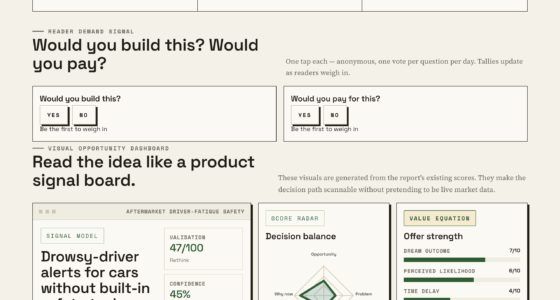

📊 Full opportunity report: A War Room for Your Next Idea: Inside IdeaClyst on ThorstenMeyerAI.com — validation score, market gap, and execution plan.

Get business pricing on monitors, keyboards and dev gear
- Business-only prices and quantity discounts
- Tax-exempt purchasing
- Multiple users, one account, clear invoices
TL;DR
IdeaClyst is a local-first AI tool designed for founders to rigorously evaluate startup ideas through a structured, multi-model council. It aims to reduce costly market failures by providing rapid, evidence-based validation and decision support.
IdeaClyst has been introduced as a local-first AI tool that acts as a structured war room for startup founders to evaluate, critique, and develop their ideas without relying on cloud services or risking data leaks.
Designed specifically for founders facing the challenge of choosing which ideas to pursue, IdeaClyst offers a multi-model AI council that pressure-tests ideas through a five-step deliberation process. Unlike typical AI tools that provide single responses, it stages disagreements among different models to surface potential flaws and strengths, producing a comprehensive founder report stored locally on the user’s machine.
The tool emphasizes data privacy by operating entirely offline, saving all files as plain Markdown documents on the local disk. It integrates real web research, pulling in live data from competitor sites and discussions, grounding its assessments in current market realities. This approach aims to prevent the common trap of overconfidence based on unchallenged AI approval, which many founders have experienced, similar to the challenges discussed in how structured idea evaluation can improve startup success.
IdeaClyst functions as a three-in-one platform: an AI council for critique, a discovery engine for new ideas, and a workspace for moving promising concepts toward readiness. Its design responds to the high costs of market failure, estimated at over $150,000 for a year of building the wrong product, by enabling faster, evidence-based validation.
A war room for your next idea
The build isn’t the hard part anymore — conviction is. Knowing which idea deserves the next six months, and being able to defend it. Most founders answer with gut feel and optimistic math. That’s hope wearing a blazer. IdeaClyst replaces it with a process.
The most expensive decision is what to build
The single most valuable thing a tool can do is talk you out of the wrong six months. The numbers make the case better than any pitch.
Three tools in one — on your own machine
Strip away the framing and IdeaClyst is three things at once, all running locally with nothing leaving your laptop.
An AI council
Pressure-tests an idea you bring it — advisors who argue on purpose.
A discovery engine
Finds ideas you didn’t know to look for by hunting real demand signals.
A founder’s workspace
Carries winners from “interesting” all the way to “ready to build.”
Advisors who disagree on purpose
Not one confident, agreeable answer — a structured five-step deliberation where models play different roles and turn on their own work. The disagreement is the feature.
The five-step deliberation
A council that leads with the bad news surfaces the objections you’d otherwise find the expensive way, on month five.
Product strategy
Who’s it for, what’s the wedge, why now, what’s the business model.
Technical architecture
What would it actually take to build — and where’s the risk.
Critique pass
The council turns on its own work. Where’s the hand-waving? What kills this?
Second, independent critique
A different voice, a different angle — so blind spots don’t survive.
Final synthesis
Everything into one coherent founder packet: strategy, architecture, validation, plan.
When IdeaClyst cites a source, it actually fetched it
The hard departure from “ask an AI what it thinks of my startup.” It runs in a strict, real-data-only mode — if it can’t gather genuine evidence, it says so plainly rather than inventing a plausible paragraph.
Confidence with receipts
No fabricated statistics, no imaginary competitors, no made-up citations. The packet survives a skeptical co-founder or a sharp investor because the reasoning has receipts.
Market research first
Scouts the landscape before the council reasons about anything.
Competitor read
Real positioning, pricing signals, feature claims — differentiation vs. reality.
Validation with links
Not “talk to customers” — concrete signals & sources you can click.
From the blank page to build-ready
Evaluation is half the problem; the blank page is the other half. And a plan is worthless if it dies in a tab you never reopen.
Bring a space, not an idea
“AI for accountants,” “tools for indie game studios” — plus your goal and real capacity. It hunts demand signals across HN, Reddit, Product Hunt, GitHub, pricing pages.
- An honest market read — leads with the bad news when a space is hard
- An opportunity map — high pain, thin competition
- Ranked candidates — wedge, who pays, effort, risk, confidence
- each with KILL CRITERIA — when to walk away
A home and a forward path
Every promising idea gets carried forward, with every artifact in plain files on your disk.
- Validation tooling — sprint board, interview list, evidence browser
- Founder profile — a personal-fit lens; same discovery, different advice
- Build workspaces — funnel, personas, landing draft, version history
- “Build this idea” → a PRD + task queue, ready for a coding agent
Potential Impact on Startup Validation and Decision-Making
By providing founders with a structured, privacy-preserving tool that accelerates idea validation, IdeaClyst could significantly reduce the risk of building products with no market need, which accounts for roughly 42% of startup failures. Its offline operation appeal to those concerned about data security and control, making it a noteworthy innovation in early-stage startup tooling.
Moreover, its multi-model debate approach encourages more critical thinking and thorough analysis, potentially leading to better strategic choices and resource allocation. If widely adopted, it could shift how startups approach validation, moving from hope-driven guesses to evidence-backed decisions.
offline AI idea validation software
As an affiliate, we earn on qualifying purchases.
As an affiliate, we earn on qualifying purchases.
Background on Startup Failure and Validation Challenges
Startup failures often stem from building products that lack market demand, a problem highlighted by CB Insights, which states that 42% of failures are due to no market need. Traditional validation methods—surveys, customer interviews, and consultants—are costly and slow, often taking months and thousands of dollars, which many founders skip or underestimate.
Recent advancements in AI and web scraping have begun to reduce these costs, with tools capable of compressing research from months into hours. However, most existing solutions depend on cloud services, raising data security concerns. IdeaClyst addresses this gap by offering a local alternative that emphasizes privacy and real-time market grounding.
The platform builds on the recognition that founders need faster, more reliable validation to avoid costly missteps, especially as AI becomes more integrated into early-stage decision-making.
“IdeaClyst isn’t just another AI tool; it’s a strategic war room that helps founders rigorously challenge their ideas with real-time research and structured debate, all stored securely on their own machines.”
— Thorsten Meyer, founder of ThorstenMeyerAI.com
local data privacy startup research tool
As an affiliate, we earn on qualifying purchases.
As an affiliate, we earn on qualifying purchases.
Unanswered Questions About Adoption and Effectiveness
It is not yet clear how widely founders will adopt IdeaClyst, or how effective its multi-model council will be in preventing costly mistakes in real-world scenarios. Long-term user feedback and comparative studies are still forthcoming to validate its impact on startup success rates.
AI-powered business idea critique software
As an affiliate, we earn on qualifying purchases.
As an affiliate, we earn on qualifying purchases.
Next Steps for Adoption and Validation Studies
The company plans to release beta versions to early adopters and collect user feedback over the coming months. Future updates may include integrations with other startup tools and more refined research capabilities. Industry observers will be watching for data on whether IdeaClyst reduces failed ventures and accelerates successful product launches.
As an affiliate, we earn on qualifying purchases.
Key Questions
How does IdeaClyst protect my data?
All data, ideas, and reports are stored locally on your machine as plain files, with no data leaving your device, ensuring maximum privacy and control.
Can I use IdeaClyst without internet access?
Yes, since it operates entirely locally, you can use it offline once installed, making it suitable for secure environments or remote work.
How does the AI council work in practice?
You input an idea, and the platform stages a structured five-step debate among different AI models representing various perspectives, culminating in a comprehensive report that challenges and validates your concept.
Is IdeaClyst suitable for non-technical founders?
Yes, its interface is designed to be accessible, guiding users through structured deliberations without requiring technical expertise.
What are the costs involved in using IdeaClyst?
Since it runs locally, there are no subscription fees or cloud charges; however, initial setup may require some technical familiarity.
Source: ThorstenMeyerAI.com
Fall Picks
fall essentials
As an affiliate, we earn on qualifying purchases.