
TL;DR

Get business pricing on monitors, keyboards and dev gear
- Business-only prices and quantity discounts
- Tax-exempt purchasing
- Multiple users, one account, clear invoices
IdeaClyst acts as a personal digital war room, offering a private space for founders to test, develop, and decide on ideas quickly. It combines AI-driven debate, research, and planning—all on your own machine—saving time and money while boosting confidence.
Imagine sitting at your desk, staring at three different ideas, each with potential but also risks that could drain your time and savings. Now picture a space where those ideas are dissected, debated, and refined—all on your own computer, with no cloud or third-party data.
This is what makes IdeaClyst special. It’s not just another tool; it’s a private war room that helps you develop your ideas faster, with more clarity, and less guesswork. In this article, I’ll show you how IdeaClyst turns the messy process of innovation into a focused, strategic battle—where your best ideas win.
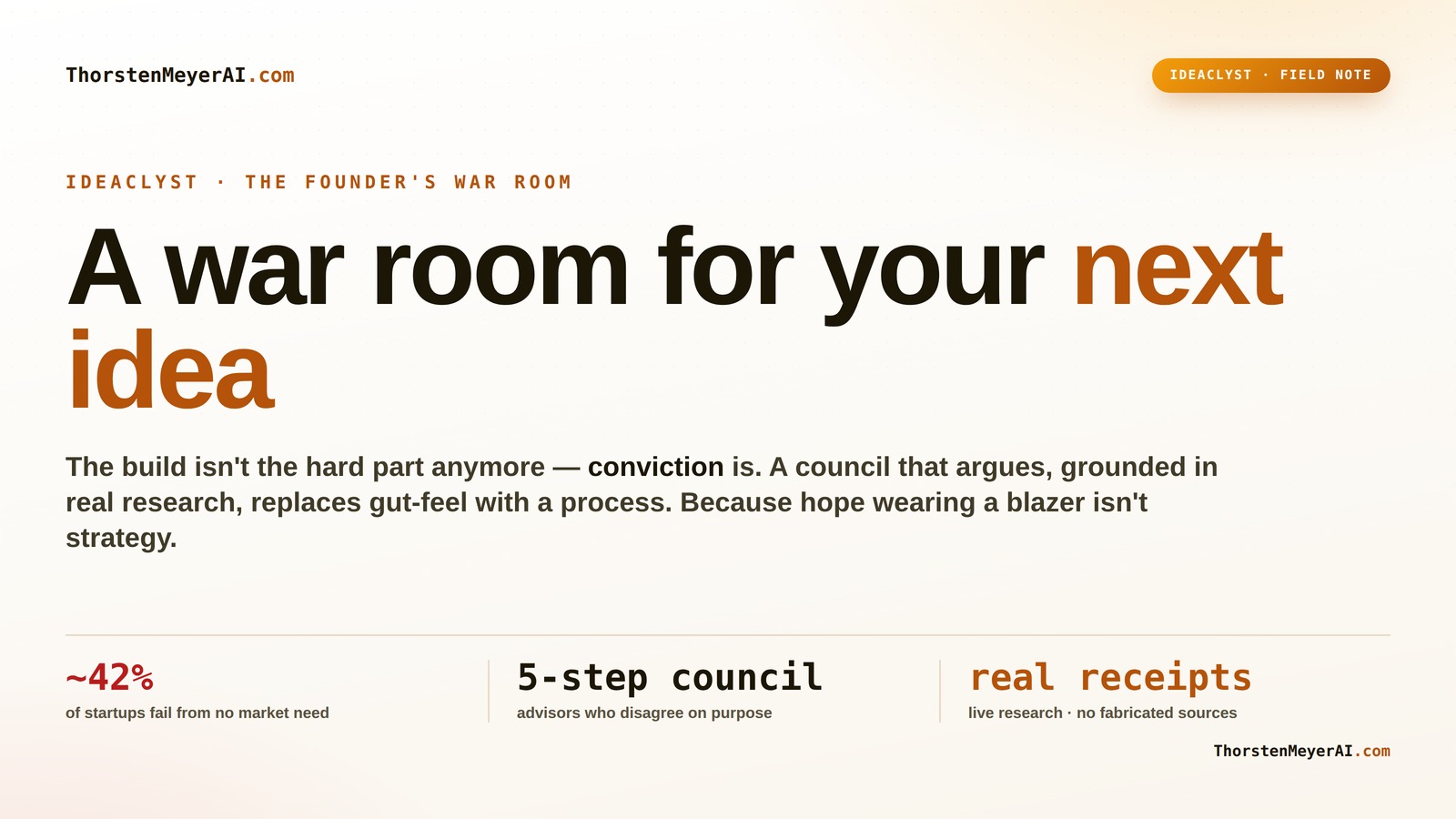
A war room for your next idea
The build isn’t the hard part anymore — conviction is. Knowing which idea deserves the next six months, and being able to defend it. Most founders answer with gut feel and optimistic math. That’s hope wearing a blazer. IdeaClyst replaces it with a process.
The most expensive decision is what to build
The single most valuable thing a tool can do is talk you out of the wrong six months. The numbers make the case better than any pitch.
Three tools in one — on your own machine
Strip away the framing and IdeaClyst is three things at once, all running locally with nothing leaving your laptop.
An AI council
Pressure-tests an idea you bring it — advisors who argue on purpose.
A discovery engine
Finds ideas you didn’t know to look for by hunting real demand signals.
A founder’s workspace
Carries winners from “interesting” all the way to “ready to build.”
Advisors who disagree on purpose
Not one confident, agreeable answer — a structured five-step deliberation where models play different roles and turn on their own work. The disagreement is the feature.
The five-step deliberation
A council that leads with the bad news surfaces the objections you’d otherwise find the expensive way, on month five.
Product strategy
Who’s it for, what’s the wedge, why now, what’s the business model.
Technical architecture
What would it actually take to build — and where’s the risk.
Critique pass
The council turns on its own work. Where’s the hand-waving? What kills this?
Second, independent critique
A different voice, a different angle — so blind spots don’t survive.
Final synthesis
Everything into one coherent founder packet: strategy, architecture, validation, plan.
When IdeaClyst cites a source, it actually fetched it
The hard departure from “ask an AI what it thinks of my startup.” It runs in a strict, real-data-only mode — if it can’t gather genuine evidence, it says so plainly rather than inventing a plausible paragraph.
Confidence with receipts
No fabricated statistics, no imaginary competitors, no made-up citations. The packet survives a skeptical co-founder or a sharp investor because the reasoning has receipts.
Market research first
Scouts the landscape before the council reasons about anything.
Competitor read
Real positioning, pricing signals, feature claims — differentiation vs. reality.
Validation with links
Not “talk to customers” — concrete signals & sources you can click.
From the blank page to build-ready
Evaluation is half the problem; the blank page is the other half. And a plan is worthless if it dies in a tab you never reopen.
Bring a space, not an idea
“AI for accountants,” “tools for indie game studios” — plus your goal and real capacity. It hunts demand signals across HN, Reddit, Product Hunt, GitHub, pricing pages.
- An honest market read — leads with the bad news when a space is hard
- An opportunity map — high pain, thin competition
- Ranked candidates — wedge, who pays, effort, risk, confidence
- each with KILL CRITERIA — when to walk away
A home and a forward path
Every promising idea gets carried forward, with every artifact in plain files on your disk.
- Validation tooling — sprint board, interview list, evidence browser
- Founder profile — a personal-fit lens; same discovery, different advice
- Build workspaces — funnel, personas, landing draft, version history
- “Build this idea” → a PRD + task queue, ready for a coding agent
Key Takeaways
- IdeaClyst offers a private, local-first digital war room that helps founders challenge and develop ideas faster, with less risk.
- A structured, visible workspace accelerates decision-making and reduces costly mistakes—especially when combined with AI critique and research.
- Include research notes, sketches, decisions, and critiques inside your war room to keep ideas organized and actionable.
- Regular updates, active debates, and clear archiving keep your war room vibrant and valuable over time.
- Hybrid setups—physical and digital—maximize flexibility, but digital tools like IdeaClyst are ideal for remote or privacy-sensitive projects.
personal AI research assistant software
As an affiliate, we earn on qualifying purchases.
As an affiliate, we earn on qualifying purchases.
What is IdeaClyst? The Digital War Room You Can Trust
IdeaClyst is a local-first platform designed to give founders a private, structured space for idea development. Think of it as your personal war room—where your team can gather, debate, and plan without leaks or distractions.
It combines three core features: an AI council to challenge your ideas, a discovery engine to find hidden opportunities, and a founder’s workspace to organize and prepare for action.
Most importantly, everything stays on your machine—no cloud, no subscriptions, no data leaks. This keeps your early-stage concepts safe, private, and under your control. For more details, visit IdeaClyst.
As an affiliate, we earn on qualifying purchases.
Why a War Room Approach Accelerates Your Ideas
War rooms aren’t just for military strategy—they’re a proven way to boost collaboration, surface hidden issues, and make faster decisions. When your team has a dedicated space to visualize progress, it becomes easier to spot gaps and pivot quickly.
In startup terms, a war room cuts down the endless back-and-forth. It keeps your ideas visible, your research central, and your critique honest. For example, a team working on a new SaaS product can see all their hypotheses, customer feedback, and technical risks laid out in one place, making adjustments in real time. Learn more about creating effective war rooms.
Research from design and innovation fields shows that teams who keep work visible outperform those who only discuss ideas in meetings. Visibility isn’t just about pictures on the wall; it’s about creating a shared mental model that everyone can act on. This shared mental model is crucial because it aligns team members’ understanding, reduces misunderstandings, and accelerates consensus. To learn more about effective decision-making, visit HaltMal.
As an affiliate, we earn on qualifying purchases.
What Belongs in Your IdeaClyst War Room? The Must-Have Elements
To make your digital war room effective, you need to fill it with the right artifacts. Think of it like a cockpit where every control and readout helps steer your idea forward. These elements are the building blocks that ensure your team can make informed, timely decisions and pivot when necessary.
Key elements include:
- Research notes: Customer interviews, market data, competitor analysis. These form the factual backbone that informs your assumptions and helps avoid biases or guesses.
- Sketches & diagrams: Visuals of user flows, technical architecture, or prototypes. Visual artifacts facilitate understanding and communication, especially for complex ideas, enabling quick iteration and shared comprehension.
- Decision logs: Clear records of what was decided, why, and next steps. This history prevents redundant debates and helps new team members catch up quickly, maintaining momentum.
- Critique reports: Challenges, risks, and alternative strategies identified by your AI council. These foster critical thinking and help surface blind spots before costly mistakes happen.
- Final plan & roadmap: A consolidated document ready for execution or investor presentation. It synthesizes all insights into a clear, actionable strategy, reducing ambiguity and aligning team efforts.
For example, a founder working on a new AI-powered app might keep research on user pain points, sketches of the interface, and AI architecture diagrams—all in one place, easy to update and review. This comprehensive organization accelerates validation and reduces the risk of overlooking critical details, which can otherwise cause costly delays or pivots later. For insights on sustainable innovation, see Attune Magazine.
Amazonidea development software for entrepreneurs
As an affiliate, we earn on qualifying purchases.
As an affiliate, we earn on qualifying purchases.
How Teams Use IdeaClyst in Practice: From Idea to Action
Using IdeaClyst isn’t just about storing ideas—it’s about actively shaping them. Here’s a typical flow that highlights how this process leads to better, faster decisions:
- Start with a rough idea: Write a quick pitch or concept into the system. This initial step captures your raw thinking and sets the stage for deeper exploration.
- Activate the AI council: Let it critique, challenge assumptions, and surface risks. This step is crucial because it introduces an objective, data-driven perspective that can identify flaws or overlooked opportunities early on.
- Explore new angles: Use the discovery engine to find related ideas, market niches, or technical solutions. This broadens your perspective and uncovers potential pathways you might not have considered.
- Refine the plan: Organize research, sketches, and critiques into a final strategy document. This synthesis ensures all insights are integrated, reducing ambiguity and aligning your team.
- Decide and build: With a clear, validated plan, you can confidently move into development, minimizing rework and costly mistakes.
For instance, a founder exploring a new health tech app used IdeaClyst to debate features, test technical feasibility, and identify potential regulatory hurdles—all before a single line of code was written. This proactive approach saved time, avoided costly pivots, and clarified the product’s value proposition early in the process. To see more about innovative health solutions, visit Guidetohalal.
Digital or Physical? How to Build Your War Room for Ideas
Traditional war rooms are physical spaces filled with whiteboards, sticky notes, and charts. But in the digital age, your war room can be just as vibrant—without the clutter. The choice between physical and digital depends on your team’s workflow, environment, and the nature of your project. Digital setups offer flexibility, scalability, and ease of access, especially for remote teams, but require discipline to keep organized and current.
For a digital setup like IdeaClyst, focus on a clean, organized workspace on your laptop or desktop. Use folders, markdown files, and embedded research to recreate the wall of ideas and notes, ensuring that critical insights are easily accessible and editable. This approach allows rapid iteration and seamless updates, which are vital in fast-paced startup environments.
Need a physical war room? Use a rented meeting space with whiteboards, movable partitions, and plenty of wall space. For example, a startup working on hardware prototypes might create a physical war room on-site, constantly updating sketches and test results to facilitate hands-on collaboration. Physical spaces can foster spontaneous creativity and immediate feedback but are less flexible for remote or distributed teams.
Hybrid setups work too—digital for ongoing research and decision logs, physical for brainstorming sessions, and quick updates. This combination leverages the strengths of both approaches, enabling continuous progress while fostering in-person innovation when needed.
Best Practices to Keep Your Idea War Room Alive and Moving
Setting up your war room is just the start. The real power comes from how you keep it active and valuable over time. A static war room quickly becomes outdated and loses its strategic advantage. To sustain momentum, you need consistent discipline, engagement, and adaptation.
Here are some tips:
- Update regularly: Keep research, critiques, and decisions fresh. Regular updates ensure that the war room reflects the current state of your project, preventing misalignment and outdated assumptions from creeping in.
- Schedule reviews: Weekly or bi-weekly check-ins to reassess progress. These reviews provide structured opportunities to identify bottlenecks, celebrate wins, and recalibrate strategies.
- Encourage debate: Let your AI council challenge every assumption. Active critique fosters a culture of continuous improvement and prevents complacency.
- Archive old ideas: Keep a history to see how your thinking evolved. Archiving helps you learn from past decisions, recognize patterns, and avoid repeating mistakes.
- Make it visible: Share progress with your team or investors, even if remote. Visibility creates accountability, fosters collaboration, and keeps everyone aligned on goals and progress.
For example, a remote team working on a SaaS product set up a shared markdown folder, with weekly virtual standups to review and update the content. This routine kept progress visible, promoted accountability, and fostered a proactive mindset that continuously pushed the project forward.
Common Mistakes to Avoid When Building Your War Room
Even the best ideas can falter if your war room isn’t set up right. Here are pitfalls to watch out for, along with their implications:
- Overloading with info: Too many notes or sketches bury the key insights. When clutter takes over, decision-making slows, and critical signals get lost in the noise. Prioritize clarity and relevance to ensure that the most important insights are front and center, enabling quick comprehension and action.
- Turning it into just a storage closet: Use it actively, not just as a dumping ground. An inactive war room becomes a graveyard of outdated ideas, which can mislead or distract your team. Regular pruning and structured updates keep the space dynamic and purposeful, ensuring it remains a strategic asset rather than a cluttered archive.
- Ignoring updates: A stale war room loses its value quickly. If old data, decisions, or critiques aren’t refreshed, your team risks making choices based on outdated assumptions, leading to costly pivots or rework. Establish routines for review and update to keep the war room a living, breathing reflection of your current strategy.
- Making it too complex: Keep tools simple and focused on your goals. Overly complicated setups can hinder engagement and slow down processes. Use straightforward tools like markdown, simple diagrams, and clear labels to facilitate rapid updates and ease of use, especially for non-technical team members.
- Forgetting the human element: Even in digital, foster honest debate and critique. Encouraging open, respectful dialogue ensures diverse perspectives are heard, which improves decision quality. Balance AI critiques with human judgment to create a robust, resilient idea development process.
For example, a startup once filled their digital war room with hundreds of research files but never revisited or organized them. This clutter made decision-making slow and frustrating, defeating the purpose. Regular maintenance and disciplined curation are essential to keep the war room effective and focused.
The Future of Idea Development: Hybrid, Private, and Fast
The way teams develop ideas is changing fast. Digital war rooms like IdeaClyst are leading the way—combining privacy, speed, and collaborative power. They address core challenges such as maintaining confidentiality, enabling rapid iteration, and fostering deep analysis—elements that traditional physical spaces can’t always provide at scale.
Today, more founders want a private space that’s portable and persistent. Cloud-based tools are useful but often lack the privacy guarantees or control necessary for sensitive early-stage work; local tools like IdeaClyst fill that gap by keeping data on your machine. This approach also reduces reliance on internet connectivity, enabling work in secure environments or locations with poor coverage.
With AI’s help, decision cycles shrink from months to weeks or days. The key is having a dedicated, flexible environment—physical or digital—that keeps progress visible and continuous. This environment should also be adaptable, allowing for quick setup, easy updates, and seamless collaboration—whether remote or co-located.
Imagine a startup that tests ideas on the go, using a portable war room app that syncs with their main workspace, ensuring that insights and decisions are always up to date. This hybrid, private approach is where innovation is heading—combining the best of both worlds for maximum agility and security.
Your Questions Answered: War Rooms & IdeaClyst FAQs
What is IdeaClyst? It’s a private, local-first tool that acts as a digital war room, helping founders develop, challenge, and plan ideas with AI-driven critique and research.
Is it a physical space or a digital tool? It’s a digital tool that runs entirely on your machine, but it mimics the feel of a physical war room—organized, visual, and collaborative.
What problem does a war room solve? It keeps work visible, reduces wasted effort, and accelerates decision-making—especially when developing new ideas or products.
How much space do I need? A laptop or desktop setup is enough; physical space depends on your team’s needs but isn’t required for the digital version.
Can remote teams use this approach? Absolutely. Digital war rooms are perfect for remote or hybrid teams, keeping everyone aligned and engaged.
Frequently Asked Questions
How does IdeaClyst compare to regular project management tools?
Unlike traditional management tools, IdeaClyst is designed specifically for idea validation and critique, with a focus on structured debates between AI models, research grounding, and decision recording—all on your local machine.Can I use IdeaClyst for team collaboration?
Yes, but it’s optimized for individual founders or small teams working privately. For larger teams, you can share files or sync data, but the core is a personal, secure environment.What’s the learning curve for setting up IdeaClyst?
It’s straightforward—mostly familiar markdown and folder management. You can customize and integrate it into your workflow with a little setup, but it’s designed to be accessible for non-technical founders.Is IdeaClyst suitable for early-stage startups?
Absolutely. Its private, flexible setup makes it perfect for early ideas, helping founders validate assumptions before investing heavily in development.Conclusion
Building a war room isn’t just about having a cool space. It’s about creating a dedicated environment that amplifies your team’s ability to test, challenge, and refine ideas fast. With tools like IdeaClyst, you get all the benefits of a physical war room—privacy, visibility, and collaboration—without leaving your desk.
Remember: the best ideas don’t survive by hope—they thrive in a well-organized, active war room. So, set one up, keep it alive, and watch your ideas become real, confident decisions.
HALLOWEEN Halloween Picks
halloweenhalloween
As an affiliate, we earn on qualifying purchases.