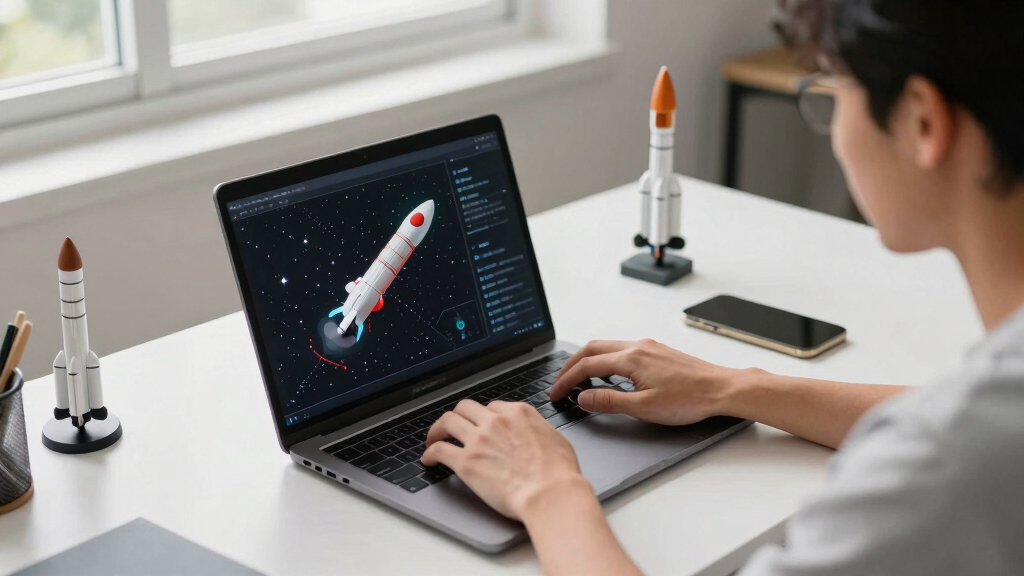

📊 Full opportunity report: The $60 Billion Bargain: Why Cursor Could Be a Steal for SpaceX on ThorstenMeyerAI.com — validation score, market gap, and execution plan.

Get business pricing on monitors, keyboards and dev gear
- Business-only prices and quantity discounts
- Tax-exempt purchasing
- Multiple users, one account, clear invoices
TL;DR
SpaceX acquired Cursor, an AI coding tool company, for $60 billion in stock, despite the high headline price. The deal is strategic, leveraging Cursor’s rapid growth, profitability, and proprietary AI assets, and was made with minimal market impact.
SpaceX announced it has acquired Cursor, an AI coding startup, for $60 billion in all-stock. This deal, announced just days after SpaceX’s record-breaking IPO, is the largest acquisition of a venture-backed startup in history and signals a strategic move to strengthen its AI and software capabilities.
The acquisition was entirely financed with SpaceX’s own stock, representing only about 3.4% dilution at the company’s IPO valuation. The market responded positively, with SpaceX’s stock rising approximately 16%, boosting its valuation to nearly $2.94 trillion. Cursor, which reported $4 billion in annualized revenue as of early June, has experienced rapid growth, doubling revenue in four months and projecting $6 billion by the end of 2026.
While the headline multiple of 15x revenue appears high, the valuation is decreasing when considering future revenue projections. At a $6 billion run-rate, the valuation is closer to 10x, and comparable to what acquirers pay for fast-growing AI firms. Notably, no cash changed hands; the deal was entirely in stock, which appreciated upon announcement, further benefiting SpaceX. Cursor’s assets include a profitable enterprise segment, a leading developer platform, and its own AI model, Composer, built on open weights, which handles most coding tasks.
The $60B bargain: why Cursor could be a steal
$60 billion for a code editor sounds like a bubble. Look past the headline and the price isn’t the scandal — it’s the discount. Here’s the case that SpaceX got Cursor cheap.
A melting multiple, paid in appreciating paper that cost almost nothing, for the profitable leader of the only AI category reliably making money — plus the missing app layer and an escape from the margin trap. If the growth holds and integration doesn’t break the product, $60B will read like a down payment. The risk isn’t overpaying for what Cursor is — it’s breaking what made it worth buying.
Why This Acquisition Is a Strategic Masterstroke
This deal provides SpaceX with a profitable foothold in the lucrative AI coding market, which is one of the few areas of generative AI generating substantial revenue. Cursor’s enterprise subscription model already shows positive gross margins, offering a stark contrast to SpaceX’s cash-intensive rocket and satellite ventures. Owning Cursor’s platform and models grants SpaceX a critical distribution point for enterprise AI workflows, potentially shaping future AI adoption in industry.
Furthermore, by acquiring a proven applied-AI team and its own shipping product, SpaceX gains a competitive edge over rivals like OpenAI and Microsoft, who had previously shown interest but were rebuffed. The deal also enables SpaceX to internalize the costs of frontier models, reducing reliance on third-party providers and opening the path to higher margins through vertical integration. This move echoes Musk’s previous strategy of building in-house capabilities across his ventures, aiming for control and profitability.
As an affiliate, we earn on qualifying purchases.
Cursor’s Rapid Growth and Strategic Assets
Cursor, founded in 2022, quickly established itself as a leader in AI coding tools, with over a million paying users and 50,000 enterprise customers, including more than half of the Fortune 500. Its revenue doubled from $2 billion in February to $4 billion in early June, marking the fastest growth in software history. The company developed Composer, its own AI coding model, which now handles most coding tasks and is slated for integration with other products like xAI and Grok.
Prior to acquisition, Cursor had turned down offers from OpenAI and Microsoft, indicating strong strategic independence. Its revenue growth was partly constrained by high costs paid to third-party AI providers, which were squeezing margins and market share. The company’s position made it an attractive target for SpaceX, seeking to internalize AI development and reduce dependency on external labs.
“This acquisition accelerates our AI capabilities and positions SpaceX at the forefront of enterprise AI workflows.”
— SpaceX spokesperson
enterprise AI development platform
As an affiliate, we earn on qualifying purchases.
As an affiliate, we earn on qualifying purchases.
Remaining Questions About the Acquisition’s Impact
It is not yet clear how effectively SpaceX will integrate Cursor’s technology and team into its broader operations. The long-term profitability of the combined entity depends on how well SpaceX can internalize AI costs and scale Cursor’s platform. Additionally, the competitive response from rivals like OpenAI and Microsoft remains uncertain, as does the future trajectory of Cursor’s growth post-acquisition.
As an affiliate, we earn on qualifying purchases.
Next Steps in SpaceX’s AI and Business Strategy
SpaceX is expected to begin integrating Cursor’s models and platform into its existing infrastructure over the coming months. The company may also leverage Cursor’s assets to develop proprietary AI tools for its rockets, satellites, and other ventures. Monitoring Cursor’s revenue growth and profitability will be key indicators of the deal’s success. Further announcements regarding product roadmaps and strategic collaborations are likely in the near term.
As an affiliate, we earn on qualifying purchases.
Key Questions
Why did SpaceX pay so much for Cursor?
SpaceX valued Cursor highly due to its rapid revenue growth, profitable enterprise segment, proprietary AI models, and strategic position as a distribution gateway in enterprise AI workflows. The deal also prevented rivals from acquiring Cursor, securing a competitive advantage.
How will this acquisition affect SpaceX’s future profitability?
By internalizing AI development and reducing reliance on third-party providers, SpaceX aims to improve margins. The integration of Cursor’s assets could lead to more efficient AI tools across SpaceX’s projects, boosting profitability over time.
What is Cursor’s main value proposition?
Cursor is a leading AI coding platform with a large user base, enterprise clients, and its own AI model, Composer. It offers profitable, fast-growing revenue and serves as a critical interface for enterprise AI workflows.
Will this deal influence the AI industry overall?
Yes, it signals a major tech and aerospace company’s commitment to owning and controlling AI infrastructure, potentially reshaping competitive dynamics and accelerating enterprise AI adoption.
Source: ThorstenMeyerAI.com
Halloween Picks
halloween
As an affiliate, we earn on qualifying purchases.