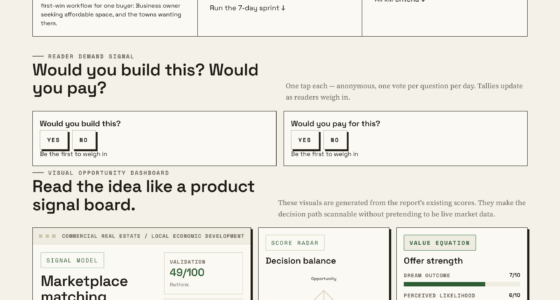
📊 Full opportunity report: A New Way To Approach Cofounder Matching on IdeaNavigator AI — validation score, market gap, and execution plan.

Get business pricing on monitors, keyboards and dev gear
- Business-only prices and quantity discounts
- Tax-exempt purchasing
- Multiple users, one account, clear invoices
TL;DR

IdeaNavigator AI proposes adding work-style compatibility to cofounder matching, which commonly focuses on skills and shared interests. The concept remains a business proposal: its suggested assessment and 12-month survival study have not been reported as tested results.
IdeaNavigator AI has outlined a cofounder-matching concept that would pair people using work-style factors such as decision speed, conflict handling, risk appetite and expected working hours. The proposal targets founders looking for a cofounder, but it is a product idea rather than a reported launch or validated service.
In its proposal, IdeaNavigator AI says the product would add a work-style assessment to existing profile-based matching. The suggested assessment would cover decision-making, conflict, risk and pace, then present matches with a compatibility map and predicted friction points. The proposal says these friction points are intended to help founders discuss potential areas of disagreement before they form a company together.
IdeaNavigator AI’s concept also calls for structured trial projects that prospective partners could complete before making a longer-term commitment. The material describes two possible revenue streams: a premium subscription for matching and paid compatibility reports for founders who are already working together. It specifies no pricing, operating product, customer numbers or paying users.
For initial validation, the proposal suggests offering compatibility reports to 200 existing early-stage founder pairs and comparing their assessment scores with whether their partnerships remain intact after 12 months. This is a proposed research plan, not a completed study. IdeaNavigator AI reports no results or evidence that the assessment predicts partnership survival.
Testing Compatibility Before Incorporation
The idea focuses on a potential gap in how founders find partners: shared skills and interest in an idea do not necessarily show how people will work together. Differences in decision speed, comfort with risk, conflict response and expectations about hours could affect a partnership even when the founders’ experience and goals appear to align.
If a work-style tool could reliably identify those differences, it might give founders a structured way to raise difficult questions before they share ownership or make major business decisions. A trial project could also offer a practical test of how a potential pair communicates and divides work. But these are proposed benefits, not demonstrated outcomes. The central question is whether assessment results predict real working compatibility well enough to improve on ordinary conversations and short-term collaboration.
For readers considering a cofounder, the proposal is a reminder to examine how a partnership would operate day to day, rather than relying only on complementary résumés or enthusiasm for the same business idea. It does not establish that a formal score can determine whether two people should work together.
Popular right now

Philips Café Aromis Automatic Espresso Machine with LatteGo Pro Milk System

Apple AirPods Max 2 Wireless Over-Ear Headphones – Midnight

Hisense 65-inch U6 Pro Mini-LED 4K UHD Smart Fire TV
As an affiliate, we earn on qualifying purchases.
From Profiles to Work Styles
IdeaNavigator AI places its proposal within the broader market for founder services and startup formation. The company says structured cofounder search has become more familiar through Y Combinator’s matching platform, and argues that this creates an audience for a service focused on compatibility beyond profile details. Its material provides no figures on platform use or market size.
In the proposed model, founders would still be matched through profiles, but work-style information would add another layer. IdeaNavigator AI says the product would try to surface potential sources of friction, rather than treating a match as a simple meeting of skills or interests. The proposal would then pair those insights with an opportunity to work together on a limited project before committing to a company.
IdeaNavigator AI’s suggested 12-month study would address a key evidence gap by following existing pairs over time. However, the proposal does not specify how the assessment would be validated, how partnership survival would be defined, or how the study would account for factors beyond work style. Those details matter before any claims about predictive accuracy could be assessed.
Evidence and Product Status
IdeaNavigator AI reports no assessment results or validation findings. Its material does not make clear whether the company has built or tested the proposed tool, recruited founder pairs, or begun the suggested 200-pair study. It also provides no launch timetable, subscription price, report format or method for producing compatibility scores.
The claim that work-style collisions contribute to founder breakups is presented in IdeaNavigator AI’s material as the problem the product aims to address, but the proposal includes no supporting data or comparison with other causes of startup failure. It does not establish that a work-style mismatch is a leading cause of partnership dissolution, or that an assessment can distinguish manageable differences from serious incompatibility.
The proposal also leaves unclear how the product would protect sensitive assessment information, whether users could challenge or correct their results, and how predictions would be explained. Until those questions and the validation plan are addressed, the concept should be understood as a proposed approach, not a proven way to select a cofounder.
A Proposed 12-Month Test
IdeaNavigator AI identifies a study involving 200 existing early-stage pairs as the next evidence milestone in its proposal. The suggested study would compare compatibility reports with partnership status after 12 months. The material gives no start date, recruitment process or study protocol, so it is not known whether or when that work will begin.
If the test proceeds, readers would need details on how the assessment is designed and evaluated, how the pairs are selected, and what counts as a surviving partnership. Results would also need to show whether work-style scores offer useful predictive information beyond factors such as company progress, funding, prior relationships and founders’ experience.
For now, IdeaNavigator AI describes a proposed product and validation path. There is no confirmed launch or evidence of effectiveness in the information available.
Source: IdeaNavigator AI
Key Questions
What is the proposed cofounder-matching product?
IdeaNavigator AI proposes adding work-style assessments covering decision-making, conflict, risk and pace to profile-based founder matching. The proposal also includes compatibility maps and trial projects.
Has the product launched?
The available information describes a product concept, not a confirmed launch. IdeaNavigator AI gives no release date or indication that a working service is available.
Has the assessment been shown to predict successful partnerships?
No results are reported in IdeaNavigator AI’s material. The company proposes testing reports with 200 existing early-stage pairs and comparing scores with partnership survival after 12 months.
How would the proposed service make money?
IdeaNavigator AI’s suggested revenue model includes a premium matching subscription and paid compatibility reports for founders who are already partners. Pricing is not specified.
What remains unknown about the proposal?
Its development and study status, assessment method, pricing, launch timing and predictive accuracy are all unclear or unreported in IdeaNavigator AI’s material. The concept has not been shown to improve cofounder selection.
Source: IdeaNavigator AI