
📊 Full opportunity report: A Digital Matchmaker For Businesses And Small-Town Retail Space on IdeaNavigator AI — validation score, market gap, and execution plan.

Get business pricing on monitors, keyboards and dev gear
- Business-only prices and quantity discounts
- Tax-exempt purchasing
- Multiple users, one account, clear invoices
TL;DR
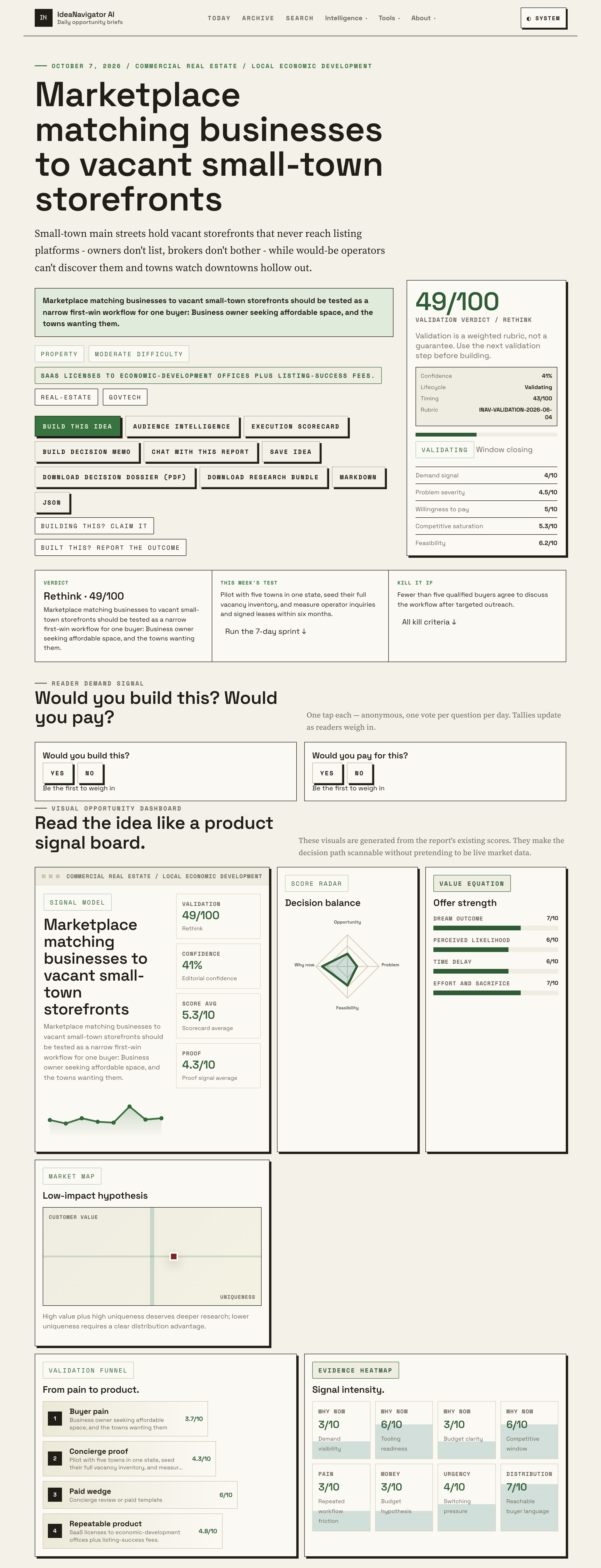
IdeaNavigator AI has outlined a proposed marketplace to connect businesses with vacant storefronts in small towns and route interested operators to local economic-development offices. The concept calls for a five-town pilot, but no launch, participating towns, funding commitments or results are confirmed.
IdeaNavigator AI has outlined a proposed digital marketplace to connect business owners seeking affordable premises with vacant storefronts in small towns, directing potential matches to local economic-development offices. The concept is a suggested first-step product, not a confirmed operating service: no participating towns, launch date, funding or completed leases are identified.
The proposed marketplace would let towns and property owners post storefront listings with photographs, floor area, rent and available incentives. Business operators could browse listings using town profiles and foot-traffic information, then send inquiries through a process that routes potential matches to a local development office. The proposal says relevant grant programs could be attached to those inquiries, giving an operator a way to find local support alongside a property.
The stated problem is a gap between available space and the people who might use it. According to the proposal, some small-town property owners do not advertise through listing platforms, while brokers may not pursue these properties. As a result, prospective operators may have trouble discovering storefronts, and local officials may have limited means to connect them with vacant premises. These points are the proposal’s description of the market problem; it does not provide vacancy counts or research measuring its scale.
For an initial test, IdeaNavigator AI recommends working with five towns in one state, entering each town’s full vacancy inventory and tracking operator inquiries and signed leases over six months. The suggested business model combines software-as-a-service licenses for economic-development offices with fees tied to successful listings. The material does not say that towns have agreed to participate or that the platform has been built.
Connecting Listings With Local Incentives
If developed and adopted, the marketplace could give small businesses a more direct way to find premises that are not routinely advertised, while helping towns bring vacancies to the attention of potential tenants. The proposed handoff to a development office is central: rather than treating a storefront as an isolated property listing, the service would connect an interested operator with local contacts and available grant programs.
That approach could also give towns a clearer way to track whether outreach is producing inquiries and leases. But the proposal does not establish that a digital listing service would reverse downtown vacancies, attract operators, or make grants easier to obtain. Those outcomes would depend on whether listings are accurate and complete, whether businesses find them useful, and whether local offices can respond to leads.
The concept puts a practical test ahead of claims about a wider market opportunity. A six-month pilot measuring inquiries and signed leases would offer early evidence about interest and conversion, though those measures alone would not show the service’s longer-term effect on town centers or whether the proposed fees could support its costs.
Popular right now

Philips 2200 Series Fully Automatic Espresso Machine with Classic Milk Frother, Ceramic Grinder, and AquaClean Filter

eufy C28 Robot Vacuum and Mop with 15,000 Pa Suction

Apple AirPods Pro Wireless Earbuds
As an affiliate, we earn on qualifying purchases.
The Proposed First-Test Model
IdeaNavigator AI presents the marketplace as a narrow initial workflow for two groups: business owners looking for affordable space and towns seeking occupants for empty storefronts. The proposal identifies revived interest in small-town commercial property associated with remote-work migration, as well as grant funding available to economic-development offices, as reasons the idea may be timely. No data or named grant programs are supplied to document those conditions.
The suggested product is more than a searchable directory. It combines property details, town information and foot-traffic data with an inquiry route to local development staff. That design reflects the stated aim of matching space with operators while connecting them to municipal assistance. The proposal does not specify how foot-traffic data would be collected, how listings would be checked, or how a town would keep rent, availability and incentive details up to date.
The recommended validation plan is to seed a complete vacancy inventory for five towns in one state and assess inquiries and signed leases during a six-month period. It is a proposed experiment, not a report of a pilot already under way. No state, town, software provider, budget or start date is named.
Pilot, Participation and Results
There is no confirmation that the marketplace exists as a live service or that any town has committed to a trial. The proposal gives no product demonstration, implementation schedule, cost estimate or details of who would operate the platform. It also does not identify grant programs or confirm that funding is available to support a particular pilot.
The scale of the underlying issue is unquantified in the material. It gives no count of vacant storefronts, comparison with other listing channels, or evidence of how often businesses fail to find small-town premises. Whether remote-work migration has increased demand in the relevant locations is also not substantiated with figures.
Further questions include how property owners would be recruited, how listing accuracy would be maintained, and whether towns can provide comparable foot-traffic information. The proposed success measures—operator inquiries and signed leases within six months—are not accompanied by a baseline, target or method for attributing leases to the marketplace. The suggested listing-success fees are also undefined, including who would pay and what event would trigger a charge.
Evidence Needed From a Pilot
The next step in the proposal is a five-town pilot in one state, with each participating community’s vacant storefronts entered into the marketplace. Town and property participation would need to be established before that test could begin; neither is confirmed at present.
If a pilot proceeds, its stated six-month measures are inquiries from operators and signed leases. A useful account of the results would also clarify how many storefronts were listed, whether inquiries led to viewings or negotiations, how quickly listings were updated, and what resources local development offices used to handle referrals. Those details would help distinguish interest in browsing from completed matches.
No timetable for selecting towns or publishing findings is provided. Until a pilot is announced and its results reported, the marketplace remains a business concept rather than evidence that digital matching can fill vacant small-town retail space.
Source: IdeaNavigator AI
Key Questions
Is the small-town storefront marketplace already operating?
No operating service is confirmed. IdeaNavigator AI describes a proposed marketplace and a possible pilot, but supplies no launch announcement or participating towns.
How would the proposed marketplace work?
Property owners and towns would post storefront information, including photos, size, rent and incentives. Operators could browse by town profile and foot-traffic information, then send inquiries to a local development office.
What is the proposed pilot?
The suggested test would involve five towns in one state, with their vacancy inventories entered and operator inquiries and signed leases tracked over six months. No pilot has been confirmed.
How might the service make money?
The proposal suggests software licenses sold to economic-development offices and fees tied to successful listings. Pricing and the conditions for a success fee are not specified.
What evidence is available that it will fill vacant storefronts?
No results are reported. The material offers a rationale and a plan for testing the idea, but gives no pilot data, lease outcomes or measured impact on storefront vacancies.
Source: IdeaNavigator AI