
🔍 Read the full analysis: Can AI Help Dockworkers Handle More Containers? on ThorstenMeyerAI.com

Get business pricing on monitors, keyboards and dev gear
- Business-only prices and quantity discounts
- Tax-exempt purchasing
- Multiple users, one account, clear invoices
TL;DR
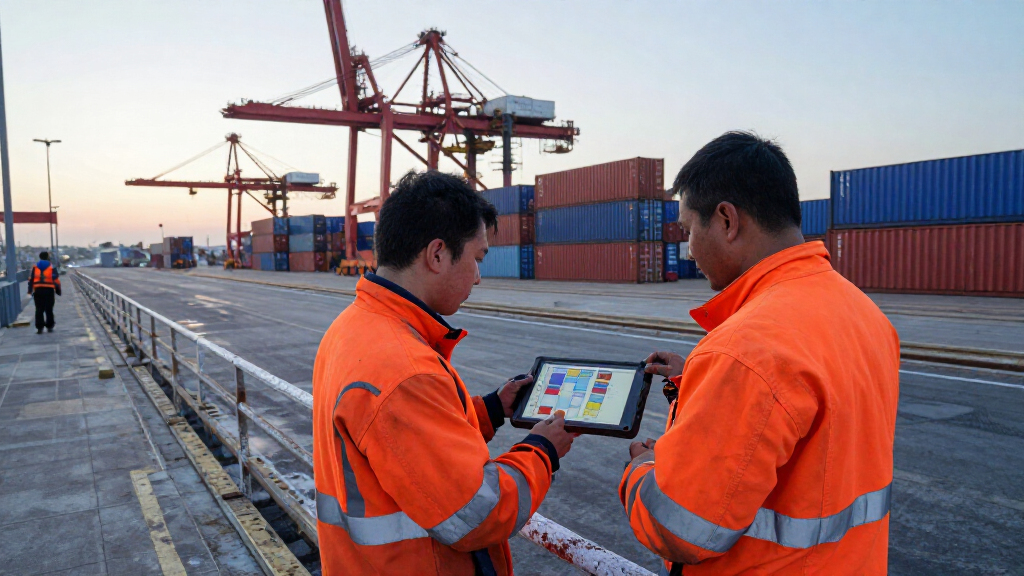
Automation transformed ports by moving cargo in standardized containers, but that shift also sharply reduced the number of dockworkers needed. A 2024 U.S. government report found denser stacking at some automated terminals, while also reporting slower moves and more breakdowns at some sites; the source provides no evidence that AI itself increased container throughput.
A new history article on port automation says the evidence for AI helping dockworkers handle more containers is not yet established: a 2024 U.S. government report found that some automated terminals stacked containers more densely, but also recorded slower moves and more breakdowns at some sites. The account, published November 23, 2026, traces how containerization transformed port work and warns against treating automation as a guaranteed productivity gain.
The article focuses on the shift from break-bulk cargo—individual sacks, barrels and crates handled by workers—to standardized containers moved between trucks, ships and trains. It recounts the April 1956 voyage of the Ideal X, which carried 58 truck bodies from Newark to Houston. The source says the system, rather than the container alone, made it possible to move freight without unpacking and handling each item at every stage.
Drawing on historian Marc Levinson’s book The Box, the article reports that loading loose cargo cost about $5.83 a ton in 1956, compared with 15.8 cents a ton for the Ideal X operation. The article calculates that as roughly 36 times cheaper. It also cites workforce figures: the Port of New York and New Jersey had more than 35,000 longshoremen in the early 1960s and about 3,500 in 2013, according to the Waterfront Commission.
The account describes how unions negotiated over mechanization, including a 1960 West Coast agreement that exchanged changes to work rules for a $29 million fund and protections for registered dockworkers. It notes that East and Gulf Coast dockers struck in 2024 over wages and automation. The historical evidence concerns mechanization and containerization, however; the article does not identify an AI system currently increasing container volumes handled per worker.
Infographic 01 · Before the box
Why the port cost more than the ocean
Before the container, every sack and crate was handled one by one. The port, not the sea, was the expensive part of a trip.
One truckload of medicine, Chicago → Nancy (France) · estimate ca. 1960 · total $2,386
Cost of loading one ton · 1956
Roughly 36 times cheaper to load (5.83 ÷ 0.158, our calculation). The loading figures are from Levinson’s own article; other authors cite them to The Box, 1st ed. (2006), p. 52.
Sources: M. Levinson, The Box, 2nd ed. (Princeton UP, 2016), ch. 1, Table 1, p. 12 (American Association of Port Authorities data); M. Levinson, The Box That Shrank the World, Works That Work No. 2.
Powered by Thorsten Meyer AI
Automation’s Productivity Trade-Off
The history matters because port automation changes both how cargo moves and who is needed to move it. Standardized containers cut handling costs dramatically, but the workforce figures cited in the article show that the long-term changes to dock employment were substantial. For workers, the question is not only whether technology can move more boxes, but how gains and job risks are distributed.
For shipping companies, ports and consumers, faster or cheaper handling could affect supply-chain costs and capacity. Yet the 2024 report’s mixed findings caution that installing automation does not automatically deliver faster operations. If equipment failures or slower moves offset denser storage, a terminal may gain one form of efficiency without increasing overall throughput. The source offers no measured result showing that AI, specifically, has improved container handling.
The labor history also shows that technology’s effects are shaped by bargaining and policy, not just equipment. The 1960 agreement included income and retirement protections for registered workers, while the 2024 strikes put automation back into labor negotiations. Those precedents help explain why claims about AI at ports are relevant to workers, operators and the broader movement of goods.
Popular right now

Ninja Foodi Smart XL 6-in-1 Indoor Grill and Air Fryer, Black/Silver (DG551)

LG 55-Inch QNED73B Mini LED 4K Smart TV (2026)

Dyson V15 Detect Cordless Stick Vacuum
As an affiliate, we earn on qualifying purchases.
From Break-Bulk to Standard Boxes
Before containerization, longshoremen handled cargo piece by piece, loading it from trucks or trains, storing it, and securing it in a ship’s hold. The article describes work as irregular and recounts New York’s morning hiring practice, known as the shape-up, in which workers waited to be selected for a day’s job. It cites the Waterfront Commission’s account of how the system could leave hiring vulnerable to corruption and kickbacks.
Malcom McLean, a trucking businessman, is associated with the early container-shipping breakthrough. The source treats the familiar story that he conceived the idea while waiting at a pier as unverified, while documenting the Ideal X’s 1956 voyage. It says containers themselves predated McLean; the important innovation was coordinating the truck-to-ship-to-truck system.
On October 18, 1960, the International Longshoremen’s and Warehousemen’s Union and the Pacific Maritime Association signed the Mechanization and Modernization Agreement. According to the article, employers gained flexibility to mechanize, while registered workers received financial and retirement protections, including a no-layoff commitment tied to mechanization. The article places the 2024 East and Gulf Coast strikes over wages and automation within this longer labor history.
AI’s Measured Port Impact
The source does not specify which terminals or systems were covered by the 2024 government report, provide the report’s detailed methods or figures, or explain how it defined automation. It says only that some terminals achieved denser stacking while experiencing slower moves and more breakdowns. The comparison basis and scale of those results are not given in the article.
It is also unclear whether the report evaluated AI, automated machinery, or both. The source contains no direct comparison of AI-enabled and non-AI terminals, no quantified measure of containers handled per worker, and no evidence that AI has raised overall port throughput. Claims about AI’s potential should not be confused with measured outcomes for containerization or mechanized equipment.
The article also does not provide updated workforce counts after 2013 for the Port of New York and New Jersey, or details of the outcomes of the 2024 strikes. Those limits leave open how current technology is affecting staffing, productivity and labor agreements across different ports.
Evidence Needed From Terminals
The next useful evidence would be detailed, comparable measurements from operating terminals: container moves per hour, total throughput, equipment downtime, staffing levels, and the time period and baseline used for each comparison. Results would need to distinguish AI software from cranes, automated vehicles and other mechanized systems to establish what technology is producing any reported change.
Labor agreements and implementation plans will also shape what happens next. The source points to the 2024 East and Gulf Coast strikes over wages and automation, but does not report a settlement’s specific terms or a future milestone for AI deployment. Until those details and measured results are available, whether AI will help dockworkers handle more containers remains an open question rather than a demonstrated outcome.
Key Questions
Does the source show that AI helps dockworkers handle more containers?
No. It cites a 2024 report about automated terminals with mixed findings, but does not show that AI itself increased the number of containers handled.
What did the 2024 report find about automated terminals?
As summarized in the article, some terminals stacked containers more densely, but also had slower moves and more breakdowns. The article does not give detailed figures or identify the terminals.
How did containerization change port work?
It replaced much of the piece-by-piece handling of break-bulk cargo with standardized boxes that could move between trucks, ships and trains without being unpacked at each stage. The article says this reduced loading costs and was accompanied by major long-term declines in dockworker numbers.
What protections did dockworkers receive in the 1960 West Coast agreement?
The article says the Mechanization and Modernization Agreement created a $29 million fund for registered workers, including income guarantees when hours fell, early-retirement payments and other benefits. It also describes a no-layoff promise tied to mechanization.
Source: ThorstenMeyerAI.com