
🔍 Read the full analysis: A Guide To Robots In The Modern Factory on ThorstenMeyerAI.com

Get business pricing on monitors, keyboards and dev gear
- Business-only prices and quantity discounts
- Tax-exempt purchasing
- Multiple users, one account, clear invoices
TL;DR
The International Federation of Robotics reported 5 million industrial robots operating worldwide in 2025, with China accounting for 59% of new installations. Research finds that robots can displace workers, but job effects differ by country and may be offset by gains in other sectors.
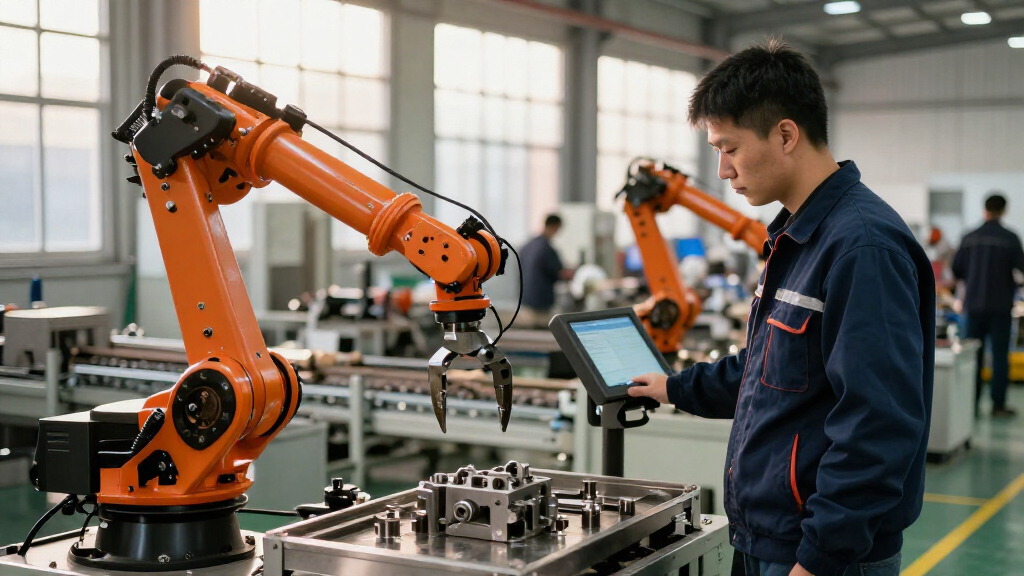
A report published November 24 by ThorstenMeyerAI.com examines how factory robots have spread since Unimate began work at a General Motors plant in 1961, and what research says about their effect on employment. The International Federation of Robotics (IFR) counted 5 million industrial robots in operation worldwide in 2025, while studies of the United States and Germany show that job outcomes vary by country and by which workers are counted.
The report describes Unimate as a roughly 4,000-pound machine that unloaded hot metal castings from a die-casting press at GM’s Ternstedt plant in Trenton, New Jersey. Inventor George C. Devol filed a patent for a programmed article-transfer machine in 1954; the patent was granted in 1961. Devol and entrepreneur Joseph Engelberger formed Unimation, which supplied the machine. The IFR and The Henry Ford museum, which holds the robot, identify the Trenton installation as its first production-line use.
Industrial robots later took on other demanding factory tasks. GM installed Unimate spot-welding robots at its Lordstown, Ohio, plant in 1969. The IFR says they automated more than 90% of body welding there, compared with 20% to 40% at traditional plants, where welding was manual. Japan’s first locally built industrial robot followed in 1969 under a Kawasaki-Unimation licence. Kawasaki’s company history links demand to a shortage of workers for what it calls “3K” jobs: hard, dirty and dangerous work.
In its World Robotics report dated September 24, 2026, the IFR counted more than 600,000 new installations in 2025, including 354,000 in China, or 59% of the year’s total. The United States installed almost 38,500, Japan 36,219, South Korea 30,000 and Germany fewer than 25,000. These annual installation figures are not the same measure as the total number of robots in operation.
Infographic 01 · Five million robots
Where the robots work
Sixty-five years after the first Unimate, five million industrial robots work in the world's factories. South Korea has by far the most per worker.
Robots per 10,000 employees in manufacturing · 2024
Where the new robots went · 2025
- China: 354,000 installed, 59% of the world total.
- United States: almost 38,500 (+12%), again the second-largest market.
- Japan 36,219 (−19%) · South Korea 30,000 · Germany fewer than 25,000 (−8%), Europe’s largest market.
Robot density = operational industrial robots per 10,000 employees in manufacturing. China (166 in 2024) is not compared here: the IFR switched to updated Chinese labour data in 2026, which changed the denominator.
Sources: IFR, robot density press release, 8 Apr 2026 (data 2024); IFR, World Robotics 2026 press release, 24 Sep 2026.
Powered by Thorsten Meyer AI
Robot Growth, Uneven Job Effects
The scale of factory automation matters because robots change which tasks factories need people to perform, while the employment consequences can extend beyond the plant floor. The report cites research by economists Daron Acemoglu and Pascual Restrepo, published in the Journal of Political Economy in 2020. For the United States from 1990 to 2007, they estimated that each additional industrial robot was associated with about 3.3 fewer workers across the economy and estimated a total of roughly 400,000 jobs displaced. Those findings concern a particular period and method; they do not establish a fixed job loss for every robot installed today.
The report contrasts that estimate with German research it summarizes: Germany lost almost two manufacturing jobs per additional robot but gained about as many jobs in services, leaving an estimated overall employment effect close to zero. The comparison illustrates why a factory-only count can miss changes elsewhere in the economy. Outcomes also depend on whether analysis follows workers who keep their jobs, those who lose them, or people who never enter an automated workplace.
Robot density offers another way to compare adoption, but it measures robots relative to manufacturing employment, not the number of jobs robots cause or eliminate. IFR figures for 2024, published in April 2026, put South Korea at 1,220 robots per 10,000 manufacturing employees, Germany at 449 and the United States at 307; the world average was 132. High density alone does not show whether automation has increased or reduced total employment.
Popular right now

Dyson V15 Detect Cordless Stick Vacuum

Apple AirPods Max 2 Wireless Over-Ear Headphones, Midnight

Dyson Cyclone V10 Origin Cordless Vacuum
As an affiliate, we earn on qualifying purchases.
From Hot Castings to Global Deployment
Unimate’s first task helps explain the early appeal of industrial robots: handling hot castings was repetitive and hazardous. The report says the machines moved from that work into welding and then across car-body production. It also traces early developments beyond the United States: Kawasaki completed its first Unimate under licence in 1969, while German and Swedish firms introduced new robot designs in 1973.
The newer figures show how much adoption has grown, but they describe different things. The 5 million figure is the worldwide operating stock in 2025; the more than 600,000 figure counts installations during that year. The IFR’s country ranking by density uses 2024 data, so it should not be read as a same-year comparison with 2025 installations. The report attributes these figures to the IFR’s World Robotics publications.
“Japan’s “3K” jobs were “hard, dirty and dangerous.””
— Kawasaki, in its company history, as summarized by ThorstenMeyerAI.com
What the Employment Estimates Miss
The figures do not settle how today’s installations will affect jobs. The US estimate covers 1990 to 2007, and the German comparison described in the source reflects a different national economy and research analysis. The article does not provide enough methodological detail to compare the studies directly or establish that their results apply to current factories.
It is also unclear from the supplied material how many workers were reassigned, left employment, or were prevented from entering manufacturing roles. Nor do robot counts show which tasks a machine performs, how much human labor remains alongside it, or whether new jobs compensate for displaced work over time. The IFR totals track robot deployment; they are not employment measurements.
Tracking Robots and Workers
The next useful comparisons will pair future IFR installation and operating-stock data with employment, wages and worker transitions over the same periods. Country-level results will need to distinguish manufacturing losses from job gains in services and other sectors, and to show how outcomes differ across regions, occupations and age groups.
The source article does not identify a forthcoming study or a scheduled employment milestone. For now, the confirmed development is the continued growth of industrial robot use; its implications for jobs remain dependent on the task, the workplace and the economy being measured.
Key Questions
How many industrial robots were operating worldwide in 2025?
The IFR counted 5 million industrial robots in operation worldwide in 2025, 9% more than in 2024, according to figures cited by ThorstenMeyerAI.com.
Which country installed the most industrial robots in 2025?
China installed 354,000 in 2025, equal to 59% of the new installations counted worldwide that year, according to the IFR figures in the report.
Did robots reduce employment in the United States?
A study by Daron Acemoglu and Pascual Restrepo estimated that each additional industrial robot was associated with about 3.3 fewer workers across the US economy from 1990 to 2007. That estimate covers a specific period and does not by itself predict the effect of current installations.
Does high robot density mean a country has fewer jobs?
No. Robot density measures industrial robots per 10,000 manufacturing employees; it does not directly measure job losses. The report’s comparison of Germany and the United States shows that employment effects can differ across countries and sectors.
Source: ThorstenMeyerAI.com