📊 Full opportunity report: Revolutionizing Industrial Checks With Camera-Based Gauge Monitoring on IdeaNavigator AI — validation score, market gap, and execution plan.

Get business pricing on monitors, keyboards and dev gear
- Business-only prices and quantity discounts
- Tax-exempt purchasing
- Multiple users, one account, clear invoices
TL;DR
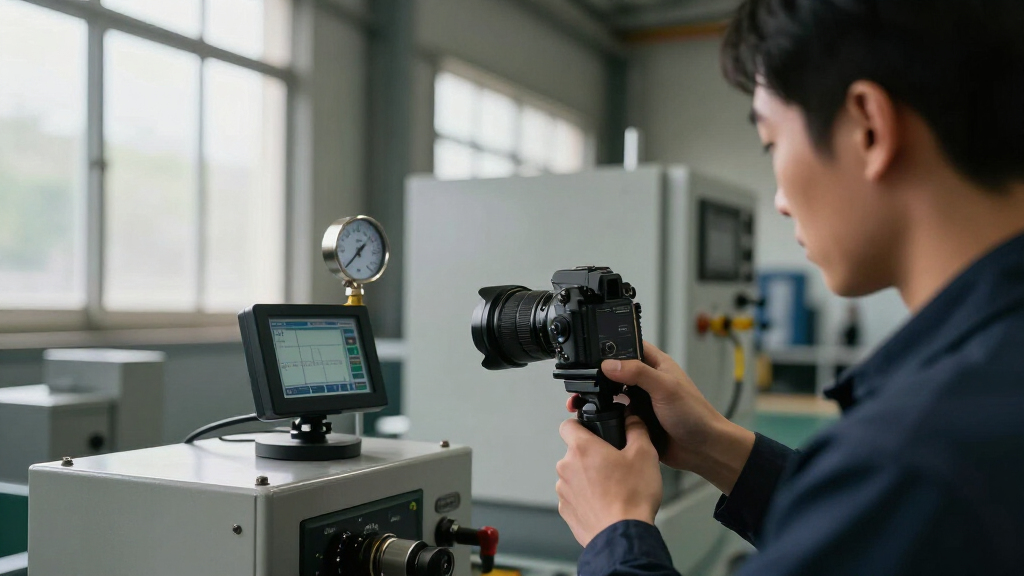
A new camera-based system allows industrial facilities to replace manual gauge readings with phone photos, enabling real-time monitoring and early failure detection without costly sensor retrofits. Validation is underway at multiple sites.
A new phone-photo gauge monitoring system is being tested in industrial facilities to replace manual clipboard rounds with automated, sight-based readings. The technology leverages vision models to read analog gauges, sight glasses, and counters directly from phone photos, enabling real-time data collection without installing sensors. This development could significantly improve maintenance accuracy and early failure detection, especially for legacy equipment.
The system involves technicians photographing each gauge during their routine rounds using a dedicated app. The app then analyzes the images with machine vision models to extract gauge readings, compare them against expected ranges, and log the data with timestamps and location tags. Any anomalies are flagged immediately, allowing maintenance teams to respond proactively. This approach aims to replace traditional manual transcription of gauge readings onto paper, which often introduces errors and prevents effective trending analysis.
According to an anonymous industry expert, the key advantage of this system is its ability to make every legacy gauge a data source without the need for costly retrofitting with IoT sensors. The pilot program involves running parallel photo-based and traditional clipboard rounds at three facilities over a month, comparing error rates and early detection of issues. Early results indicate a promising reduction in transcription errors and improved anomaly detection.
Impact on Maintenance and Legacy Equipment Monitoring
This technology could revolutionize how industrial facilities perform routine checks, especially on aging equipment where retrofitting sensors is impractical or too costly. By providing accurate, real-time data without hardware upgrades, plants can improve operational reliability, reduce downtime, and catch failures earlier. The cost-effective subscription model makes it accessible for facilities of various sizes, potentially transforming maintenance workflows across the industry.
industrial gauge camera monitoring system
As an affiliate, we earn on qualifying purchases.
As an affiliate, we earn on qualifying purchases.
Traditional Methods and Industry Challenges
Manual gauge reading has long been a labor-intensive process, prone to transcription errors and lacking in data trendability. Many facilities rely on clipboard rounds, which often result in inconsistent data collection and delayed failure detection. While IoT sensors offer a solution, their high installation costs and compatibility issues with legacy equipment limit widespread adoption. Recent advances in computer vision now enable sight-based readings from phone photos, opening new possibilities for non-intrusive, cost-effective monitoring.
The concept has gained momentum as industries seek to modernize maintenance without extensive hardware investments. Pilot programs are now testing the reliability and accuracy of vision models in real-world settings, with initial results showing promise for a scalable solution.
As an affiliate, we earn on qualifying purchases.
Unconfirmed Aspects and Pilot Validation Status
While initial testing shows promise, it is not yet clear whether the system can reliably handle all types of gauges, lighting conditions, and environmental factors across diverse industrial settings. The pilot program is ongoing, and comprehensive validation results are expected in the coming months. It remains unknown how quickly the system can scale to larger facilities or integrate with existing maintenance management systems.
As an affiliate, we earn on qualifying purchases.
Next Steps for Broader Adoption and Validation
The ongoing pilot involves three facilities over a month, with plans to expand testing to additional sites. Researchers and developers aim to refine the vision models further, improve anomaly detection accuracy, and develop seamless integration options with existing maintenance workflows. If successful, commercial deployment could begin within the next year, with industry-wide adoption following as the technology matures.
As an affiliate, we earn on qualifying purchases.
Key Questions
How accurate is the phone-photo gauge reading system?
Initial pilot results suggest high accuracy in controlled conditions, but comprehensive validation across diverse environments is ongoing. The system is designed to flag readings outside expected ranges for further review.
Can this system replace all manual gauge readings?
It is intended as a supplement or replacement for manual transcription on legacy gauges. Its effectiveness depends on environmental conditions and gauge types, with ongoing testing to determine scope.
What are the cost implications for facilities?
The system operates on a per-facility monthly subscription model, making it a cost-effective alternative to sensor retrofitting, especially for facilities with extensive legacy equipment.
Will this technology integrate with existing maintenance software?
Integration options are being developed, with the goal of seamless data transfer into existing CMMS or asset management systems. Details are still being finalized.
When can facilities expect commercial availability?
If pilot testing continues positively, commercial deployment could occur within the next 12 months, with broader industry adoption following as the technology is validated.
Source: IdeaNavigator AI
Fall Picks
fall essentials
As an affiliate, we earn on qualifying purchases.