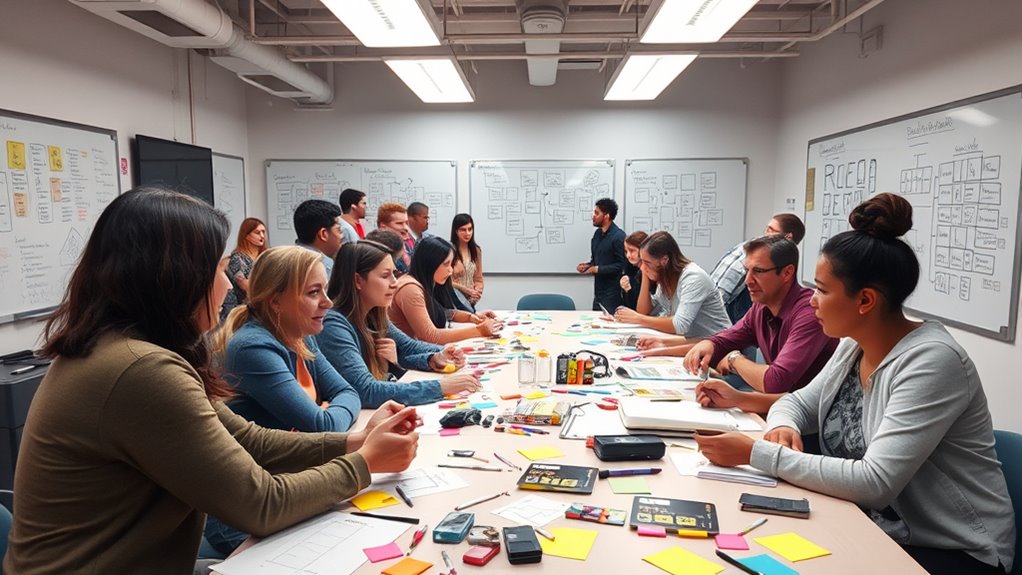

A Service Prototyping Playbook shows you how to use role-playing and mock services to improve customer experiences. By simulating real interactions, you can quickly spot pain points and service gaps, making it easier to refine your approach. These techniques promote empathy among your team and facilitate fast, cost-effective testing, ensuring each touchpoint adds value. Keep exploring to discover how these methods can help you create more engaging, customer-focused services.
Key Takeaways
- Role-playing simulates real customer interactions to identify pain points and service gaps early in the design process.
- Mock services and prototypes enable visualization of service components, facilitating stakeholder feedback and iterative improvements.
- Prototyping fosters empathy among team members and promotes cross-functional collaboration to refine customer experiences.
- Using role-playing and mock services helps detect issues early, reducing costly fixes and ensuring consistent touchpoint value.
- The playbook approach accelerates service development, supports flexibility, and encourages customer-centric innovation through continuous testing.

A Service Prototyping Playbook is an essential tool for designing and refining customer experiences quickly and effectively. It helps you visualize and test how your service interacts with customers at every stage of their journey. When you focus on the customer journey, you gain insight into how users move through your service, from initial awareness to post-service follow-up. By mapping these stages, you identify critical service touchpoints—the moments where customers interact with your service. These touchpoints are your opportunities to create positive impressions or, if poorly executed, frustrations. Understanding and optimizing them is key to delivering a seamless experience.
Using role-playing and mock services in your prototyping process allows you to step into your customers’ shoes. You can simulate real interactions at each touchpoint, revealing pain points and areas for improvement that might be invisible otherwise. For example, you might act out a customer calling support, steering through your website, or visiting a physical location. These role-playing exercises help you observe how your staff or systems respond to customer needs, uncovering gaps or inconsistencies in service delivery. It’s a practical way to test assumptions before investing heavily in full-scale implementation. Additionally, engaging in such exercises can foster a greater sense of empathy among team members, which is crucial for enhancing overall service quality.
Role-playing and mock services reveal hidden pain points and improve customer interactions through practical testing.
Mock services further streamline this process by creating low-fidelity versions of your service components. These can be simple sketches, storyboards, or clickable prototypes that demonstrate how different touchpoints work together. As you test these mockups, you gather immediate feedback from stakeholders or potential users, which guides iterative improvements. You might discover that a certain step in the customer journey feels confusing or that a touchpoint isn’t engaging enough. Making adjustments based on these insights ensures your final service aligns better with customer expectations.
The beauty of this playbook approach lies in its speed and flexibility. Instead of waiting until a service is fully developed, you prototype and role-play early, catching issues when they’re easier and less costly to fix. This iterative cycle of testing, learning, and refining lets you fine-tune your customer journey, ensuring each touchpoint delivers consistent value. It also fosters cross-functional collaboration, as team members from different departments can participate in role-playing scenarios and share ideas for improvement. Embracing curiosity during this process can lead to more innovative solutions and a deeper understanding of customer needs.

Role Playing For Unbeatable Customer Service: #CustomerServiceTraining #Role-PlayingTechniques #ServiceExcellence #CustomerInteractionSkills #ComplaintHandlingStrategies #HelpDeskTraining
As an affiliate, we earn on qualifying purchases.
As an affiliate, we earn on qualifying purchases.
Frequently Asked Questions
How Do I Choose the Best Role-Playing Scenarios?
You choose the best role-playing scenarios by focusing on realistic, high-impact situations that reflect customer interactions. Involve stakeholders early to identify common pain points and critical touchpoints. Use their insights to select scenarios that reveal gaps and opportunities for improvement. Prioritize scenarios that challenge assumptions and encourage empathy, ensuring your role-playing exercises provide valuable feedback to refine the overall service experience effectively.
What Tools Are Recommended for Creating Mock Services?
Imagine building a virtual mock service where you can swiftly test ideas. Use tools like Figma for interactive prototypes, Miro for collaborative flow mapping, or InVision for quick visual mockups. These platforms enable virtual collaboration and support rapid iteration, allowing you to refine your service experience efficiently. By leveraging these tools, you create a dynamic environment where feedback flows seamlessly, and your prototypes evolve to meet user needs faster.
How Can Feedback Be Effectively Gathered During Prototypes?
You can effectively gather feedback during prototypes by encouraging active customer engagement and establishing clear feedback loops. Ask open-ended questions, observe their reactions, and listen carefully to their suggestions. Use quick surveys or informal conversations to collect insights regularly. Keep the process iterative, so you can refine the service based on real user input, ensuring the experience aligns with customer needs and expectations.
What Common Pitfalls Should I Avoid in Service Prototyping?
Avoid common pitfalls like neglecting customer engagement and misallocating resources during service prototyping. Don’t assume your team knows what customers want—actively involve them through role-playing and mock services. Be mindful of overextending resources on complex prototypes that may not yield clear insights. Instead, focus on simple, targeted prototypes that engage customers effectively, ensuring your resource allocation supports meaningful feedback and improves the overall service experience.
How Do I Measure Success After Implementing Prototypes?
You can’t judge a book by its cover, so don’t rely solely on one measure. To gauge success, combine quantitative metrics like usage rates, wait times, and satisfaction scores with qualitative insights from customer feedback and staff observations. If these indicators show improvement and align with your goals, your prototype is on the right track. Keep refining based on ongoing feedback to guarantee continuous service excellence.

KI-gestütztes Prototyping für Nicht-Designer: Wie man mit Claude Produkt-Mockups, Präsentationen und Markenmaterialien von Grund auf erstellt (German Edition)
As an affiliate, we earn on qualifying purchases.
As an affiliate, we earn on qualifying purchases.
Conclusion
By embracing role-playing and mock services, you can uncover hidden pain points and refine your customer experience effectively. Did you know that 70% of successful innovations come from iterative prototyping? Incorporating these techniques into your process not only boosts your team’s creativity but also markedly enhances user satisfaction. So, start experimenting today—your future customers will thank you for the improved service journey.

Mapping Experiences: A Complete Guide to Creating Value through Journeys, Blueprints, and Diagrams
As an affiliate, we earn on qualifying purchases.
As an affiliate, we earn on qualifying purchases.
stakeholder feedback prototyping tools
As an affiliate, we earn on qualifying purchases.
As an affiliate, we earn on qualifying purchases.