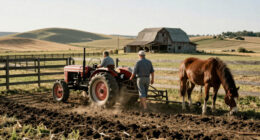

🔍 Read the full analysis: When Almost Everyone Farmed—and What Came Next on ThorstenMeyerAI.com

Get business pricing on monitors, keyboards and dev gear
- Business-only prices and quantity discounts
- Tax-exempt purchasing
- Multiple users, one account, clear invoices
TL;DR
A November 3, 2026, article from ThorstenMeyerAI.com examines how farming went from employing most workers in many countries to a small share in some, while food production rose. It traces changes in tools, crop breeding and fertilizer, and reports that an estimated 928 million people still work in agriculture worldwide.
A report published November 3 by ThorstenMeyerAI.com traces how farming’s share of employment fell from about three in four U.S. workers around 1800 to roughly 1.5% today, as tools, crop varieties and fertilizer helped raise output. The account says agriculture still employs an estimated 928 million people worldwide, about one in four workers, underscoring that the shift has unfolded unevenly across countries.
The report draws on estimates by economic historian Stanley Lebergott, published by the U.S. Census Bureau, that put 1.4 million of 1.9 million U.S. workers in agriculture in 1800, or 73.7%. The figures for years before 1840 are estimates rather than census counts, and the underlying labor force includes enslaved people. The article therefore describes the historical share as about three in four, rather than treating the estimate as an exact count.
It describes agricultural change as a series of developments, not a single event: improved implements, including John Deere’s steel plough in 1837; industrial production of ammonia fertilizer following Fritz Haber’s 1908 patent; and higher-yielding crop varieties, including short-straw wheat introduced in India and Pakistan in the 1960s. The article cites Indian statistics showing wheat production rose from 12.3 million tonnes in 1964–65 to 26.4 million tonnes in 1971–72, then reached 117.5 million tonnes in the 2024–25 third advance estimate.
The report says the number of U.S. farm workers did not fall as soon as farming’s share of employment began to decline: it continued to rise until about 1910, when it reached 11.8 million. It also cites a global estimate of 928 million agricultural workers in 2025 from the International Labour Organization. Agriculture’s share of workers remains much higher in India, at 43%, than in the United States, at about 1.5%, or Germany, at about 1%.
Rising Output, Fewer Farm Jobs
The history matters because it offers evidence that employment can contract in a sector without food production falling. The report says the world’s cereal harvest grew 4.2-fold from 1961 while the population grew 2.7-fold. It also reports that U.S. farm output in 2023 was nearly three times its 1948 level, with only a small rise in total inputs. Those figures describe production over specific periods; they do not mean every country or household has benefited equally.
For readers considering automation and work, agriculture illustrates a long adjustment rather than an overnight replacement of workers. Farmers’ share of employment fell over generations, while the total number of workers could still rise during part of the shift. The report’s author argues that automation might eventually reshape other sectors on a large scale, but presents that as a thesis, not an established forecast. The farming record does not by itself show how quickly other industries will change or what jobs will replace those lost.
Popular right now

Ninja Foodi 10-Qt DualZone Air Fryer, 6-in-1, Black (DZ302)

TCL 65 Inch QM8L Series SQD-Mini LED QLED 4K Smart Google TV

Philips Café Aromis Automatic Espresso Machine with LatteGo Pro Milk System
As an affiliate, we earn on qualifying purchases.
A Long Shift Across Countries
The U.S. was not alone in relying heavily on agricultural work. The article cites economic historians’ reconstruction that roughly 85% of Japan’s gainfully occupied population worked in the primary sector in 1872; that category included farming, forestry and fishing. For Germany, a reconstruction puts the primary sector at 56.7% in 1849, while an 1882 occupational census counted 43.4% in agriculture and forestry. The report cautions that the census undercounted women working on family farms.
In China, the employment series beginning in 1952 records 83.5% of employed people in the primary sector. India’s 1951 census counted cultivators and agricultural laborers as 69.7% of workers. These historical measures are not perfectly comparable: they come from different years and methods, and some cover a broader sector than farming alone.
The report’s central explanation is that, before modern productivity gains, food production depended heavily on human and animal labor. Hand tools, draft animals and weather limited how much food a household could grow beyond its own needs. Mechanical equipment, fertilizer and higher-yielding seeds later changed those limits, though the article notes that mechanization is covered in a subsequent episode.
““The share fell long before the headcount.””
— Thorsten Meyer, the report’s author
Limits of the Historical Comparisons
Several figures in the report are estimates or reconstructions, not directly comparable census results. The U.S. figures before 1840 are estimates; Japan’s 1872 share is an economic historians’ reconstruction; and historical occupational categories vary between countries. Germany’s early census also omitted some women’s farm work, according to the report. The precise scale of agricultural employment in earlier periods is consequently uncertain.
The article’s global figure of 928 million is attributed to an ILO 2025 estimate, but the supplied source does not give the estimate’s detailed definition or calculation method. It also does not establish that productivity increases alone explain the full decline in farm employment; migration, economic policy and changes in how work is classified may also matter. Meyer’s suggestion that automation could affect up to 90% of a sector within a decade or a few decades is explicitly his thesis, not a verified prediction.
The Report’s Next Agriculture Episode
The article identifies mechanical reapers, threshers and tractors as developments to be covered in Episode 3 of its series. That installment is expected to add detail on farm machinery to the account of tools, fertilizer and crop breeding presented here. The supplied material does not give a publication date for the next episode.
For the broader question of work and automation, the next point to watch is whether the report’s later installments distinguish between a sector’s share of employment, its total worker count and its output. Those measures moved at different rates in agriculture, and the source presents the pace and scale of future changes elsewhere as uncertain.
Key Questions
How many U.S. workers farmed around 1800?
Stanley Lebergott’s estimate, published by the U.S. Census Bureau, puts 1.4 million of 1.9 million workers in agriculture in 1800, or 73.7%. The figure is an estimate, not a census count, and includes enslaved people in the labor force.
How many people work in agriculture worldwide today?
The report cites an ILO estimate of 928 million agricultural workers in 2025, or about one in four workers globally. The supplied material does not provide the estimate’s detailed methodology.
The report points to a sequence of changes: improved tools, industrial fertilizer and higher-yielding crop varieties. It does not attribute the employment shift to one invention alone.
No. The report says the U.S. farm-worker count continued rising until about 1910, reaching an estimated 11.8 million, even as agriculture’s share of the workforce was falling over the longer term.
Does the report predict that automation will eliminate most jobs?
No verified forecast is established. The author’s suggestion that automation could affect up to 90% of a sector within a decade or a few decades is presented as his thesis, not a confirmed outcome or a settled prediction.
Source: ThorstenMeyerAI.com