📊 Full opportunity report: ADU Insights For Anyone Considering A Backyard Home on IdeaNavigator AI — validation score, market gap, and execution plan.

Get business pricing on monitors, keyboards and dev gear
- Business-only prices and quantity discounts
- Tax-exempt purchasing
- Multiple users, one account, clear invoices
TL;DR
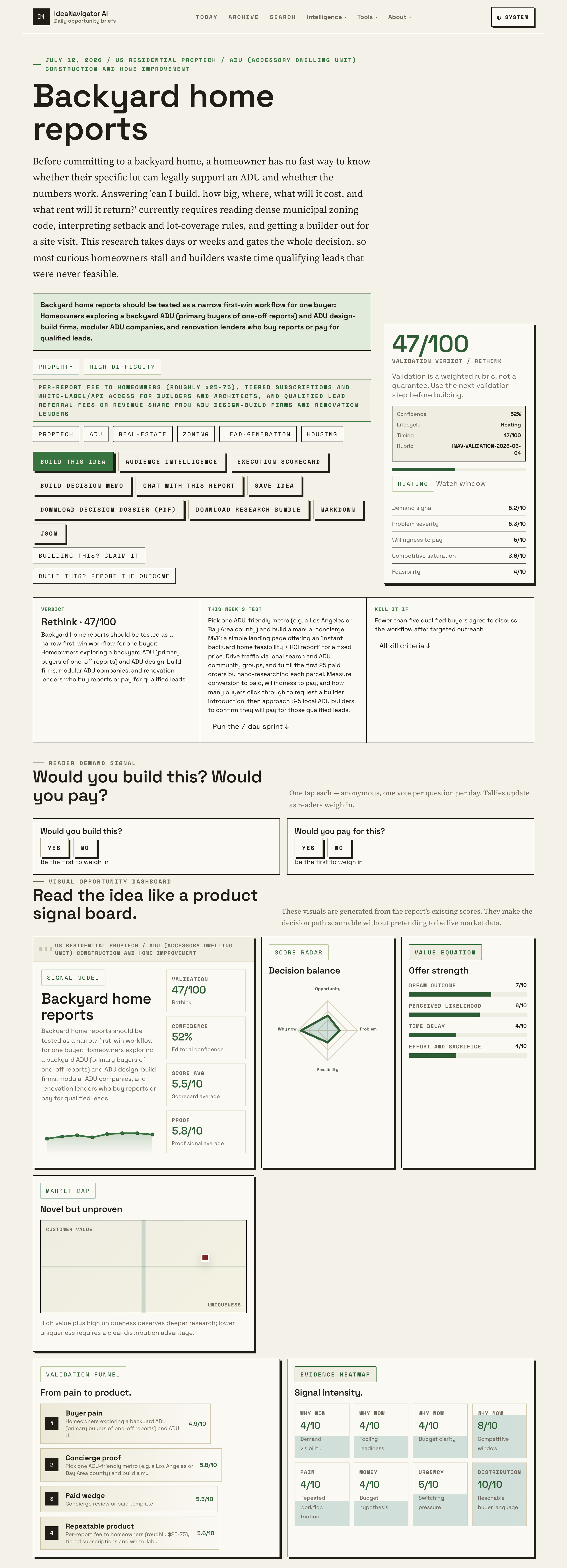
IdeaNavigator AI has outlined a proposed service that would sell homeowners address-specific reports on whether a backyard accessory dwelling unit may fit their lot and budget. The concept has not been shown to be operating or validated with customers; the proposal calls for testing demand by manually preparing the first 25 reports in one metro area.
IdeaNavigator AI has proposed testing a paid backyard-home feasibility report for homeowners considering an accessory dwelling unit, or ADU, on their property. The proposed service would assess local rules, possible building area, estimated costs and rental income, but the material describes a business concept and pilot plan, not a launched product or confirmed customer results.
The proposed web service would let a homeowner enter an address and receive a PDF report. For an initial market, the plan calls for using county parcel information, including lot boundaries, lot size and existing building footprints, then checking those details against state ADU law and a manually assembled set of local zoning rules. The report would estimate which ADU types may be allowed, potential size limits, setbacks, lot coverage and buildable area.
The concept also includes a build-cost range and projected rent based on local rental comparisons. IdeaNavigator AI suggests charging homeowners roughly $25 to $75 per report, alongside subscriptions or white-label and API services for builders and architects. A builder-introduction feature could generate referral fees or revenue sharing with ADU firms and renovation lenders.
To test whether customers will pay, the proposal recommends choosing one ADU-friendly metro or county, advertising a fixed-price report and fulfilling the first 25 orders by hand. The pilot would track paid conversions, willingness to pay and requests for builder introductions. The plan also calls for approaching three to five local ADU builders to ask whether they would pay for qualified leads. No pilot results, participating businesses or operating service are identified in the material.
A Faster First Check for ADUs
An address-specific report could address an early hurdle for homeowners: figuring out whether a backyard unit appears feasible before spending time on detailed design or arranging a builder visit. Zoning rules can involve local setbacks, lot coverage and other parcel-specific limits. A simpler initial assessment may help a homeowner decide whether to investigate further, while giving builders a way to screen inquiries before dedicating staff time to a site review.
The report would be an early planning aid, rather than a permit decision or construction quote. Its usefulness would depend on accurate parcel data and current interpretation of local rules, as well as cost and rent estimates that reflect conditions at the property. The proposed pilot could reveal whether homeowners value that combination enough to pay and whether builders see the resulting inquiries as qualified leads.
California’s ADU Growth Sets the Scene
California began statewide ADU legalization in 2016 and has since loosened rules, according to the proposal. It cites more than 45,000 ADUs permitted in Los Angeles County in 2023 and says ADUs account for roughly one in five new housing units produced in California. Those figures are presented as context for the opportunity; the material does not specify the underlying datasets or define the period for the statewide share.
The proposal links the timing to housing shortages, wider adoption of ADUs in other jurisdictions, parcel data becoming more available and language-model tools that may help parse building codes. It recommends beginning with one market and manually curated rules rather than attempting immediate nationwide coverage. That limited scope would allow the team to test the report workflow before deciding whether to automate it or expand to additional places.
Accuracy and Demand Remain Untested
The proposal does not establish whether homeowners will pay the suggested price, how often an address-specific report would lead to a builder consultation, or whether local firms and lenders would pay for referrals. It gives no results from a live pilot, customer interviews or confirmed commercial partners.
It is also unclear how the service would handle incomplete parcel records, exceptions in local zoning codes, recent rule changes or site conditions that public records do not capture. The proposed cost bands and rental projections would be estimates; no methodology, accuracy range or comparison with completed projects is provided. A report could not by itself confirm that a project will receive a permit.
A 25-Report Pilot Would Test Interest
The next step described is to select one California county or metro area, set up a landing page with a fixed price and manually research the first 25 paid requests. The pilot would measure how many visitors buy, whether customers request introductions and whether three to five local builders say they would pay for those leads. The material does not give a launch date, identify a market selected for the test or say whether work on the pilot has begun.
Key Questions
What is a backyard ADU feasibility report?
It is a proposed paid report that would use a property address to estimate local ADU rules, possible building area, construction costs and rental income. The concept has not been presented as a launched service.
Would the report confirm that a homeowner can get a permit?
No permit determination is described. The report would provide an initial estimate based on parcel data and curated rules; the proposal does not say it would replace review by local officials or a property-specific design process.
How much might a report cost?
IdeaNavigator AI suggests a price of roughly $25 to $75 for a homeowner report. That is a proposed range, not a confirmed price charged by an operating service.
How would the idea be tested?
The proposed pilot would fulfill the first 25 paid orders manually in one metro area, measure conversion and builder-introduction requests, and ask three to five local ADU firms whether they would pay for qualified leads.
Source: IdeaNavigator AI
Fall Picks
fall essentials
As an affiliate, we earn on qualifying purchases.