📊 Full opportunity report: An Empty Trust Tracker For Organizing Assets And Trusts on IdeaNavigator AI — validation score, market gap, and execution plan.

Get business pricing on monitors, keyboards and dev gear
- Business-only prices and quantity discounts
- Tax-exempt purchasing
- Multiple users, one account, clear invoices
TL;DR
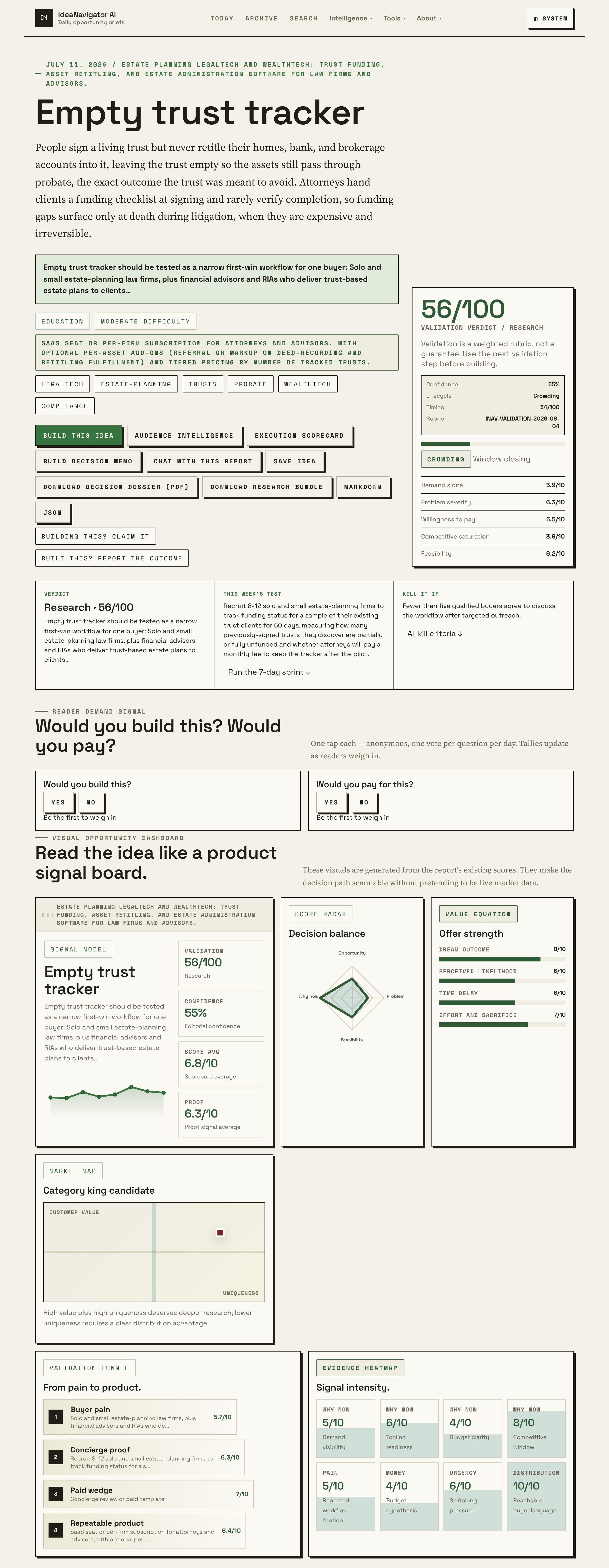
IdeaNavigator AI describes an empty trust tracker as a proposed workflow for law firms and financial advisers to monitor whether clients move assets into living trusts. The concept has not been presented as a launched product; its suggested next step is a 60-day pilot with 8 to 12 firms.
IdeaNavigator AI has proposed an asset-funding tracker for solo and small estate-planning law firms, financial advisers and registered investment advisers, targeting a gap between signing a living trust and transferring assets into it. The concept is at the proposal and validation stage: no product launch, pilot results or paying customers are reported.
The proposed tool would let a firm create a client-by-client checklist for assets that may need to be retitled or otherwise coordinated with a trust. Categories could include real estate, bank and brokerage accounts, business interests and beneficiary designations. Each item would be marked pending, in progress or confirmed funded, with clients or staff able to attach records such as a recorded deed or a statement showing a retitled account.
The tracker would also send automated reminders and provide a firm dashboard showing the share of listed assets marked as funded for each trust. The concept suggests that attorneys or advisers could use that overview to identify trusts with substantial outstanding items and follow up with clients. The proposal does not specify how records would be checked, who would confirm an asset’s status, or how the system would handle assets for which retitling is not appropriate.
IdeaNavigator AI proposes charging firms through a subscription per seat or firm, with pricing tiers based on the number of trusts tracked. It also suggests optional per-asset services connected to deed recording or retitling. These are possible business models in the proposal; no prices for the tracker, service partners or revenue have been reported. The concept points to deed-funding services priced from $250 as evidence of a paid market, but does not identify providers or provide further pricing details.
Closing the Trust Funding Gap
A living trust can be signed while assets remain titled in an individual’s name. The proposal says those assets may still pass through probate, depending on the asset and the applicable arrangements, which can undermine a client’s goal for creating the trust. A checklist and follow-up system could give firms a routine way to notice incomplete funding while the client can still address it.
The proposed dashboard would shift follow-up from a one-time document handoff toward ongoing status tracking. That could matter to small practices that manage many client files and lack a dedicated process for checking every transfer. However, a status label does not itself transfer ownership or establish that a legal requirement has been met. The practical value would depend on accurate records, appropriate professional review and clients completing the needed steps.
The concept also sits between existing estate-planning documents and services that complete specific transfers. If firms adopt such a tool, it could give advisers and attorneys a clearer view of unfinished work across their client books. Whether that would reduce probate complications, save staff time or justify a recurring fee remains unmeasured.
From Signed Trust to Funded Assets
The proposal focuses on the gap between creating a living trust and funding it by transferring or coordinating assets. It says attorneys commonly provide clients with a funding checklist at signing but may not verify that the steps were completed. It describes the resulting gaps as problems that can surface only after a client’s death, when correction may be difficult and disputes costly. Those points are presented as the opportunity’s rationale; no case data or independent study is provided.
IdeaNavigator AI says roughly 11% of Americans hold a trust and characterizes estate-planning adoption and digital tools as growing in 2026. The proposal gives no survey citation, date range or definition of “hold a trust,” so the figure’s measurement basis cannot be assessed here. It also argues that document-drafting software does not close the funding gap, but does not name products or compare their features.
The suggested first step is a 60-day pilot involving 8 to 12 solo or small estate-planning firms. Participants would track funding status for a sample of existing trust clients. The proposed measures are how many signed trusts are found to be partly or wholly unfunded and whether participating attorneys would pay a monthly fee to keep using the tracker. No pilot recruitment, start date or findings are reported.
Pilot and Product Status
The proposal does not establish whether a tracker has been built, whether any firms have agreed to test it, or whether clients have used such a system. There are no reported findings on how often existing trusts are unfunded, how quickly clients complete outstanding transfers, or whether firms would pay for the service.
Several operating details are also open. The concept does not explain how sensitive financial and property records would be stored, what evidence would qualify as confirmation, how mistakes would be corrected, or how responsibilities would be divided between clients and professional staff. It also does not describe integrations with law-practice software, financial institutions or deed-recording services. The proposal’s market statistics and claims about current workflows are not accompanied by citations in the description.
Testing Demand With Firms
The next proposed milestone is recruiting 8 to 12 small firms for a 60-day trial with a sample of existing trust clients. The test would count trusts found to be partly or fully unfunded and ask whether attorneys would pay a monthly subscription afterward. No timetable for recruitment or results has been announced, and the proposal does not state when a product might become available. Until a pilot is reported, the tracker remains a product concept rather than a demonstrated solution.
Source: IdeaNavigator AI
Key Questions
Is the empty trust tracker available now?
No launch is reported. IdeaNavigator AI describes a proposed tool and a plan to test demand with small firms, but gives no release date or product availability details.
What would the tracker record?
It would list assets associated with a client’s trust, mark each as pending, in progress or confirmed funded, and allow supporting records such as deeds or account statements to be attached.
Who is the proposed tool for?
The target users are solo and small estate-planning law firms, along with financial advisers and registered investment advisers that provide trust-based estate plans.
How would the idea be tested?
The proposed test would ask 8 to 12 firms to track funding for a sample of existing trust clients over 60 days, then measure discovered funding gaps and attorneys’ willingness to pay a monthly fee. No results are available.
Source: IdeaNavigator AI
Fall Picks
fall essentials
As an affiliate, we earn on qualifying purchases.