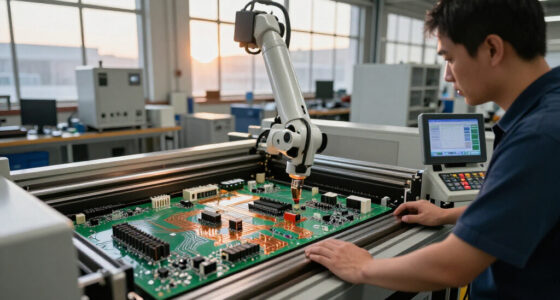
🔍 Read the full analysis: Why AI Is Changing The Shape Of Factory Work on ThorstenMeyerAI.com

Get business pricing on monitors, keyboards and dev gear
- Business-only prices and quantity discounts
- Tax-exempt purchasing
- Multiple users, one account, clear invoices
TL;DR
A November 8 report from ThorstenMeyerAI.com tracks factory employment and output in the United States, Germany and China. U.S. factory jobs fell from a record 19.6 million in June 1979 to a preliminary 12.7 million in October 2026, while factory output was nearly twice its 1979 level in September 2026. The figures show a long-term shift in factory work, but do not establish how much of it is due to AI.
U.S. factory employment stood at a preliminary 12.7 million jobs in October 2026, down from a record 19.6 million in June 1979, while manufacturing output in September was nearly twice its 1979 level, according to a report published November 8 by ThorstenMeyerAI.com. The figures describe how factory work has changed, but the report’s data do not identify artificial intelligence as the cause of the employment decline or measure its effect separately.
The report uses the U.S. Bureau of Labor Statistics’ Current Employment Statistics payroll series, which counts jobs at employers and excludes the self-employed and private-household workers. The monthly series begins in 1939. Factory employment reached 19,553,000 in June 1979, the highest level in the series, then fell to 12.7 million in October 2026, a preliminary estimate. The report puts the latest figure at 8.0% of U.S. payroll jobs, compared with 21.7% in June 1979.
Employment and output have not moved in lockstep over the full period. The Federal Reserve’s manufacturing production index rose from 50.4 in June 1979 to 98.4 in September 2026, which the report describes as about 1.95 times the 1979 level. Comparing that output measure with job counts, the report estimates output per factory job at roughly three times the 1979 level. It cautions that this is a rough comparison of jobs, not hours worked. Manufacturing output has also been below its earlier high: the index reached 108.6 in December 2007 and was about 9% lower in September 2026.
The employment decline was especially steep from January 2000 to February 2010, when U.S. factory payrolls fell from 17.3 million to 11.4 million—nearly six million jobs. The report also tracks long-term changes in Germany and China, using different national measures. Those comparisons show that the shift away from industrial employment is not confined to the United States, but the measures are not directly interchangeable.
Factory Jobs and Output Diverge
The numbers challenge a simple account in which fewer factory workers necessarily mean less manufacturing. Since 1979, U.S. output has nearly doubled even as the number of factory jobs fell by about 35%. That gap points to changes in how production is organized and measured, but the figures alone cannot assign responsibility among automation, productivity gains, trade, changes in demand or other forces.
For workers and communities, the difference matters: a country can produce more while employing fewer people in factories. The report’s comparison also has a significant limit. Its estimate of output per job does not account for hours worked, and it does not show whether workers’ wages, job quality, skills or geographic opportunities rose or fell alongside output. It offers no separate estimate of AI’s impact.
Popular right now

Dyson 360 Vis Nav Robot Vacuum

Roborock RockNeo Q110H Wire-Free Robot Lawn Mower

De'Longhi Classic Signature Espresso Machine with Adjustable Milk Frother
As an affiliate, we earn on qualifying purchases.
The Long Decline in Industrial Employment
The report traces U.S. factory employment from 9.1 million jobs in January 1939 to a wartime peak in November 1943, when 16.6 million people worked in factories. Factories then accounted for 38.8% of payroll jobs, the highest share in the available series. The share declined even as the total number of factory jobs continued to grow, reaching its record in 1979. That distinction is central: the share of jobs peaked decades before the number did.
After the early-1980s recession, factory employment partly recovered before falling again. From January 2000 to February 2010, nearly six million U.S. factory jobs disappeared, according to the report. It notes that rising Chinese imports contributed to this period’s losses: economists have estimated that imports from China cost up to about one million U.S. factory jobs from 1999 to 2011. The report also points out that the broader U.S. decline began 22 years before China joined the World Trade Organization, so trade with China cannot account for the full long-term trend.
International figures point in a similar direction but use different definitions. Germany’s producing sector—factories plus construction, energy, water and mining—accounted for 22.9% of employment in 2025, compared with 49.2% in West Germany in 1965. China’s industry and construction employment peaked at 232 million in 2012, according to the report. These figures add perspective, but differences in sector categories and statistical methods mean they should not be treated as one directly comparable dataset.
““The number to remember is 19.6 million.””
— ThorstenMeyerAI.com report
What the Figures Cannot Establish
The report title asks why AI is changing factory work, but the figures presented do not isolate AI adoption or its effects. They do not measure how many jobs have been automated by AI, which tasks have changed, or whether AI has created other factory roles. The employment and production trends span decades and include many possible influences; attributing them to one technology would go beyond the evidence provided.
The October 2026 U.S. employment figure is marked preliminary. The report’s output-per-job comparison is its own rough calculation, based on an output index and job counts rather than hours worked. It also says U.S. manufacturing output remains below its December 2007 peak. The material does not provide a forecast for future factory employment or output, or comparable AI-specific measures for Germany and China.
Tracking AI’s Factory-Level Effects
The next step for understanding AI’s role is to examine data that directly track adoption and workplace outcomes: which plants use AI systems, what tasks those systems affect, and how staffing, hours, productivity and wages change over time. The historical employment and output series provide a baseline, but cannot answer those questions by themselves.
Readers should also watch for revisions to the preliminary October 2026 employment estimate and subsequent Federal Reserve manufacturing-output data. Until research separates AI from other drivers of productivity and job change, the established finding is broader: U.S. factories employ fewer people than at their 1979 peak, while output remains substantially above its 1979 level and below its 2007 high.
Key Questions
How many people worked in U.S. factories at the 1979 peak?
The report gives 19,553,000 jobs in June 1979, commonly rounded to 19.6 million. It identifies this as the highest monthly count in the BLS payroll series, which begins in 1939.
How many U.S. factory jobs were there in October 2026?
The report gives a preliminary estimate of 12.7 million factory jobs in October 2026, or 8.0% of all payroll jobs.
Has U.S. factory output fallen with employment?
Not over the entire period. The report says manufacturing output in September 2026 was about 1.95 times its June 1979 level. It was still about 9% below the output index’s December 2007 high.
Does the report show that AI caused factory job losses?
No. It documents long-term employment and output trends but does not quantify AI adoption or separate AI’s effect from trade, automation and other factors.
Did U.S. factory jobs disappear because of imports from China?
The report says economists estimated rising Chinese imports cost up to about one million U.S. factory jobs from 1999 to 2011. It also notes the overall U.S. decline began 22 years before China joined the WTO, so the report does not attribute the full decline to China.
Source: ThorstenMeyerAI.com