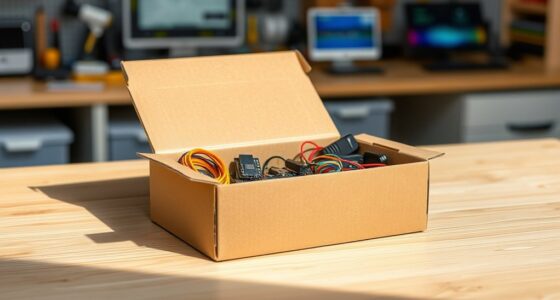

Pretotyping helps you test your product idea quickly and cheaply by creating minimal versions like landing pages or mock-ups. It lets you see if there’s genuine interest before investing heavily in full development. By focusing on user engagement and feedback, you can validate demand, save time, and reduce risks. This approach guarantees your product aligns with real needs and increases your chances of success. Keep exploring to discover how you can effectively implement pretotyping in your project.
Key Takeaways
- Pretotyping involves creating simple, inexpensive prototypes to quickly test market interest without full development.
- It helps validate whether potential users see value in an idea before investing heavily.
- Methods include landing pages, videos, or mock-ups to gauge user engagement and feedback.
- Benefits include reducing risk, saving resources, and gaining insights to refine or pivot the idea.
- It embodies “faking it before making it,” enabling early validation and better product-market fit.

Have you ever wondered if your new product idea is worth building? It’s a common question among entrepreneurs and innovators alike. Instead of diving headfirst into full-scale development, pretotyping offers a smarter way to test your assumptions early on. Pretotyping involves creating a simplified version of your product—a prototype that’s quick, inexpensive, and focused on gauging genuine interest. This approach allows you to perform market testing without investing significant resources upfront. By presenting your idea in its most basic form, you can observe how potential users respond and whether they’re truly engaged. This user engagement is vital because it reveals whether people see value in what you’re offering, even before you’ve finalized design or features.
When you start with pretotyping, you shift the focus from building to learning. Instead of developing a polished product, you create a minimal version that captures the core concept. This could be as simple as a landing page, a video demonstration, or a manual mock-up. The goal is to see if your target market is interested enough to take action—sign up, share, or provide feedback. Market testing with these quick-and-dirty prototypes can uncover insights that traditional methods might miss. For example, you might find that the problem you’re solving isn’t as urgent as you thought, or that your target audience has different needs or preferences. These early signals help you pivot or refine your idea before committing to full development.
Engaging users early through pretotyping also reduces risk. It’s easier to iterate on a rough concept than a finished product, saving you both time and money. As users interact with your simple prototype, you gain valuable data about their behaviors and preferences. This data helps validate whether there’s real demand and if your idea has a chance to succeed. Plus, by involving potential users from the start, you foster a sense of community and ownership, which can translate into loyal early adopters. Understanding flushing mechanisms and efficiency can be crucial for designing products that truly meet user needs and conserve resources.
In essence, pretotyping is about faking it before making it. You’re not lying or exaggerating your product’s capabilities; instead, you’re testing the waters with a minimal effort to see if your idea is worth pursuing. It’s a pragmatic approach that leverages market testing and user engagement as foundational tools. When you use pretotyping effectively, you turn uncertainty into clarity, ensuring you’re building something people actually want before you’ve spent months or years developing it. Ultimately, this strategy helps you save resources, reduce risk, and increase your chances of creating a successful product that truly resonates with your audience.
Building Websites with AI: Launch Websites in Minutes Without Coding
As an affiliate, we earn on qualifying purchases.
As an affiliate, we earn on qualifying purchases.
Frequently Asked Questions
How Does Pretotyping Differ From Prototyping?
Pretotyping differs from prototyping in that it’s a concept comparison focused on quickly testing ideas with minimal effort, often through fake or simplified versions. You can use pretotyping for practical applications like gauging interest or validating demand without investing heavily upfront. Prototyping, on the other hand, involves creating detailed models to refine functionality. Pretotyping helps you decide whether to proceed, while prototyping helps perfect the product.
Can Pretotyping Be Used for Complex Products?
Yes, you can use pretotyping for complex products. It helps you quickly test market feasibility and gauge user engagement without investing heavily. By creating simple, fake versions of your product, you see if people are interested and willing to use it. This approach saves time and resources, allowing you to refine your ideas early on and confirm there’s real demand before fully developing the complex product.
What Are the Costs Associated With Pretotyping?
You’ll find that pretotyping costs are generally lower than full-scale development, making it a smart choice for cost analysis and risk mitigation. Expenses include creating simple prototypes, tools, and limited resources. By testing ideas early, you minimize financial risks and avoid costly investments in unviable concepts. This approach helps you identify potential flaws quickly, saving money and reducing the risk of failure before committing significant resources.
How Do You Measure Pretotyping Success?
You measure pretotyping success by gathering customer feedback and analyzing success metrics like engagement, interest, and willingness to pay. If your early test resonates with users and meets your predefined goals, you’re on the right track. Focus on actionable insights from customer responses and quantitative data to verify whether your idea warrants further development. This approach guarantees you’re validating concepts efficiently before investing heavily.
Is Pretotyping Suitable for All Industries?
Wondering if pretotyping fits your industry? It’s highly adaptable, but not a one-size-fits-all solution. You’ll find it particularly useful for addressing cross-sector challenges, where rapid validation saves time and resources. However, some industries with highly regulated or complex products might need tailored approaches. The key is understanding your unique context and leveraging pretotyping as a flexible tool to test ideas quickly, no matter your field.

Canva-Affinity Workflow Bible: A Practical Guide To Designing Logos, Posters, Carousels, Thumbnails, Brochures, Mockups and More (The Digital Wealth Systems Series)
As an affiliate, we earn on qualifying purchases.
As an affiliate, we earn on qualifying purchases.
Conclusion
By embracing pretotyping, you unknowingly align yourself with a timeless approach of testing ideas before fully committing. It’s almost as if the universe nudges you toward simplicity and clarity, revealing whether your concept truly resonates. When you fake it just enough to gauge interest, you might find that what seems like a small step opens unexpected doors. Sometimes, the simplest tests lead to the most profound insights—proof that in pretending, you’re really paving the way forward.

Burning Studio 26 – Burn, copy, save – the multimedia all-rounder – burning software – create covers, inlays, disk labels for Win 11, 10
Your powerful burning software for burning and copying CDs, DVDs and Blu-ray Discs
As an affiliate, we earn on qualifying purchases.
As an affiliate, we earn on qualifying purchases.

Kaisiking 6 Pcs Double Sided Soldering Assist Aid Repair Tool with 2 Precision Tweezers for Electronics Repair and Soldering
Soldering tools kit includes 6 double-sided soldering assist tool and 2 precision Tweezers, More flexible and convenient when…
As an affiliate, we earn on qualifying purchases.
As an affiliate, we earn on qualifying purchases.