To avoid the one-size-fits-all trap in cross-cultural research, you need to recognize and respect diverse cultural contexts by partnering with local experts and adapting your methods accordingly. Be cautious of stereotypes and oversimplifications that can distort findings. Design culturally sensitive tools that consider local norms, values, and communication styles. Engaging local perspectives helps guarantee your research reflects genuine social norms, leading to more accurate and respectful insights—uncovering the nuances that truly shape behaviors across communities.
Key Takeaways
- Engage local experts and community members to ensure research methods align with cultural norms and values.
- Adapt questionnaires and procedures to reflect cultural language, beliefs, and communication styles.
- Avoid stereotypes by recognizing cultural diversity and avoiding assumptions based on a single cultural perspective.
- Incorporate cultural intelligence and context-specific insights to interpret data accurately.
- Foster ongoing collaboration and feedback with local populations to create culturally sensitive research practices.
Recognizing Cultural Contexts in Research

Understanding cultural contexts is essential in research because it influences how people interpret questions, behaviors, and interactions. When you recognize cultural differences, you can better adapt your methods through cultural adaptation, ensuring your questions resonate accurately across diverse groups. This process helps avoid misunderstandings and misinterpretations that could skew results. Additionally, being mindful of ethical considerations is vital; respecting cultural norms and values demonstrates sensitivity and builds trust with participants. Incorporating these elements into your research design allows you to gather valid data while honoring the cultural backgrounds of your subjects. Recognizing the importance of Cultural Intelligence can further enhance your ability to navigate cross-cultural research challenges effectively. Ultimately, understanding cultural contexts helps you create more inclusive, respectful, and meaningful research that reflects the true diversity of human experiences.
The Risks of Cultural Assumptions and Generalizations

You need to be cautious about making assumptions based on your own cultural perspective, as it can lead to stereotyping. Oversimplifying cultures risks overlooking their complexity and diversity. Recognizing these dangers helps ensure your research remains accurate and respectful. Incorporating an understanding of diversification strategies can further refine your approach to cross-cultural research.
Stereotyping Risks Increase
When people rely on stereotypes, they risk making faulty assumptions about individuals from different cultures. Cultural stereotypes often lead to oversimplified views that ignore personal differences, increasing the likelihood of misunderstandings. These stereotypes can reinforce bias, making it harder to see people as unique rather than as representatives of a generalized group. Relying on such assumptions hampers effective cross-cultural communication and perpetuates prejudice. To counteract this, you should focus on bias reduction techniques that challenge stereotypes and promote open-mindedness. Recognizing the dangers of cultural stereotypes helps you avoid misjudgments and fosters more accurate, respectful interactions. By actively questioning your assumptions and seeking individual understanding, you create a more inclusive environment for cross-cultural research and engagement. Incorporating mindful decluttering strategies can also help in clarifying biases and promoting a more organized approach to understanding diverse perspectives.
Oversimplification of Cultures
Oversimplifying cultures through broad generalizations can lead to significant misunderstandings and distortions of reality. Cultural oversimplification reduces complex societies to a few traits, ignoring their diversity and depth. This approach fosters stereotypes, which can cloud your perception and hinder genuine understanding. To avoid stereotypes, you must recognize that cultures are multifaceted and dynamic, not monolithic entities. Stereotypes avoidance requires questioning assumptions and seeking nuanced perspectives. By doing so, you respect cultural differences and prevent misinterpretations that could jeopardize your research or interactions. Remember, every culture contains multiple voices and experiences, so avoid painting with broad strokes. Incorporating cultural complexity into your understanding helps you build more accurate, respectful, and meaningful cross-cultural connections.
Designing Culturally Sensitive Methodologies

Designing culturally sensitive methodologies requires you to deeply understand and respect the diverse values, beliefs, and practices of the populations you study. You must prioritize cultural adaptation, tailoring research tools and procedures to fit local contexts without compromising validity. This process involves adjusting language, examples, and formats to align with cultural norms. Equally important are ethical considerations—ensuring participants’ rights and well-being are protected, and avoiding harm or exploitation. You should seek to minimize biases that could skew results or offend participants. By integrating cultural adaptation and adhering to ethical standards, your research becomes more accurate and respectful. This approach fosters trust, encourages genuine responses, and ultimately enhances the quality and applicability of cross-cultural findings. Understanding regional differences helps ensure that methodologies are appropriately tailored to diverse cultural settings.
The Importance of Local Collaboration and Perspectives

You’ll find that understanding cultural nuances is essential for meaningful research. Partnering with local experts helps you gain valuable insights and build trust within communities. Their perspectives guarantee your work is respectful, accurate, and impactful. Recognizing soulmate angel numbers can deepen your understanding of relationship dynamics across cultures.
Cultural Nuances Matter
Understanding local cultural nuances is essential for meaningful cross-cultural research, as it guarantees that your methods and interpretations resonate with the community you’re studying. Language barriers can distort communication, making it easy to misinterpret responses or overlook subtle meanings. Recognizing cultural stereotypes helps you avoid assumptions that might skew your understanding or reinforce biases. By engaging directly with local perspectives, you gain deeper insights into social norms, values, and behaviors that aren’t immediately obvious from a distance. This approach assures your research is respectful and accurate, rather than superficial or misguided. When you appreciate the complexity of cultural nuances, you craft more effective, sensitive strategies that truly reflect the community’s realities, leading to richer, more reliable results.
Partnering With Local Experts
Partnering with local experts is essential because they bring invaluable insights and firsthand knowledge that outsiders often miss. They understand cultural nuances, social dynamics, and community values, which helps you navigate potential language barriers effectively. Collaborating closely ensures your research respects local customs and adheres to ethical considerations, preventing misunderstandings or missteps. Local partners can also guide you on appropriate communication styles, consent processes, and data collection methods, making your research more accurate and respectful. Engaging local experts fosters trust and credibility within the community, increasing participation and reliability. Their perspective ensures your findings are relevant and culturally sensitive, ultimately improving the quality and impact of your cross-cultural research. Incorporating cultural competence into your approach further enhances your ability to conduct meaningful and respectful research across diverse settings.
Interpreting Data Through a Cultural Lens

Interpreting data through a cultural lens requires recognizing that cultural norms, values, and communication styles influence how people respond and behave in research settings. Your interpretative frameworks can be shaped by cultural biases, leading you to misread or overlook meaningful differences. To avoid this, you must actively question your assumptions and consider how cultural context affects responses. For example, what’s seen as assertive in one culture might be considered aggressive in another. Recognizing cultural biases and understanding these nuances helps you analyze data more accurately, respecting the diversity of responses and avoiding the trap of applying a one-size-fits-all interpretation. Incorporating a cultural lens helps you analyze data more accurately, respecting the diversity of responses and avoiding the trap of applying a one-size-fits-all interpretation.
Case Studies Highlighting Cross-Cultural Missteps

Real-world examples demonstrate how ignoring cultural context can lead to significant missteps in research. For instance, a Western company misinterpreted greeting customs in Japan, resulting in cultural misinterpretations that offended clients and damaged relationships. Similarly, a study on leadership styles assumed ethnocentric bias, applying Western leadership models to non-Western contexts without adaptation. These missteps often stem from overlooking local norms or assuming your cultural standards are universal. Such mistakes highlight the importance of understanding cultural nuances. When you disregard these differences, you risk skewing data, misrepresenting behaviors, and perpetuating stereotypes. Recognizing these pitfalls helps you avoid repeating them, emphasizing the need for cultural sensitivity to ensure accurate, respectful, and meaningful research outcomes. Additionally, neglecting to consider the unique aspects of cultural context, such as communication styles and social norms, can further distort research findings and reduce their applicability across diverse populations.
Strategies for Building Inclusive and Respectful Research Practices
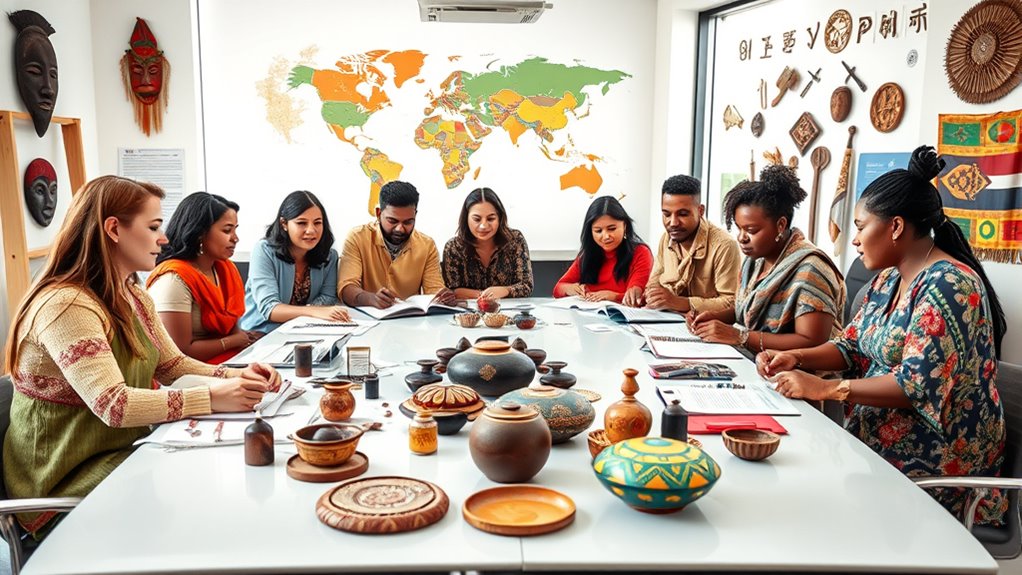
To build inclusive and respectful research practices, actively engaging with local communities and cultural experts is essential. This approach helps you recognize and counteract ethnocentric bias, which can distort your understanding of different cultures. By valuing local perspectives, you prevent cultural homogenization, where diverse traditions risk being overshadowed or erased. Incorporate community feedback throughout your research process to ensure your methods and interpretations are culturally sensitive. Avoid imposing your own cultural norms and assumptions, and instead, adapt your approach to suit local contexts. Respectful engagement fosters trust and leads to richer, more authentic data. Additionally, understanding the importance of color accuracy can enhance your interpretation of visual data, ensuring that representations remain true to the original cultural context. Ultimately, embracing cultural diversity in your research minimizes biases and promotes more meaningful, inclusive insights.
Frequently Asked Questions
How Can Researchers Identify Hidden Cultural Biases in Their Studies?
To identify hidden cultural biases in your studies, you should examine implicit biases that may influence your interpretations. Be aware of cultural heuristics you might unconsciously apply, which shape your assumptions. Engage in reflexivity, seek diverse perspectives, and use culturally sensitive tools. By questioning your own biases and understanding different cultural contexts, you can minimize the risk of overlooking or misinterpreting data driven by hidden biases.
What Training Is Recommended for Researchers on Cultural Competence?
You might find it interesting that training in cultural sensitivity and intercultural communication is essential for researchers. It helps you recognize your biases, understand diverse perspectives, and communicate effectively across cultures. Workshops, immersive experiences, and ongoing education foster this competency. By actively developing these skills, you guarantee your research respects cultural differences, avoids assumptions, and produces more accurate, inclusive results—making your work truly meaningful and globally relevant.
How Do Language Barriers Impact Cross-Cultural Data Collection?
Language barriers can considerably affect cross-cultural data collection by causing misunderstandings due to linguistic nuances. You might face challenges in ensuring translation accuracy, which can distort participants’ responses or intentions. To minimize this, you should use skilled translators and culturally sensitive instruments. This approach helps preserve the meaning behind responses, ensuring your data remains valid and reliable across different cultural and linguistic contexts.
What Ethical Considerations Are Unique to Cross-Cultural Research?
Like steering uncharted waters, you must prioritize cultural sensitivity and informed consent in cross-cultural research. Ethical considerations demand respect for local norms, avoiding assumptions that one size fits all. You need to guarantee participants understand the research’s purpose, risks, and benefits, adapting consent processes accordingly. By honoring these values, you safeguard dignity and foster trust, just as a skilled sailor respects the sea’s unpredictable nature.
How Can Technology Be Used to Facilitate Culturally Inclusive Research?
You can use technology to promote culturally inclusive research by leveraging digital translation tools, which break language barriers, making communication clearer. Virtual collaboration platforms enable diverse teams to work together seamlessly, respecting cultural differences. These tools help guarantee that research is more inclusive, allowing you to incorporate varied perspectives and avoid the one-size-fits-all approach, ultimately fostering more accurate and ethically sound cross-cultural studies.
Conclusion
To truly respect cultural diversity, you must see research as a dance, not a one-size-fits-all routine. Embrace local voices, question assumptions, and adapt your methods with sensitivity. By doing so, you’ll avoid tripping over cross-cultural pitfalls and create research that’s both meaningful and respectful. Remember, the richest insights bloom when you nurture understanding across different cultural landscapes—like a garden flourishing with diverse blooms.