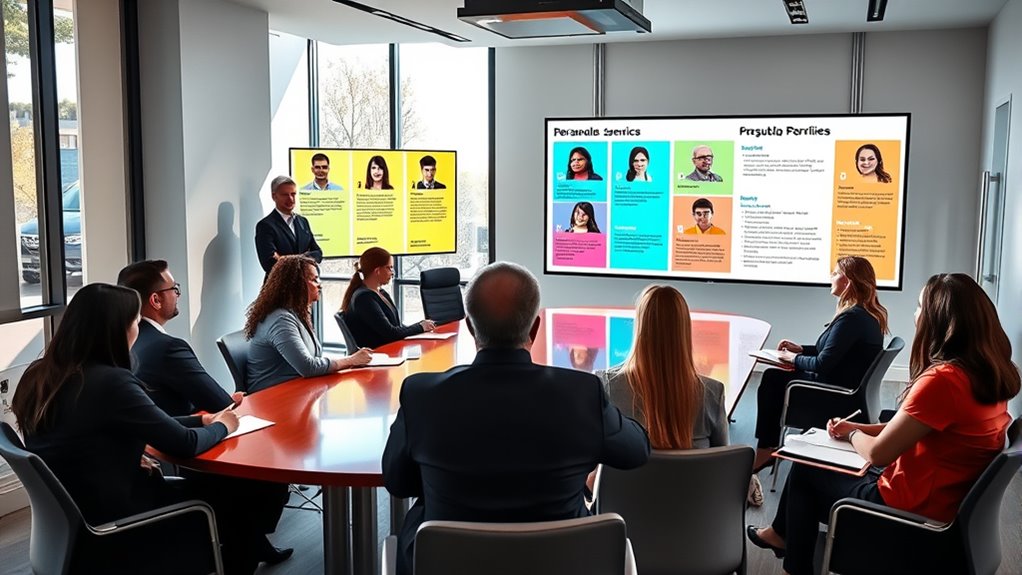

To craft effective service personas for your frontline staff, start by clearly defining customer profiles with detailed insights into their needs, emotions, and expectations. Assign specific roles based on customer scenarios, such as problem solver or guide, to guarantee staff understand their responsibilities. Develop tailored scripts and behaviors aligned with each role, fostering genuine empathy and relevance. Keep refining these personas as you go, and you’ll discover how to create more authentic, personalized customer experiences.
Key Takeaways
- Define specific frontline roles based on customer needs, scenarios, and touchpoints to ensure targeted service delivery.
- Use empathy mapping to understand customer emotions, motivations, and pain points, guiding role and script development.
- Develop role-specific scripts and behaviors that reflect customer profiles and foster authentic, personalized interactions.
- Clearly communicate roles and responsibilities to staff to promote consistency, ownership, and accountability in customer service.
- Continuously refine personas, roles, and scripts based on customer feedback and evolving service experiences to enhance effectiveness.

Creating effective service personas is vital for designing user-centered experiences that truly meet customer needs. When you develop these personas, you’re fundamentally crafting detailed profiles that represent your typical users, allowing your frontline staff to better understand who they’re serving. One of the most valuable tools in this process is empathy mapping. By engaging in empathy mapping, you help your team step into the shoes of your customers, uncovering their emotions, motivations, pain points, and expectations. This deep understanding enables your staff to approach each customer interaction with genuine empathy, leading to more personalized and satisfying service experiences.
Role differentiation plays a critical part in creating impactful service personas. It involves clearly defining the specific roles your frontline staff will embody when interacting with customers. Instead of a one-size-fits-all approach, you assign distinct roles based on the different types of customer needs, scenarios, or service touchpoints. For example, one role might be that of a problem solver who handles complaints efficiently, while another could be a knowledgeable guide who provides detailed product information. Differentiating roles ensures your team members are prepared with the right mindset, language, and behavior to meet varied customer expectations. It also streamlines training and empowers staff to act confidently within their designated roles, creating consistency across the service experience.
When you combine empathy mapping with role differentiation, you’re giving your team a clearer picture of who the customer is and how they should respond. Empathy maps reveal what customers feel, think, see, and hear, which you can translate into tailored scripts and behaviors for each role. This alignment helps staff deliver more authentic, relevant interactions, increasing customer satisfaction and loyalty. Furthermore, role differentiation clarifies responsibilities, so your team isn’t confused about who should handle specific situations. It fosters a sense of ownership and accountability, reducing ambiguity and streamlining service delivery.
Effective service personas, built through empathy mapping and role differentiation, serve as practical guides for your frontline staff. They help you tailor training, develop scripts, and create a cohesive service culture that’s rooted in a deep understanding of your customers. By ensuring each team member knows their role and understands the customer’s perspective, you set the stage for more confident, empathetic interactions. In turn, this leads to better experiences, higher satisfaction, and stronger relationships with your customers. Fundamentally, investing time in crafting these personas isn’t just about internal processes—it’s about creating meaningful, human-centered service that truly resonates with those you serve.
Frequently Asked Questions
How to Update Personas as Customer Needs Evolve Over Time?
You should regularly review and update your personas by incorporating customer feedback and tracking their evolving needs. Observe changes in behaviors, preferences, and pain points, then refine your personas to reflect these insights. This process guarantees your service remains relevant and responsive. By actively embracing persona evolution, you’ll better anticipate customer expectations and tailor your frontline staff’s roles and scripts for ongoing engagement.
What Tools Are Best for Creating Detailed Service Personas?
You should use tools like customer journey mapping and empathy mapping to create detailed service personas. These tools help you visualize customer interactions and understand their emotions, needs, and pain points. Platforms like Miro, Lucidchart, or Smaply support these processes, enabling you to build thorough, dynamic personas. Incorporating these tools guarantees your personas stay relevant, guiding frontline staff to deliver personalized, empathetic service that aligns with evolving customer needs.
How Can Personas Improve Staff Training Effectiveness?
Personas boost staff training by fostering customer empathy, helping you better understand client needs and expectations. This understanding makes your team more engaged, as they can relate to real customer scenarios. When staff see the human side of service, they become more committed and attentive. Consequently, training becomes more effective, as employees internalize personas, leading to improved interactions, higher satisfaction, and stronger customer relationships.
How Do You Measure the Success of Implemented Personas?
You measure the success of implemented personas by examining customer feedback and performance metrics side by side. Positive feedback shows customers feel understood, while improved metrics like quicker resolution times indicate enhanced staff effectiveness. When both align, you know your personas work. Conversely, if feedback stalls or metrics dip, it signals a need to refine your personas for better engagement and service quality.
What Common Mistakes Should Be Avoided in Persona Development?
You should avoid persona biases that can skew understanding of your customers and hinder genuine insights. Ensuring stakeholder alignment is essential to develop accurate and useful personas. Don’t rely solely on assumptions or stereotypes; instead, gather diverse data. Overlooking these can lead to ineffective service strategies. Regularly review and update personas, and involve stakeholders throughout the process to maintain objectivity and relevance.
Conclusion
By creating detailed service personas, you’ll empower your frontline staff to deliver consistent, personalized experiences. Did you know that 78% of customers say that meaningful interactions with staff influence their loyalty? When you craft clear roles and scripts, you make those interactions seamless and memorable. Keep refining your personas based on real feedback, and watch customer satisfaction soar. Remember, your team’s understanding and confidence are key to turning every service encounter into a positive one.